

Commentary
Alexey Malashenko
{
  "authors": [
    "Alexey Malashenko"
  ],
  "type": "commentary",
  "centerAffiliationAll": "",
  "centers": [
    "Carnegie Endowment for International Peace",
    "Carnegie Russia Eurasia Center"
  ],
  "collections": [],
  "englishNewsletterAll": "",
  "nonEnglishNewsletterAll": "",
  "primaryCenter": "Carnegie Russia Eurasia Center",
  "programAffiliation": "",
  "programs": [],
  "projects": [],
  "regions": [
    "Caucasus",
    "Russia"
  ],
  "topics": [
    "Political Reform",
    "Security",
    "Foreign Policy"
  ]
}
Source: Getty
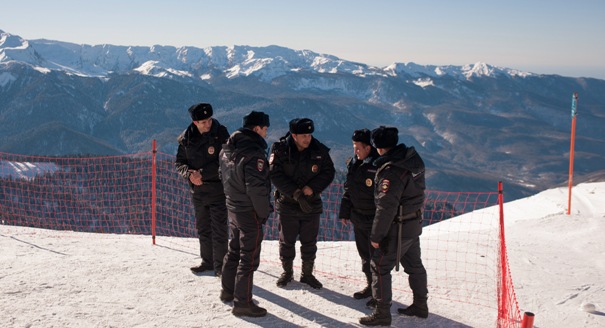
Probably for the first time in the history of the Olympics, sports-related issues concerning the Games took a back seat to the issues of security. Keeping the Sochi Olympics safe is a matter of Russia’s political prestige, as well as the evidence of its ability to respond to terrorism.
Reading the Sochi Olympics media coverage, one may get the impression that those behind it would be very surprised if the Olympics actually went without a hitch. Probably for the first time in the history of the Olympics, sports-related issues took a back seat to the issues of security. From this standpoint, these are perhaps the most politicized Olympics since the 1980 Moscow Games, which were boycotted by the United States and other major sports powers in the aftermath of the Soviet invasion in Afghanistan.
Keeping the Games safe is a matter of Russia’s political prestige, as well as the evidence of its ability to respond to one of its major internal challenges, which also has a direct bearing on Russia’s external politics. Russia appears more vulnerable to the acts of terror than other countries, with the obvious exception of Afghanistan, Pakistan, and the Arab states. Apart from the perennially unstable North Caucasus, terrorist attacks are carried out in other Russian regions, including Moscow. The last three explosions in Volgograd, in October and December 2013, have demonstrated how vulnerable Russia is in the face of terror. Some think that by concentrating all the security efforts around Sochi, the authorities might enable terrorists to act as they please in other regions.
If the terrorists actually manage to penetrate into Sochi, it will to some extent devalue Russia’s security and stability-based foreign policy agenda. It will adversely affect President Vladimir Putin’s popularity, since he will be the one held primarily responsible for the terrorist incidents.
Putin took the risk right from the start, when he proposed that Sochi host the Olympics. As the games draw closer, the risk becomes increasingly evident. Those getting ready to head for Sochi are bound to be asked, “Aren’t you scared?” Attending the Games resembles extreme tourism of sorts (an acquaintance of mine was considering a similar business venture after the end of the second war in Chechnya).
I do not want to discuss where the threat to Sochi comes from, how it is to materialize, and which terrorist factions are more dangerous than others. I will only mention the so-called “ghost” suicide bombers, which the media has been reporting on literally in the last few days. No one yet really knows where these “ghosts” come from.
One more thing comes to mind in this respect. How will the authorities react if something indeed happens in Sochi? Who will they take their grief and desperation out on through accusations of aiding and abetting the terrorists?
But what a sigh of relief will the Kremlin breathe if everything goes as planned. What a match it will win! And against what adversary! Keeping Sochi safe will be the most valuable gold medal for Putin and his Kremlin Olympic team. Some will even believe for a while that the authorities have found a working remedy against terrorism.
We do not yet know the final score of the Russian Security Forces vs. the Terrorists United game. Whatever we think of the current regime, let us wish success to the Team Russia.
Former Scholar in Residence, Religion, Society, and Security Program
Malashenko is a former chair of the Carnegie Moscow Center’s Religion, Society, and Security Program.
Recent Work
Alexey Malashenko
Alexey Malashenko
Carnegie does not take institutional positions on public policy issues; the views represented herein are those of the author(s) and do not necessarily reflect the views of Carnegie, its staff, or its trustees.

Ahead of a tough winter for Ukraine, Donald Trump’s swing back toward Russia bodes ill. But instead of panicking, Kyiv’s European allies are focusing on action.

Rym Momtaz

Funding Ukraine remains a priority for European leaders. As Russia’s war of aggression heads into another winter, two feasible options to mobilize support for Kyiv should be fast-tracked.


Vladyslav Rashkovan, Gregory P. Wilson

While the EU and European governments are embracing the much-lauded middle-power moment, this entails three difficult conundrums.

Richard Youngs

Europe is facing rising populism internally as well as external pressures from Russia, China, Turkey, and the United States.

Dimitar Bechev

A notable degree of participative democracy has firmly arrived in Europe. But to have more far-reaching impact, democratic deliberation needs to move into a radically new phase.
Richard Youngs