

Commentary
Are Germany’s economic, industrial, and political struggles becoming a liability for the EU’s ability to rise to the geopolitical moment?
Rym Momtaz, ed.
{
  "authors": [
    "Akio Kawato"
  ],
  "type": "commentary",
  "centerAffiliationAll": "",
  "centers": [
    "Carnegie Endowment for International Peace",
    "Carnegie Russia Eurasia Center"
  ],
  "collections": [],
  "englishNewsletterAll": "",
  "nonEnglishNewsletterAll": "",
  "primaryCenter": "Carnegie Russia Eurasia Center",
  "programAffiliation": "",
  "programs": [],
  "projects": [
    "Eurasia in Transition"
  ],
  "regions": [
    "East Asia",
    "China",
    "Central Asia",
    "Russia"
  ],
  "topics": [
    "Political Reform",
    "Economy",
    "Trade",
    "Climate Change",
    "Security",
    "Military",
    "Foreign Policy"
  ]
}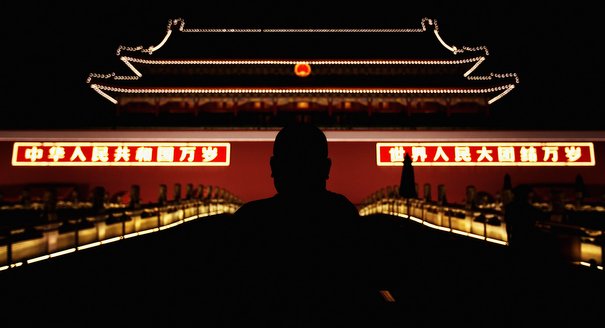
Source: Getty
Russia must know that an exclusive alliance with China will incur its own cost.
To paraphrase Marx and Engels’s “Manifesto”, a specter is haunting Asia—the specter of Sino-Russian collusion. President Vladimir Putin went to China in May and reached an—apparently tentative—agreement on natural gas export, and this generated world-wide speculation about the emergence of an awesome alliance: the Chinese economy and the Russian military.
However, there are many factors which go against this argument. First and foremost, for both Russia and China, the relations with the West have top priority. Their security and well-being depend upon it. How close Russia and China get to each other is a function of how bad their relations with the West become.
Russia has not totally succumbed to China’s tight embrace. For example, in the joint naval exercise, which was held off the shore of Shanghai with Putin’s blessing, Russia avoided following operational scenarios which may be related to disputed islands between China, Japan and ASEAN countries, thus reaffirming its stated neutrality in the maritime disputes.
Further, Russia may play on internal political rifts in China, although this may turn out deadly. On the sidelines of his official visit in Shanghai Putin met the former leader of China—Jiang Zemin. At first glance this is very natural, not only because Jiang, in retirement, lives in Shanghai, but also because the two leaders cooperated on concluding the Treaty on Good-Neighborly Relations, Friendship and Cooperation in 2001 and on finalizing the Sino-Russian border settlement, all the way to demarcation, in 2004.
But beware: Jiang Zemin now figures in the power struggle in Beijing, which was triggered by the downfall of ambitious Chongqing Party Secretary Bo Xilai. Cryptic fighting is still going on between President Xi Jinping and Zhou Yongkang, Bo Xilai’s friend and former head of the intelligence and the oil-gas complex. Had President Putin asked Jiang Zemin’s help to facilitate a final agreement on the gas deal, as some suspect, it may have worked a bit, but would have made Xi Jinping and his cohorts bitterly frown, because Jiang Zemin is considered to be the mentor of Zhou Yangkang.
Russia must know that an exclusive alliance with China will incur its own cost. Last week the United States made it clear that its forces will leave Manas, Kyrgyzstan, forever. Now Russia will have the privilege of facing China’s forays into Kyrgyzstan—and the rest of Central Asia—alone. In South-East Asia, too close collusion between Russia and China would damage Moscow’s image, because many Asian countries are now facing blunt pressure from China on territorial and other issues. In this situation, Russia cannot expect to see the number of its friends in Asia grow. Already in late March, only North Korea joined Russia in opposing the UN General Assembly’s Resolution which denounced the Crimea referendum.
If Russia wants to halt the incessant encroachment by the West and China on her erstwhile sphere of interest, the only viable way is to reform her economy and to develop real charm for outsiders. Instead of the futile tug of war between forced democratization and a coerced economic union, it would make sense to jointly contribute to the development of ex-Soviet countries, who should also receive guarantees for the maintenance of their territorial status quo. The G-20 needs to think about it.
Akio Kawato
Writer
Akio Kawato is a former Japanese diplomat and blogger.
Carnegie does not take institutional positions on public policy issues; the views represented herein are those of the author(s) and do not necessarily reflect the views of Carnegie, its staff, or its trustees.

Are Germany’s economic, industrial, and political struggles becoming a liability for the EU’s ability to rise to the geopolitical moment?

Rym Momtaz, ed.

European Commission President Ursula von der Leyen is about to give her annual address on the state of the EU. Here’s what she won’t—but should—say.
Rym Momtaz

The aftermath of the Ceuta crisis shows Europe has drawn the wrong lessons. Rather than doubling down on failed migration policies, the EU needs to address the underlying roots of such episodes.

Richard Youngs

Canadian Prime Minister Mark Carney has twice inspired praise for standing up to U.S. President Donald Trump: at the 2026 World Economic Forum in Davos and on Canada-U.S. trade negotiations. Is Carney showing a third way better than the EU has in dealing with the Trump administration?
Rym Momtaz, ed.

The EU’s responses to two recent incidents expose the gulf between European perceptions and capabilities. Unless the union can bridge that gap, it will never become a real geostrategic power.
Rym Momtaz