

Article
Thomas de Waal
{
  "authors": [
    "Thomas de Waal"
  ],
  "type": "commentary",
  "centerAffiliationAll": "",
  "centers": [
    "Carnegie Endowment for International Peace",
    "Carnegie Europe",
    "Carnegie Russia Eurasia Center"
  ],
  "collections": [],
  "englishNewsletterAll": "",
  "nonEnglishNewsletterAll": "",
  "primaryCenter": "Carnegie Europe",
  "programAffiliation": "",
  "programs": [],
  "projects": [],
  "regions": [
    "Russia",
    "Eastern Europe",
    "Ukraine"
  ],
  "topics": [
    "Political Reform",
    "Security",
    "Military",
    "Foreign Policy"
  ]
}
Source: Getty
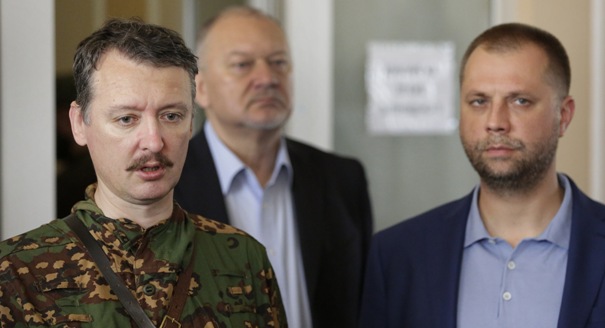
The leaders of the Donetsk People’s Republic, Alexander Borodai and Igor Strelkov, are both Russian citizens who worked for the intelligence services, fought in Chechnya, spent time in Transnistria and worked for the ultra-nationalist newspaper, Zavtra. Putin must know that they have become a toxic liability.
In the fall of 1993, as a young newspaper reporter in Moscow, I made several visits to the besieged White House building where supporters of the Supreme Soviet had set up camp and were resisting Boris Yeltsin’s order of September 21 to dissolve the legislature.
At the time, it felt like a last stand. Extreme politicians of all stripes had gathered there, from the ultra-rightist Alexander Barkashov to the ultra-leftist Viktor Anpilov to the writer-radical Eduard Limonov. Around them were dozens of men of uncertain provenance in camouflage fatigues carrying small weapons. They were self-proclaimed defenders of the constitution, enjoying this moment of defiance in the center of Moscow.
These men had completely different political goals, but were united by a general rage that they had lost their country, the Soviet Union, to a regime acting on the orders of the enemy, the West.
On October 4, 1993, White House rebels were crushed by Boris Yeltsin, brutally. They seemed to have been swept away into history.
That was not the case of course. The armed men in camouflage did not disappear, they relocated. Some fought in Russia’s wars in Chechnya. Others found a haven in the pro-Russian enclave of Transnistria, which had broken away from Moldova in 1992.
Under Vladimir Putin, the marginal narrative of blaming the West for a conspiracy against Russia became first acceptable and then mainstream. But Putin himself has always steered clear of the sensitive issue of October 1993, maintaining his double identity as both Yeltsin’s heir and anti-Yeltsin. Back then, after all, he was working for the pro-Yeltsin mayor of St Petersburg, Anatoly Sobchak and he doubtless approved of the crushing of a group of armed anti-state rebels.
Fast forward to Donetsk and Luhansk in 2014. The two main leaders of the Donetsk People’s Republic, Alexander Borodai and Igor Strelkov, are both Russian citizens who worked for the intelligence services, fought in Chechnya, spent time in Transnistria and worked for the ultra-nationalist newspaper, Zavtra.
There has been much debate about the degree of autonomy these men enjoy. In a persuasive article, security expert Mark Galeotti describes Strelkov as a “a loyal Russian well off the reservation,” speculating that he got involved in Crimea and Donetsk on his own initiative but has been coordinating his actions with the security establishment in Moscow.
Which brings us back to October 1993. Borodai was there. Writing for Zavtra, he calls the siege, when he was a “White House defender” at the age of just 19, the defining moment of his biography. He reflects that Putin’s regime lacks legitimacy because it is the successor of Yeltsin’s, but gives it some credit for correcting Russia’s course.
There is a growing and appalling body of evidence that suggests these men were responsible for the shooting down of an international airliner. Even without that, President Putin must know that they have become a toxic liability and that their views are sufficiently different from his own that they might resist orders to stand down.
In the longer run, Borodai’s and Strelkov’s agenda is to establish a “patriotic regime” in Russia akin to the one that failed to come to power in Moscow in 1993. Hearing their words, you get the impression that they would be happy to do so either with Putin or without him.

Senior Fellow, Carnegie Europe
Thomas de Waal is a senior fellow at Carnegie Europe, specializing in Eastern Europe and the Caucasus.
Recent Work
Thomas de Waal
Thomas de Waal
Carnegie does not take institutional positions on public policy issues; the views represented herein are those of the author(s) and do not necessarily reflect the views of Carnegie, its staff, or its trustees.

The aftermath of the Ceuta crisis shows Europe has drawn the wrong lessons. Rather than doubling down on failed migration policies, the EU needs to address the underlying roots of such episodes.

Richard Youngs

Canadian Prime Minister Mark Carney has twice inspired praise for standing up to U.S. President Donald Trump: at the 2026 World Economic Forum in Davos and on Canada-U.S. trade negotiations. Is Carney showing a third way better than the EU has in dealing with the Trump administration?

Rym Momtaz, ed.

The EU’s responses to two recent incidents expose the gulf between European perceptions and capabilities. Unless the union can bridge that gap, it will never become a real geostrategic power.
Rym Momtaz

European states control several Overseas Countries and Territories around the world that carry strategic, economic, and environmental weight. As great powers challenge the rules-based order, defending them is a geopolitical imperative for Europe.

Marc Pierini

In supporting Europe’s far-right, MAGA and Russia both want the same thing: a weaker EU. Europe must defend itself without abandoning the openness these forces exploit.

Armida van Rij