

Article
Thomas de Waal
{
  "authors": [
    "Thomas de Waal"
  ],
  "type": "commentary",
  "centerAffiliationAll": "",
  "centers": [
    "Carnegie Endowment for International Peace",
    "Carnegie Europe",
    "Carnegie Russia Eurasia Center"
  ],
  "collections": [],
  "englishNewsletterAll": "",
  "nonEnglishNewsletterAll": "",
  "primaryCenter": "Carnegie Europe",
  "programAffiliation": "",
  "programs": [],
  "projects": [],
  "regions": [
    "Caucasus",
    "Azerbaijan",
    "Armenia"
  ],
  "topics": [
    "Security",
    "Military",
    "Foreign Policy"
  ]
}
Source: Getty
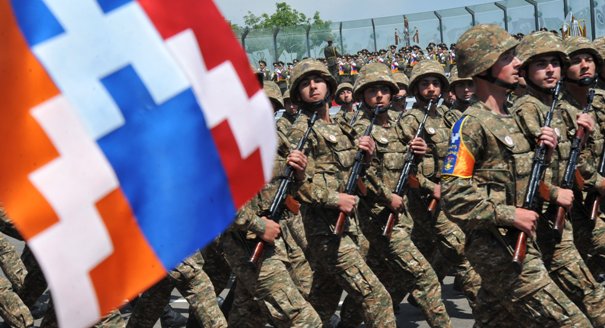
The ceasefire in Nagorny Karabakh has been violated multiple times over the last few days. Without a more substantial peace process that both Armenia and Azerbaijan can buy into, the violence is all too likely to re-occur.
More gunfire disturbed this unquiet summer over the last few days, this time across the Armenian-Azerbaijani ceasefire line.
Reliable information is hard to find from the remote war zone around Nagorny Karabakh. But information from both sides suggests that at least 30 soldiers have died in the last few days—and perhaps many more. Armenian sources claim that five Armenians and 25 Azerbaijanis have died. An Azerbaijani general said that 71 Armenians had been killed, while the Azerbaijani defense ministry puts its losses at 13.
That suggests there have been many more casualties on the front-line in a week than in the whole of 2013.
In the last 15 years, around two or three dozen people have died every year in shooting incidents. This year, a number of factors, such as deeper cynicism about the peace process and the continuing arms race, fuelled by Russia, have made the situation much worse.
Armenia has lurched in a more pro-Russian direction, with the country’s course set on joining Russia’s Eurasia Union. That may have reinforced the belief in Yerevan that in the event of conflict, Moscow will step in to defend its treaty obligations under the CIS Collective Security Organization and come to the aid of Armenia.
Azerbaijan looks both more insecure and more aggressive. A full-scale crackdown on human rights and civil society activists continues. Last week Arif and Leyla Yunus, who were first detained in April, were accused of ludicrous charges of treason and espionage. Since then, the health of Leyla Yunus, who has diabetes, has worryingly deteriorated in prison.
For the last two months, there have been reports of more Armenian-Azerbaijani cross-border clashes, some in border areas that had formerly been mostly quiet, such as the one around Nakhichevan.
Many of the ceasefire violations are localized and uncoordinated, but more serious incidents, such as raids across the line, could not happen without political approval.
These attacks are more likely to come from the Azerbaijani side, which has rejected international initiatives to stabilize the ceasefire by removing snipers from the front-line. As the losing side in the conflict, the Azerbaijanis make it their business to challenge the status quo, make the other side nervous and remind the world of the conflict. That is the most plausible interpretation for the last major outbreak of violence in June 2012 which coincided with former secretary of state Hillary Clinton’s visit to the region.
However, the Armenian side is not averse to making a political point either. Photographs of captured bulky radio equipment published this week by Armenians suggest a raid on Azerbaijani positions. As presidential official Novruz Mammadov pointed out, it is unlikely his side ordered an offensive when both Azerbaijan’s president and defense minister were abroad last week.
So this latest violence may have been the result of a big Armenian operation or counter-operation that came after numerous smaller Azerbaijani attacks. Once fighting kicks off, of course, the issue of “Who started it,” rapidly becomes irrelevant.
On August 4, the centenary of the outbreak of Europe’s “Guns of August,” the fighting subsided somewhat—hopefully because the killing sobered both sides up. The two presidents, Ilham Aliyev and Serzh Sargsyan, have been invited to Sochi on August 8 and 9 for separate talks with President Vladimir Putin, although it is not confirmed that they will meet each other.
Putin, of course, will have his own agenda at the meeting, which may be just as much about Ukraine as Karabakh. Without a more substantial peace process that the two parties can buy into, the violence is all too likely to re-occur.

Senior Fellow, Carnegie Europe
Thomas de Waal is a senior fellow at Carnegie Europe, specializing in Eastern Europe and the Caucasus.
Recent Work
Thomas de Waal
Thomas de Waal
Carnegie does not take institutional positions on public policy issues; the views represented herein are those of the author(s) and do not necessarily reflect the views of Carnegie, its staff, or its trustees.

The EU had to compromise to adopt a twenty-first sanctions package against Russia, exposing growing cracks in the union’s resolve. Is this latest, weaker round worth it to keep pressure on Moscow?

Rym Momtaz, ed.

Trump is distracted and Ukraine wants Europe to step up. The continent’s leaders must find their voice and assert it in talks with Russia.

Alissa de Carbonnel

Mounting economic strain and battlefield losses will not necessarily make the Kremlin less dangerous. They could instead push Moscow toward a more aggressive hybrid campaign designed to test NATO’s Eastern flank, exploit allied hesitation, and fracture European resolve.

Maksym Beznosiuk

Over the past ten years, NATO has held almost as many summits as it did during the entirety of the Cold War. Are they still useful, or is it time to stop holding annual meetings?
Rym Momtaz, ed.
Nearly a year and a half after Europeans leaned into sucking up to Trump, the strategy has produced some benefits when it comes to Ukraine.
Rym Momtaz