

Commentary
Dmitri Trenin
{
  "authors": [
    "Dmitri Trenin"
  ],
  "type": "legacyinthemedia",
  "centerAffiliationAll": "",
  "centers": [
    "Carnegie Endowment for International Peace",
    "Carnegie Russia Eurasia Center"
  ],
  "collections": [],
  "englishNewsletterAll": "",
  "nonEnglishNewsletterAll": "",
  "primaryCenter": "Carnegie Russia Eurasia Center",
  "programAffiliation": "",
  "programs": [],
  "projects": [],
  "regions": [
    "North America",
    "United States",
    "Russia",
    "Eastern Europe",
    "Ukraine",
    "Western Europe"
  ],
  "topics": [
    "Security",
    "Military",
    "Foreign Policy"
  ]
}
Source: Getty
Prudence dictates that Russia should not invade Ukraine. However, if Putin decides differently, the Ukraine crisis will immediately become a Russia crisis, and then a European one.
Source: EL PAÍS
Ever since the Maidan revolution in Kiev last February, Vladimir Putin has been facing some of the toughest choices as Russian president. The choices he confronts in the next few weeks, and the decisions he takes, will be fateful not only for Russia and Ukraine, but also for Europe.
After the sudden toppling of his unreliable Ukrainian partner, Viktor Yanukovych, Putin faced the prospect of a Ukraine led by a coalition of radical nationalists from the country’s west who are anti-Russian by definition, and of pro-Western figures in the Kiev elite that are ready to lead Ukraine to an association with the European Union and, as Putin suspected, also to NATO membership and a de facto alliance with the United States. This would have been an intolerable challenge to Russia’s security, and a check on the Kremlin’s ambition to create a powerful Eurasian Union.Putin’s response to that first challenge was two-fold. Immediately, he made sure that whatever else happens in Ukraine, Russian-populated and strategically important Crimea would not be part of it. This was accomplished with military precision and without a shot being fired. Broader hopes of mainly Russian-speaking regions of southern and eastern Ukraine forming a confederacy, dubbed Novorossiya—“New Russia”—and making Kiev agree to federalizing Ukraine, turned out to be largely a failure. Only two regions out of eight held referenda on self-determination, which Kiev refused to recognize. An insurgency followed in Donetsk and Lugansk, which Russia tacitly supported.
Putin’s second challenge came ahead of the Ukrainian presidential election of May 25, 2014. To the Russian leader, the people who came to power in Kiev in February were putschists and usurpers. However, he chose not to ignore the will of the Ukrainian people, who overwhelmingly chose Petro Poroshenko, the principal funder of the Maidan, as their next head of state. Putin chose a combination of supporting the insurgency in Donbass and seeking to promote, with Europe’s help, a diplomatic solution in Ukraine, which would have taken care of Moscow’s security, economic, and humanitarian interests in the country. Those included: no NATO membership or U.S. bases in Ukraine; preservation of vital economic links between the two countries; and a legal status for the Russian language. Putin’s strategy, however, was opposed by Kiev, which resolved to stamp out the insurgency no matter what, and by Washington, which began to pressure Russia into backing off from Ukraine.
The downing of the Malaysia Airlines Flight MH17 on July 17, 2014, even before the start of the investigation into what caused it, has been squarely blamed on Russia by the United States and all of its allies. In short order, they placed Russia under strict sanctions designed to cripple its economy, drive wedges between Putin and his key individual supporters, and instigate widespread anti-Kremlin resentment among the Russian population at large. Putin’s response to that is still unfolding, but it is likely to be comprehensive, ushering in a new set of policies in all key areas, from economics, to ethnic relations, to the management of the elites.
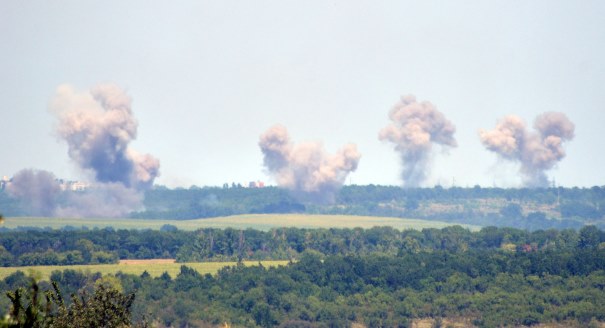
Yet, Putin’s third choice will be harder than that. The war in Ukraine’s east has already produced around 1,500 fatalities and over 800,000 displaced persons and refugees, some 700,000 of whom have crossed the border into Russia. Donetsk, a front line city of about a million residents, is half-deserted. When Kiev’s army, with full support from Washington, undertakes a final offensive to take control of the capital of the rebel “people's republic”, the civilian death toll will begin to climb fast. Putin will be faced by the dilemma of either allowing Kiev to crush Moscow’s allies, with the Kremlin helplessly standing by, or of intervening with force, plunging Russia into a painful quagmire that could be much worse than the ill-fated Soviet invasion of Afghanistan.
Prudence dictates that, whatever happens in Donetsk, Russia should not invade. Putin can survive the defeat of the rebels and hope to fight back on the political and economic fronts: Ukraine will face very serious tests soon in both areas. However, if the Russian leader decides differently, and falls into the trap where some of his would-be detractors want to see him, the Ukraine crisis will immediately become a Russia crisis, and then, in very short order, a European one. Not even the United States will escape being affected. Those solemnly pondering now over the lessons of World War I would be surprised that, with their eyes turned back on history, they have overlooked a catastrophe unfolding right before them.
This article originally appeared in EL PAÍS.
©DMITRI TRENIN/EDICIONES EL PAÍS, SL. 2014
Former Director, Carnegie Moscow Center
Trenin was director of the Carnegie Moscow Center from 2008 to early 2022.
Recent Work
Dmitri Trenin
Dmitri Trenin
Carnegie does not take institutional positions on public policy issues; the views represented herein are those of the author(s) and do not necessarily reflect the views of Carnegie, its staff, or its trustees.

Funding Ukraine remains a priority for European leaders. As Russia’s war of aggression heads into another winter, two feasible options to mobilize support for Kyiv should be fast-tracked.


Vladyslav Rashkovan, Gregory P. Wilson

While the EU and European governments are embracing the much-lauded middle-power moment, this entails three difficult conundrums.

Richard Youngs

Europe is facing rising populism internally as well as external pressures from Russia, China, Turkey, and the United States.

Dimitar Bechev

A notable degree of participative democracy has firmly arrived in Europe. But to have more far-reaching impact, democratic deliberation needs to move into a radically new phase.
Richard Youngs

Much has been said of the changes Brussels is trying to make to the EU enlargement process. Here’s why gradual integration might—or might not—be the answer.
Dimitar Bechev