

Commentary
Richard Youngs
{
  "authors": [
    "Richard Youngs"
  ],
  "type": "legacyinthemedia",
  "centerAffiliationAll": "dc",
  "centers": [
    "Carnegie Endowment for International Peace",
    "Carnegie Europe"
  ],
  "collections": [],
  "englishNewsletterAll": "ctw",
  "nonEnglishNewsletterAll": "",
  "primaryCenter": "Carnegie Europe",
  "programAffiliation": "EP",
  "programs": [
    "Europe"
  ],
  "projects": [],
  "regions": [
    "Europe",
    "Western Europe",
    "Iran"
  ],
  "topics": [
    "EU",
    "Democracy",
    "Technology"
  ]
}
Source: Getty
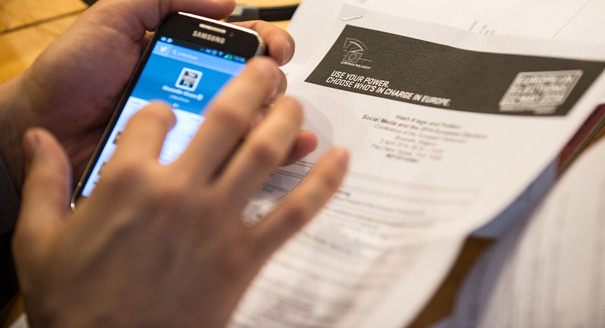
Digital media is already affecting foreign policy, by providing quick, inside information from the ground. While this is a largely positive development, there are dangers too.
Source: Deutsche Welle
Can social media gauge public opinion on emerging issues? Have they become the key platform for dialogue? Digitization has huge potential for European foreign and security policy. Richard Youngs of the international think tank Carnegie Europe reflects on questions regarding the theme of the 2015 Global Media Forum.
Digital media is, of course, already affecting foreign policy. In a positive sense, it helps provide quick, inside information from the ground. No-one can say they are ignorant today when a tragedy like Gaza or Ukraine happens. This gives governments a stronger understanding upon which to base their actions, even as it increases public pressure on them to react to crises. Again, while this is a largely positive development, there are dangers too. There is the challenge of verifying information from the ground; the social media can become a battleground for different advocacy campaigns and people with singular agendas, rather than encouraging balanced, well-grounded analysis. And it may push governments into a 'We must do something' kind of foreign policy: good in one way, but one must recall that most foreign policy crises still need long-term and balanced solutions.
I am not sure government-led foreign policy will disappear. Indeed, governments are trying to use e-based ICT groups in other countries to help carry forward projects on democracy and human rights, for example. The danger is perhaps that we come to expect too much of digital communications technology: events in many countries have shown that ICT helps mobilize people but regimes can also use it skilfully, and normal politics is still required to really change the quality of democracy.
Absolutely correct, and very well put: ideally the new High Rep should be someone aware of the importance of this kind of new diplomacy which goes beyond state-to-state relations. The EU is doing many interesting things in this area, supporting activists around the world on digital projects; again it is important not to oversell what this can achieve but also to make sure that the EU's high security policies do not cut across such approaches.

Senior Fellow, Democracy, Conflict, and Governance Program
Richard Youngs is a senior fellow in the Democracy, Conflict, and Governance Program, based at Carnegie Europe. He works on EU foreign policy and on issues of international democracy.
Recent Work
Richard Youngs

Richard Youngs, Erik Jones, Dan Baer, …
Carnegie does not take institutional positions on public policy issues; the views represented herein are those of the author(s) and do not necessarily reflect the views of Carnegie, its staff, or its trustees.

European NATO countries are wrestling with the possibility of U.S. disengagement from the alliance. With the continent’s security increasingly uncertain, governments must restore the credibility of their collective defense.



Hans-Dieter Lucas, Adam Thomson, Pierre Vimont

The domestic impacts of how long it is taking to end the war in Ukraine have pushed the French electorate to the political extremes and compromised the country’s diplomatic capacity.

Rym Momtaz

Before the next wave of EU enlargement takes place, the union needs to grapple with thorny questions of how power is distributed among its members.


Emil Sondaj Hansen, Ditte Brasso Sørensen

The new U.S.–Denmark–Greenland agreement will help Washington exert political, economic, and financial dominance under the guise of security. Yet, it acknowledged Copenhagen’s and Nuuk’s sovereignty on the island.

Marc Pierini

Are Germany’s economic, industrial, and political struggles becoming a liability for the EU’s ability to rise to the geopolitical moment?
Rym Momtaz, ed.