

Commentary
Judy Dempsey
{
  "authors": [
    "Judy Dempsey"
  ],
  "type": "legacyinthemedia",
  "centerAffiliationAll": "dc",
  "centers": [
    "Carnegie Endowment for International Peace",
    "Carnegie Europe"
  ],
  "collections": [],
  "englishNewsletterAll": "ctw",
  "nonEnglishNewsletterAll": "",
  "primaryCenter": "Carnegie Europe",
  "programAffiliation": "EP",
  "programs": [
    "Europe"
  ],
  "projects": [],
  "regions": [
    "Europe",
    "Western Europe",
    "Germany",
    "Iran"
  ],
  "topics": [
    "EU",
    "Security"
  ]
}
Source: Getty
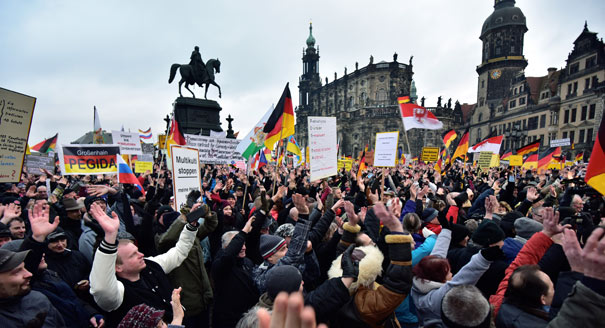
The Pegida movement has awoken Germany, but Islamophobia is a Europe-wide phenomenon whose roots lie in the alienation of citizens from politics.
Source: Deutsche Welle
Speaking to Deutsche Welle’s Quadriga, Judy Dempsey argued that the Pegida movement of “Patriotic Europeans against the Islamization of the West” has awoken German society.“The public space is changing in Germany,” warned Judy Dempsey. “Germany is not unique. . . . There is the fear of the other, the fear of the foreigner. . . . This is a European phenomenon.” In fact, Germany is only the latest country in Europe to tap into the surrounding atmosphere of Islamophobia.
As for the underlying causes of this surge, Dempsey explained that one of the problems is that “with the bureaucratization of politics and globalization, the feeling of identity between politicians and citizens is widening.” The mainstream political parties “haven’t adapted to the postmodernization of Europe, to globalization, and to [the need to] adapt policies and politics to society and its citizens.” The question of alienation between the state, political parties, and society is one of Europe’s biggest problems today.

Nonresident Senior Fellow, Carnegie Europe
Judy Dempsey is a nonresident senior fellow at Carnegie Europe
Recent Work
Judy Dempsey
Judy Dempsey

With its public finances in shambles, the far right polling at 35 percent ahead of the 2027 presidential election, and a growing protest movement, is France’s crisis a threat to the EU’s geopolitical awakening?

Rym Momtaz, ed.

Ahead of a tough winter for Ukraine, Donald Trump’s swing back toward Russia bodes ill. But instead of panicking, Kyiv’s European allies are focusing on action.
Rym Momtaz

Funding Ukraine remains a priority for European leaders. As Russia’s war of aggression heads into another winter, two feasible options to mobilize support for Kyiv should be fast-tracked.


Vladyslav Rashkovan, Gregory P. Wilson

While the EU and European governments are embracing the much-lauded middle-power moment, this entails three difficult conundrums.

Richard Youngs

Europe is facing rising populism internally as well as external pressures from Russia, China, Turkey, and the United States.

Dimitar Bechev