

Commentary
Dmitri Trenin
{
  "authors": [
    "Dmitri Trenin"
  ],
  "type": "legacyinthemedia",
  "centerAffiliationAll": "",
  "centers": [
    "Carnegie Endowment for International Peace",
    "Carnegie Russia Eurasia Center"
  ],
  "collections": [],
  "englishNewsletterAll": "",
  "nonEnglishNewsletterAll": "",
  "primaryCenter": "Carnegie Russia Eurasia Center",
  "programAffiliation": "",
  "programs": [],
  "projects": [],
  "regions": [
    "East Asia",
    "Russia",
    "Eastern Europe",
    "Ukraine",
    "Western Europe",
    "France",
    "Germany",
    "Belarus"
  ],
  "topics": [
    "Security",
    "Foreign Policy"
  ]
}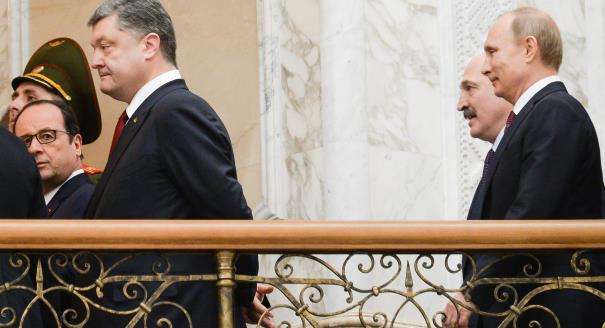
Source: Getty
Ukraine and the global crisis over it point to the start of a new period in world politics. Great powers—Russia overtly, China covertly—are challenging the U.S.-dominated order. Also, in the foreseeable future, there will be no common security system in Europe.
Source: Guardian
After the ceasefire negotiated in Minsk, a peace settlement in eastern Ukraine remains distant. Most of the points in the agreement, including Ukraine’s constitutional reform and the resumption of Kiev’s control over the entire Ukrainian-Russian border, will probably never be implemented. The most one can hope for is that the conflict is frozen and people stop dying. Even that, however, cannot be taken for granted, as continued fighting ahead of the ceasefire’s formal entry into force suggests.
If the truce sticks, it will be the first negotiated arrangement in a newly divided Europe, leaving Russia almost alone on the east, with much of the rest of Europe supporting Ukraine. This split can grow much worse if the conflict in Donbass continues. But even if it stops, reconciliation is not on the cards. This means that in the foreseeable future there will be no common security system on the continent of Europe, no commonly agreed-upon norms and no rules of behaviour. The world disorder has entered the recently most stable and best-regulated part of the globe: Europe.
The idea that a combination of western sanctions and the low oil price can bring a change in Kremlin policies, or a change in the Kremlin itself, has so far not been borne out by the facts. Putin remains defiant, the elites do not turn against him, and his popularity among the bulk of the Russian people, despite the hardships they have begun to feel, is at record levels. These people are not ignorant of the dangers a continued conflict over Ukraine can pose to them, but lay the blame for these on Kiev, Washington and the European leaders. Putin, whether as war leader or a peacemaker, is their champion.At Minsk, he has achieved his minimal goal. Kiev has conceded the failure of its efforts to wipe out the Donbass rebels backed by Moscow. If the ceasefire becomes permanent, the “people’s republics” will be physically safe and can start turning themselves into functioning entities on the models of Transnistria. Russia will need to supply them with more than weapons and humanitarian assistance, straining its resources even more, but there’s hardly an alternative. For Putin, and most Russians, these are “our people”.
Yet, in Minsk, Putin reaffirmed Russia’s official position that Donbass should remain part of Ukraine. This is not a concession. Within a formally unified Ukraine, Donetsk and Lugansk are a protected centre of resistance to the political leadership in Kiev. The situation in the rest of the country permitting, they can expand their influence beyond Donbass and link up with those who, a year after the triumph of the Maidan, have become disillusioned with their government, which is woefully unable to tame corruption and improve the lives of ordinary Ukrainians. Indeed, if the truce in the east of the country holds, the future of Ukraine will depend on how it manages reform and popular discontent.
Russia has not so much “lost Ukraine”, as, at least for the time being, its European option. The recent joint trip of chancellor Angela Merkel and president François Hollande to Moscow, which paved the road to Minsk, is a rare top-level visit to Russia by western leaders these days. The German-Russian relationship, a mainstay of Europe’s post-cold war stability, has dangerously frayed. With politics adversarial and history divisive, the 70th anniversary of the end of the Second World War has led to controversies, with a number of politicians in Poland, the Baltic states and Ukraine seeking to minimise the Soviet Union’s contribution to the defeat of Nazism or accusing the Soviets of crimes to exonerate those who sided with Hitler against Stalin.
Thus, as a result of the Ukraine conflict, the gulf between Russia and the European Union is wide, deep and growing. The Russian government does not expect the lifting of EU sanctions for a long time and, even then, it is hard to expect business as before. Putin’s idea of a “greater Europe from Dublin to Vladivostok”, which he was seeking to sell to the European, particularly German business community, only five years ago, is being replaced by the reality of Russia’s increasing closeness to China and the rise of what can be called a “greater Asia from Shanghai to St Petersburg”. When Putin reviews the Victory Day military parade on 9 May, his most honoured guest will be the Chinese president, Xi Jinping, with Barack Obama and most other western leaders boycotting the celebration.
De facto expelled from the G8, in confrontation with the United States and with its European option closed, Russia is not isolated elsewhere. Apart from China, it is trying to expand ties to India, which is also joining this year the Shanghai Co-operation Organisation. When Putin hosts the twin summits of Brics and SCO in Ufa in July, he will be in the chair of the two most prominent clubs of the non-western world. Thanks to China’s economic and financial might, and Russia’s international experience, these clubs have a potential for evolving into serious organisations capable of providing a measure of financial and political leadership.
It is not all symbolism. In a dramatic move, Russia has dropped Gazprom’s pet project, the South Stream, in favour of a gas pipeline running through Turkey to meet the EU on the Greek border. Turkey, a Nato member and US ally, is strengthening economic links to Russia. So is, albeit more quietly, South Korea, another key US ally. Prime minister Shinzo Abe of Japan has not given up on his vision of a normalised and economically vibrant relationship with Russia.
In the Middle East, Russia has intensified its outreach to Iran and Egypt, while keeping active relations with Israel and courting Saudi Arabia, not to count its involvement in Syria, of course. From Latin America to south-east Asia to Pakistan, Russia has been looking for customers for its newly revived defence industry.
Ukraine is not the centre of the geopolitical universe, neither is Russia central to the future of the globe. Yet, Ukraine and the global crisis over it point to the start of a new period in world politics. Great powers – Russia overtly, China covertly – are challenging the US-dominated order. Nationalism, on the rise in places from Turkey to India to Japan, leads to a further erosion of that order. Attempts to degrade and destroy Islamic State have yielded only partial, reversible results.
Having lost Russia as a partner and gained Ukraine as a new responsibility, Europe is uncertain what to do. Germany has provided a modicum of diplomatic leadership to the EU as a whole, but the larger issue of strategic goals and how to achieve them has not been properly addressed. Europe, an island of stability and peace for the last quarter-century, is rejoining the world.
Former Director, Carnegie Moscow Center
Trenin was director of the Carnegie Moscow Center from 2008 to early 2022.
Recent Work
Dmitri Trenin
Dmitri Trenin
Carnegie does not take institutional positions on public policy issues; the views represented herein are those of the author(s) and do not necessarily reflect the views of Carnegie, its staff, or its trustees.

Are Germany’s economic, industrial, and political struggles becoming a liability for the EU’s ability to rise to the geopolitical moment?

Rym Momtaz, ed.

European Commission President Ursula von der Leyen is about to give her annual address on the state of the EU. Here’s what she won’t—but should—say.
Rym Momtaz

Radical-right parties are expected to do well in upcoming elections in four of the EU's biggest member states. If successful, they could prevent the union from addressing key challenges ahead.

Stefan Lehne

The aftermath of the Ceuta crisis shows Europe has drawn the wrong lessons. Rather than doubling down on failed migration policies, the EU needs to address the underlying roots of such episodes.

Richard Youngs

An overwhelming victory by a far-right-wing party in a small state in eastern Germany will have major repercussions for Chancellor Friedrich Merz’s coalition.

Judy Dempsey