

Commentary
Balázs Jarábik
{
  "authors": [
    "Balázs Jarábik"
  ],
  "type": "commentary",
  "centerAffiliationAll": "",
  "centers": [
    "Carnegie Endowment for International Peace",
    "Carnegie Russia Eurasia Center"
  ],
  "collections": [],
  "englishNewsletterAll": "",
  "nonEnglishNewsletterAll": "",
  "primaryCenter": "Carnegie Endowment for International Peace",
  "programAffiliation": "",
  "programs": [],
  "projects": [
    "Eurasia in Transition"
  ],
  "regions": [
    "Russia",
    "Eastern Europe",
    "Ukraine",
    "Western Europe",
    "Belarus"
  ],
  "topics": [
    "Security",
    "Military",
    "Foreign Policy",
    "Economy"
  ]
}
Source: Getty
The Minsk agreements lay the political groundwork for peace in Ukraine. Still, several important questions remain. Moreover, the agreements are likely to be too little too late for the warring parties: they may not settle for anything less than what they consider victory.
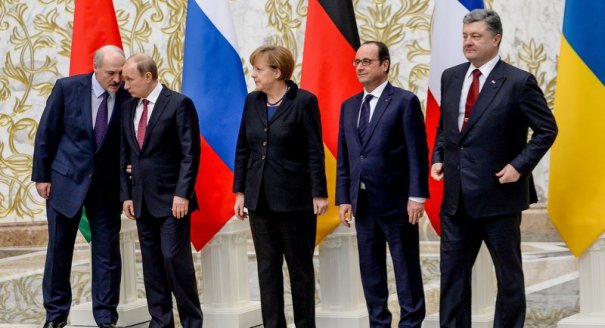
Belarus’s President Alexander Lukashenko was the only one smiling after 17 hours of negotiations in Minsk on Thursday morning, despite the announcement of a new ceasefire agreement. Though Lukashenko’s gentle mocking of President Vladimir Putin made everyone laugh briefly, there was no avoiding the reality that the Europeans remain the only party interested in freezing the conflict in Donbas.
The agreement and the subsequent joint declaration of the “Normandy Four” (Vladimir Putin, François Hollande, Angela Merkel, and Petro Poroshenko) lay the political groundwork for peace. Still, questions remain about the feasibility of a ceasefire, and the will of Russian, Ukrainian, and separatist leaders to implement the mechanisms necessary to resolve the conflict. The agreement contains a timeline for implementation but no binding mechanism, though certain elements—for example, promises to respect the territorial integrity of Ukraine, efforts by France and Germany to help restore financial links with the separatist territories, and promises to continue trilateral dialogue between the EU, Ukraine, and Russia as well as the Normandy-format discussions—are quite important from a technical perspective.
But this is likely to be too little too late for the warring parties: the Russian-backed rebels and Ukrainian forces may not settle for anything less than what they consider victory. For the separatists, this means acceptance of the statelets that they control, and the maintenance of clearly delineated political separation from Kyiv. The Ukrainians, on the other hand, cannot appear to be giving in to Russian military pressure in the east and Russian political pressure in Kyiv.
Most importantly, the Minsk II agreements fail to address the question of enforcement of the ceasefire, and leave the control of the inter-state border contingent upon constitutional reform, decentralization, and the restoration of Ukraine’s economic ties to Donbas by year-end. This gives ample opportunity for Russia to continue to supply the rebels with weapons across the porous border and to disrupt developments inside Ukraine via political and economic levers.
If the next two days don’t bring about a ceasefire, the West will fall back into a debate about arming Ukraine as pressure to “do something” builds. Many in Kyiv would actually welcome this instead of implementing the ceasefire agreement.
#Minsk II may be no win-win situation for #Ukraine if its elites and leaders continue searching for victory.Tweet This
Poroshenko and the rest of Ukraine are in a fragile position. The logic is that if Russia backs the rebels with military aid, the West has a moral obligation to do the same for Kyiv. This will only reinforce a habit of mind in Kyiv that so long as Russia is meddling in Ukraine the West should lower its expectations about serious reform. Notably, the new IMF bailout does not talk about fulfilling previous conditions but commitment for reforms. For many, this may be an essential shortcut to keep the war going rather than having to travel along the bumpy road of constitutional reforms mandated by the Minsk agreements and demanded by Moscow.
All eyes are now on Debaltsevo, where rebels say they have encircled about 6,000 Ukrainian troops. The future of this little town, an important railway juncture between Donetsk and Luhansk, is said to have prolonged the Minsk discussions into the next morning. The fact that an impending military and humanitarian disaster can be the subject of such debate shows how fragile the situation is in Ukraine.
There is little room for compromise. The continuous zero sum game played by various Ukrainian actors against each other also inadvertently contributes to Putin’s ultimate goal of promoting regime change in Kyiv. The sad reality is that absent Russia’s grave misdeeds in Crimea and Donbas, Ukraine would still be in turmoil.
There may be no win-win situation for Ukraine if its elites and leaders continue searching for victory.

Political analyst, former Slovak diplomat, and consultant specializing in Eastern Europe
Recent Work
Balázs Jarábik
Balázs Jarábik
Carnegie does not take institutional positions on public policy issues; the views represented herein are those of the author(s) and do not necessarily reflect the views of Carnegie, its staff, or its trustees.

As we close out another season of Strategic Europe, it is worth taking stock of the deep shifts underway.

Rym Momtaz

The hybrid warfare landscape is evolving rapidly, leaving policymakers without clear strategies. To better inform their work in addressing emerging challenges, governments must dig deeper into the underlying dynamics at play.


Raluca Csernatoni, Alicia Wanless
The EU had to compromise to adopt a twenty-first sanctions package against Russia, exposing growing cracks in the union’s resolve. Is this latest, weaker round worth it to keep pressure on Moscow?
Rym Momtaz, ed.

Trump is distracted and Ukraine wants Europe to step up. The continent’s leaders must find their voice and assert it in talks with Russia.

Alissa de Carbonnel

Mounting economic strain and battlefield losses will not necessarily make the Kremlin less dangerous. They could instead push Moscow toward a more aggressive hybrid campaign designed to test NATO’s Eastern flank, exploit allied hesitation, and fracture European resolve.

Maksym Beznosiuk