

Commentary
Alexey Malashenko
{
  "authors": [
    "Alexey Malashenko"
  ],
  "type": "legacyinthemedia",
  "centerAffiliationAll": "",
  "centers": [
    "Carnegie Endowment for International Peace",
    "Carnegie Russia Eurasia Center"
  ],
  "collections": [],
  "englishNewsletterAll": "",
  "nonEnglishNewsletterAll": "",
  "primaryCenter": "Carnegie Russia Eurasia Center",
  "programAffiliation": "",
  "programs": [],
  "projects": [
    "Eurasia in Transition"
  ],
  "regions": [
    "Central Asia",
    "Kazakhstan"
  ],
  "topics": [
    "Political Reform"
  ]
}
Source: Getty
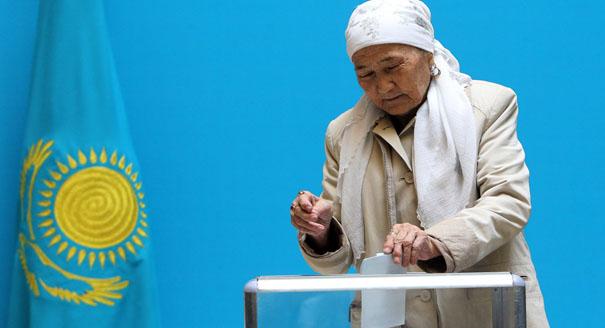
There is no doubt that Nursultan Nazarbayev will win Kazakhstan’s early presidential elections. He will stay in power for an indefinite number of years to come, and the country will implement its planned reforms under his patronage.
Source: Russian International Affairs Council
There is no doubt that Nursultan Nazarbayev will win Kazakhstan’s early presidential elections scheduled for April 26, 2015. He will stay in power for an indefinite number of years to come, and the country will implement its planned reforms under his patronage. The Kazakh political system is facing a transformation at all levels, from provincial to federal, while the judicial system can expect a significant reorganization.
These changes will be accompanied by an influx of younger state personnel and an injection of educated experts who have international experience and speak foreign languages into all levels of authority. The president has set the task of making Kazakhstan trilingual, with Kazakh, Russian, and English as its three working languages. What is more is that the younger generation, which grew up in the 1990s and 2000s, will no longer be prone to ‘post-Soviet syndrome.’
Nazarbayev will change the current system with an eye to building it not for himself, but for his successor, of whom there is not yet talk but who will sooner or later have to replace him. On the one hand, the early elections postpone the problem of the transfer of power. Talk of Nazarbayev’s successor will cease to be relevant for a certain period of time – possibly an extremely short period of time. Nazarbayev will remain at the head of the government for as long as he chooses.The question arises: What legacy will he leave to his successor? If talk of political reform is more than words, an interesting situation will unfold: The next president will not possess the powerful levers of authority that Nazarbayev enjoys. Presidential powers will be reduced, and Kazakhstan may find itself in possession of the prerequisites for political competition, perhaps multi-party competition. None of the country’s current political parties, besides the president’s Nur Otan Party, hold serious weight. However, several Kazakh experts say the parties have started to revive in anticipation of change, with the hope that they will become real parties to the political process in the next parliamentary elections in 2017. One of those parties is the Communist People’s Party of Kazakhstan, which according to some statistics is supported by approximately 10-20% of the population. Its leader, Turgun Syzdykov, will participate in the next elections, despite his very narrow chances of success.
Political reform is most certainly long overdue in Kazakhstan. The current authoritarian regime is unable to fully cope with the challenges of economic and social development. However, it was this regime that equipped Kazakhstan to enjoy sustainable development in the 1990s and that maintained stability - a lack of which, as recent events in the post-Soviet space and the Middle East have shown, leads to tragic consequences.
It will be interesting to see the degree to which the composition of the government changes after April 26, 2015. There is a high likelihood that Chairman of the Cabinet of Ministers Karim Massimov will retain his position as prime minister. In that case, he will shoulder the difficult task of reforming the country. If events unfold in his favor, there is a probability that Massimov’s authority will only grow, especially considering the degree to which Nazarbayev trusts him.
How important are the events in Kazakhstan to Russia? On the one hand, Nazarbayev’s continued presidency would serve as a positive factor. It was no accident that Vladimir Putin wished his colleague success in the upcoming elections. According to public opinion polls conducted in Russia, 38% of Russians trust Nazarbayev. However, the Kazakh president has said on more than one occasion with relation to the Ukrainian crisis that no one should cast Kazakhstan’s sovereignty in doubt, and that Astana holds a neutral position and will continue to focus its efforts on a peaceful solution to the crisis.
Furthermore, without calling into question the new Eurasian Union, which was launched on January 1, 2015, Nazarbayev has repeatedly stressed that it is an economic union, rather than the basis for a future unified state. This has often caused discontent among Russian politicians who are in favor of creating supranational institutions.
Another question arises: What will happen to ‘Eurasianism,’ and particularly the Eurasian Economic Union, in an updated and reformed Kazakhstan? Opinions differ among the country’s political elite. In some cases, ‘Eurasianism’ is perceived as subordination to Russia, attachment to which may not be so beneficial in either the economic or the political field. In that case, a situation may arise in which Kazakhstan’s national interests come into conflict with its unequivocal support for Russian integration projects.
Therefore, a situation that appears clear on the eve of Kazakhstan’s early elections may eventually become less clear.
This article originally appeared on the Russian International Affairs Council site.
Former Scholar in Residence, Religion, Society, and Security Program
Malashenko is a former chair of the Carnegie Moscow Center’s Religion, Society, and Security Program.
Recent Work
Alexey Malashenko
Alexey Malashenko
Carnegie does not take institutional positions on public policy issues; the views represented herein are those of the author(s) and do not necessarily reflect the views of Carnegie, its staff, or its trustees.

As the EU confronts profound challenges, several leaders have called for fundamental reform to the union’s model—but only modest, superficial changes have resulted. What if Europe really could be reimagined from zero today: What should such a redesigned European order look like?

Richard Youngs, ed.
Preparing candidate countries for EU membership is no longer enough. As the enlargement process becomes a reality, the union must also prepare its own societies.

Iliriana Gjoni
Countries face several hurdles in joining the EU, including the final stage of ratifying their accession treaties. Procedural reforms and substantive adjustments could help move the process forward.

Stefan Lehne
Europe has an interest in supporting Armenian leader Nikol Pashinyan as he tries to make peace with neighbors and loosen ties with Russia. But it is depersonalized support in the long term, not quickfire flash, that will win the day.

Thomas de Waal
Montenegro and Albania are frontrunners for EU enlargement in the Western Balkans, but they can’t just sit back and wait. To meet their 2030 accession ambitions, they must make a strong positive case.

Dimitar Bechev, Iliriana Gjoni