

Article
Radical-right parties are expected to do well in upcoming elections in four of the EU's biggest member states. If successful, they could prevent the union from addressing key challenges ahead.
Stefan Lehne
{
  "authors": [
    "Richard Sokolsky",
    "Paul Stronski"
  ],
  "type": "commentary",
  "centerAffiliationAll": "",
  "centers": [
    "Carnegie Endowment for International Peace",
    "Carnegie Russia Eurasia Center"
  ],
  "collections": [],
  "englishNewsletterAll": "",
  "nonEnglishNewsletterAll": "",
  "primaryCenter": "Carnegie Endowment for International Peace",
  "programAffiliation": "",
  "programs": [],
  "projects": [
    "Eurasia in Transition"
  ],
  "regions": [
    "North America",
    "United States",
    "Russia",
    "Eastern Europe",
    "Ukraine",
    "Western Europe"
  ],
  "topics": [
    "Political Reform",
    "Economy",
    "Security",
    "Military",
    "Foreign Policy",
    "Nuclear Policy",
    "Arms Control"
  ]
}
Source: Getty
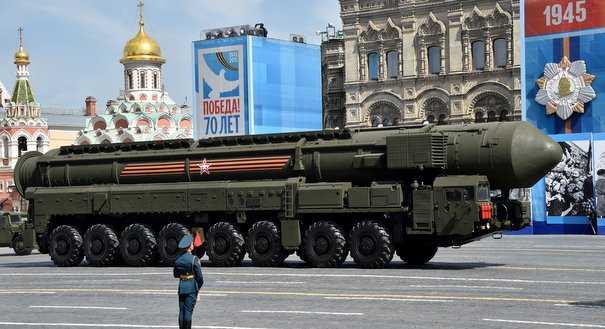
Putin’s announcement that Moscow plans to add more than 40 intercontinental ballistic missiles to its nuclear arsenal is troubling mainly because of its political and psychological impact on NATO allies. But it is no cause for alarm.
Russian President Vladimir Putin’s announcement that Moscow plans to add more than 40 intercontinental ballistic missiles (ICBMs) to its nuclear arsenal is troubling. It raises perceptions of Russian threats in Europe at a time when post-Cold War East-West relations are at a historic low. The announcement is just the latest example of nuclear saber-rattling from the Kremlin over the past year—a trend that started during an uptick in fighting in Ukraine last August, when Putin warned that “Russia is not to be messed with. Let me remind you that Russia is one of the largest nuclear powers.” In September, Russia tested a new ICBM as the Kremlin talked about the need to maintain a nuclear deterrent. In March 2015, Putin reportedly claimed that nuclear forces were put on standby during the Crimean annexation campaign a year earlier.
Even people close to Putin seem to worry about the consequences of his rhetoric. Reportedly within 40 minutes of Putin’s statement, his foreign policy advisor Yuri Ushakov stated that Russia has no intention of launching an arms race, underscoring that an arms race would weaken its economic capabilities.
This week’s rhetoric confirms to Western ears that Russia is an unpredictable actor. But, the Kremlin’s nuclear saber-rattling could easily be a sign of the Russian leadership’s lack of confidence in the country’s own conventional capabilities, particularly as the United States expands its high technology and precision strike capabilities. Russian military strategists have long feared that their conventional capabilities pale in comparison to NATO’s. Some are starting to worry about China’s too.
These ICBMs likely do not add any new nuclear capabilities to what Russia has right now. The country is already in the middle of an ICBM modernization program, as September’s ICBM test shows. It is unclear whether the announcement actually includes 40 new ICBMs or whether they are just part of the more than 50 ICBM deployments that Putin already announced for 2015 back in December. Furthermore, Russia already has a large force of tactical nuclear weapons that can reach most targets in the Baltic states and possibly elsewhere in Central Europe. The added military value of 40 ICBM warheads is marginal and it is unlikely they will give Moscow a capability it does not already have.
Putin claimed the missiles will be added to the arsenal this year, so it is conceivable that some, if not all of them, were probably already in production or pre-deployment before the announcement as part of Russia’s ongoing strategic force modernization program.
Concern in the Western media about these Russian plans provoking an arms race is misplaced. The United States is already in the middle of a robust and expensive program to modernize its strategic nuclear forces and its tactical nuclear weapons posture in Europe. Washington should therefore feel no compelling need to match these newly announced ICBMs because it is already upgrading its capabilities to meet current and future threats.There is also some doubt about Russia’s capacity to produce and pay for these new ICBMs. Russia previously co-produced ICBMs and many of their components with Ukraine. The Ukraine war is forcing the Russian military-industrial complex to become fully self-reliant. Many Russian officials tout this as a positive development. But even before the war, Deputy Prime Minister Dmitry Rogozin, who is responsible for military production, claimed that Russia’s defense factories and design bureaus were already "overworked" and "did not have time to do what the Defense Ministry orders."
A prominent example of the problems the Russian defense industry faces is its next-generation Armata T-14 battle tank. In February, Russian Deputy Minister of Defense Yuri Borisov publicly stated that the government “miscalculated” on the Armata by failing to budget enough money to build the amount of tanks it required. They also seemed to skimp on quality. One of the new tanks reportedly broke down during a dress rehearsal for this year’s May 9 Victory Day celebrations.
Russia’s budget is severely stretched and it is unclear where it will get the money to build additional ICBMs, as the Armata example shows. The rise in defense spending is forcing the government to rein in spending elsewhere. The Russian government now struggles to balance military spending—key to the war in Ukraine and to projecting military power—with the need to keep up social spending on pensions, education, and other aspects of the social safety net that underwrite domestic stability as the economy contracts. A recent poll suggested that the Russian public prioritized social spending over the military by a wide majority; 67 percent wanted the government’s first spending priority to be raising living standards, while only 12 percent thought the first priority should be military modernization and rearmament.
So, if these ICBMs might not actually be new and if Russia might not have the money to build them anyway, what was the purpose of the announcement?
The Kremlin was likely speaking to both international and domestic audiences. Russian officials earlier this week lashed out against U.S. plans to station battle tanks, infantry fighting vehicles, and other heavy weapons in Baltic and Central European countries that border Russia. That plan—still reportedly under development—is meant to assure NATO’s easternmost allies of the alliance’s commitment to their defense. Putin’s announcement was likely in response to this U.S. proposal. Its goal was to unnerve those very same allies.
The announcement also could have been an attempt to stoke discord within NATO between allies (mainly in the east) who believe that improving NATO’s ability to defend the Baltic states is the best way to deter Russian aggression and those (mainly in the south and west) who fear provoking Russia even further by being too aggressive either with sanctions or military preparations. The announcement was also likely to be an attempt to achieve the Russian goal of breaking Western consensus on how to respond to Russian aggression in Ukraine and threats elsewhere.
Domestically, Russia faces growing economic and social problems due to a combination of low oil prices, sanctions, and the Ukraine war. This announcement highlights alleged foreign threats to Russia—a tactic frequently used to divert attention from domestic problems. Furthermore, at least parts of the Kremlin see the military sector as a means to grow the economy, while defense workers have long been an important Putin constituency. Making pledges to the defense industry at an arms show outside of Moscow was possibly an attempt to shore up the country’s image as a producer of modern armaments—important both to maintain its market share in the global arms market and to reinforce perceptions of Russian strength to domestic audiences. It would be an easy political win, particularly if these weapons were already in development.
Putin’s announcement is troubling mainly because of its political and psychological impact on NATO allies. But it is no cause for alarm and the United States and NATO should avoid an overreaction that will just play into Putin’s hands.

Nonresident Senior Fellow, Russia and Eurasia Program
Richard Sokolsky is a nonresident senior fellow in Carnegie’s Russia and Eurasia Program. His work focuses on U.S. policy toward Russia in the wake of the Ukraine crisis.

Former Senior Fellow, Russia and Eurasia Program
Paul Stronski was a senior fellow in Carnegie’s Russia and Eurasia Program, where his research focuses on the relationship between Russia and neighboring countries in Central Asia and the South Caucasus.
Carnegie does not take institutional positions on public policy issues; the views represented herein are those of the author(s) and do not necessarily reflect the views of Carnegie, its staff, or its trustees.

Radical-right parties are expected to do well in upcoming elections in four of the EU's biggest member states. If successful, they could prevent the union from addressing key challenges ahead.

Stefan Lehne

The aftermath of the Ceuta crisis shows Europe has drawn the wrong lessons. Rather than doubling down on failed migration policies, the EU needs to address the underlying roots of such episodes.

Richard Youngs

Canadian Prime Minister Mark Carney has twice inspired praise for standing up to U.S. President Donald Trump: at the 2026 World Economic Forum in Davos and on Canada-U.S. trade negotiations. Is Carney showing a third way better than the EU has in dealing with the Trump administration?

Rym Momtaz, ed.

The EU’s responses to two recent incidents expose the gulf between European perceptions and capabilities. Unless the union can bridge that gap, it will never become a real geostrategic power.
Rym Momtaz

European states control several Overseas Countries and Territories around the world that carry strategic, economic, and environmental weight. As great powers challenge the rules-based order, defending them is a geopolitical imperative for Europe.

Marc Pierini