

Commentary
Cornelius Adebahr
{
  "authors": [
    "Cornelius Adebahr"
  ],
  "type": "legacyinthemedia",
  "centerAffiliationAll": "dc",
  "centers": [
    "Carnegie Endowment for International Peace",
    "Carnegie Europe",
    "Malcolm H. Kerr Carnegie Middle East Center"
  ],
  "collections": [
    "Europe’s Southern Neighborhood",
    "Iranian Proliferation"
  ],
  "englishNewsletterAll": "ctw",
  "nonEnglishNewsletterAll": "",
  "primaryCenter": "Carnegie Europe",
  "programAffiliation": "EP",
  "programs": [
    "Europe"
  ],
  "projects": [],
  "regions": [
    "Middle East",
    "Europe",
    "North America",
    "United States",
    "Iran",
    "Eastern Europe",
    "Western Europe",
    "United Kingdom",
    "France",
    "Germany"
  ],
  "topics": [
    "Foreign Policy",
    "Political Reform",
    "Nuclear Policy"
  ]
}
Source: Getty
While a rapprochement between the United States and Iran is unlikely, a warming of relations between Europe and Iran is at least as promising.
Source: Europe’s World
Most of the debate about the transformational potential of the nuclear deal reached on July 14 has been about a possible rapprochement between the United States and Iran. While this is unlikely given the long-standing enmity between the two countries, a warming of relations between Europe and Iran is at least as promising.
Despite the euphoria over the “historic deal” reached between six world powers and Iran and facilitated by the European Union, European-Iranian relations will remain tense. That’s because overcoming the nuclear stumbling block still leaves a number of other contentious issues, such as Iran’s attitude toward the Israeli-Palestinian conflict, its domestic human rights situation, and its support for terrorist groups and other violent non-state actors. Only the prospect of resuming bilateral trade, which has been central to much of the coverage in European countries of the deal itself, offers grounds for a more positive relationship.First, on nuclear issues and non-proliferation, the EU cannot rest on the laurels of seeing its decade-long preference of diplomacy over military confrontation with Iran vindicated. The really hard work starts immediately with implementing the agreement once both the U.S. Congress and the Iranian Majles have given their assent. Whatever the details of the deal itself, its ultimate success will rest on its effective implementation over the next ten to fifteen years. While a minimum level of trust has now been established between the negotiation partners, both domestic and regional dynamics are volatile enough to see this process run into roadblocks very soon.
The EU, as the mediator of the negotiations and the chair of the Joint Commission that will oversee the agreement’s implementation, will also have to engage in dispute resolution should any side perceive a violation. This means that the European External Action Service (EEAS) will have to build up the capacities, both individually and institutionally, to fulfil these functions. The time when only a small negotiation team ran the whole Iran file from within the office of the High Representative is over.
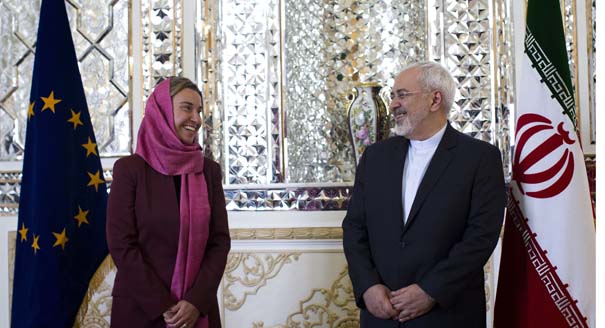
In a similar fashion, the EU will have to broaden its overall policy towards Iran, but should work with the United States in order to maintain the transatlantic unity that proved a winning formula over the past years. As a first step, during her recent trip to Tehran shortly after the deal was signed, EU High Representative Federica Mogherini pledged to work toward a new security framework for the Persian Gulf region. For this ambitious endeavour to succeed, Europeans need strong buy-in from Washington, where in particular Iran’s regional posture – not only its hostility towards Israel, but also its obvious power play with Arab neighbours – has led to concerns about the agreement. After all, the argument goes, Tehran might use the money it will receive under the deal, both in terms of unfrozen assets and profits from increased trade, to fund its proxies in Lebanon, Iraq, Syria and Yemen. In addition, the EU’s leverage in the region is weak, which is why the transatlantic partners can only jointly weigh in on Iran, as well as on Israel and the Gulf sheikhdoms, to play more constructive roles.
The nuclear deal does not offer any solution to regional sectarian and political rivalries, nor does it do away with the fundamentally anti-U.S. and anti-Israeli tenets of Iranian foreign policy. However, now that the agreement extends the newly established lines of contact between Iran and the West far into the future, it could at least provide channels to discuss the other hot spots of the Middle East. Presenting a transatlantic initiative for regional stability in the Gulf at this early stage would show that both Europe and the United States care about the repercussions of the deal and are ready to support their traditional allies while building on the new-found co-operation with Iran, for example in the fight against the self-proclaimed Islamic State.
While the prospects of re-establishing economic, societal and possibly political ties with Iran are attractive to most Europeans, the actual implications of the deal may materialise a lot more slowly than some anticipate. It is true that European companies will be well positioned to re-enter the Iranian market, an 80-million market boasting industry and manufacturing as well as an educated middle class. However, not only may the process of actually lifting international – in particular U.S. – sanctions take longer than expected, but also the Iranian economy is marred with mismanagement and corruption.
Iran’s oil and gas sector in particular needs investment to the tune of $230-260 bn, but Western financial institutions will be most careful in financing such business given the hefty fines they received in the past for deals with the Islamic Republic. In addition, fresh money will be hard to come by now that the mere expectation of future Iranian oil exports has led to another drop in already low global oil prices.
Having shepherded the deal in close coordination with its U.S. partner, the EU should now redouble its efforts – despite all internal difficulties – to regain an active foreign policy profile in its immediate neighbourhood. Europe – the EU and its member states in particular – should fill the deal with life by leading its rigorous implementation, and at the same time going beyond the nuclear file to promote regional co-operation. From such an engagement, increased economic relations will follow more or less naturally.

Former Nonresident Fellow, Carnegie Europe
Cornelius Adebahr was a nonresident fellow at Carnegie Europe. His research focuses on foreign and security policy, in particular regarding Iran and the Persian Gulf, on European and transatlantic affairs, and on citizens’ engagement.
Recent Work
Cornelius Adebahr

Cornelius Adebahr, Barbara Mittelhammer
Carnegie does not take institutional positions on public policy issues; the views represented herein are those of the author(s) and do not necessarily reflect the views of Carnegie, its staff, or its trustees.

Radical-right parties are expected to do well in upcoming elections in four of the EU's biggest member states. If successful, they could prevent the union from addressing key challenges ahead.

Stefan Lehne

The aftermath of the Ceuta crisis shows Europe has drawn the wrong lessons. Rather than doubling down on failed migration policies, the EU needs to address the underlying roots of such episodes.

Richard Youngs

An overwhelming victory by a far-right-wing party in a small state in eastern Germany will have major repercussions for Chancellor Friedrich Merz’s coalition.

Judy Dempsey

Canadian Prime Minister Mark Carney has twice inspired praise for standing up to U.S. President Donald Trump: at the 2026 World Economic Forum in Davos and on Canada-U.S. trade negotiations. Is Carney showing a third way better than the EU has in dealing with the Trump administration?

Rym Momtaz, ed.

The EU’s responses to two recent incidents expose the gulf between European perceptions and capabilities. Unless the union can bridge that gap, it will never become a real geostrategic power.
Rym Momtaz