

Commentary
Thomas de Waal
{
  "authors": [
    "Thomas de Waal"
  ],
  "type": "commentary",
  "centerAffiliationAll": "",
  "centers": [
    "Carnegie Endowment for International Peace",
    "Carnegie Europe",
    "Carnegie Russia Eurasia Center"
  ],
  "collections": [],
  "englishNewsletterAll": "",
  "nonEnglishNewsletterAll": "",
  "primaryCenter": "Carnegie Europe",
  "programAffiliation": "",
  "programs": [],
  "projects": [
    "Eurasia in Transition"
  ],
  "regions": [
    "Caucasus",
    "Russia",
    "Georgia",
    "Eastern Europe",
    "Ukraine",
    "Western Europe"
  ],
  "topics": [
    "Security",
    "Foreign Policy"
  ]
}
Source: Getty
Many people are trying to rewrite the history of the 2008 Georgia-Russia War in the light of the Ukraine crisis. The EU’s report on the war is still a useful baseline and a reminder of how different the two conflicts are.
Six years ago, on September 30, 2009, the European Union made a bold and mostly successful attempt to deal with recent history. The report on the Georgia-Russia war of 2008—known informally as the “Tagliavini Report” after its team-leader, Swiss diplomat Heidi Tagliavini—came out little more than a year after the events themselves.
The idea of the “Report of the Independent International Fact-Finding Mission on the Conflict in Georgia,” was to separate truth from fiction in the information war which both sides had waged and in particular to explain how the conflict started.
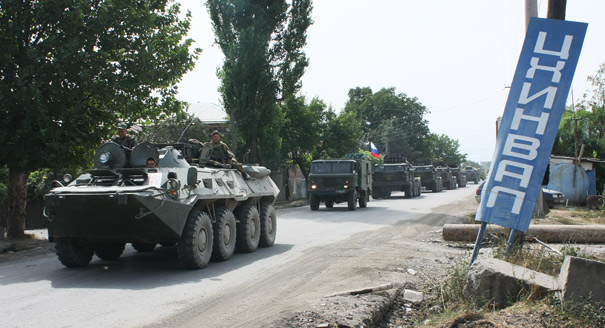
It would be wrong to simplify the report, but it did mostly achieve its goals. The report’s authors clarified an important point that anyone close to the event knew already—that the Georgian government of Mikheil Saakashvili government had indeed “fired the first shot” on the evening of August 7, 2008 when Georgian forces attacked the town of Tskhinvali and briefly captured much of South Ossetia.
Of course the report had its flaws. Its multiple authorship made for some awkward reading. It would have benefited from more information about what was happening in South Ossetia prior to the conflict. The behind-the-scenes role of the United States was signally missing—Saakashvili’s decision to attack was shaped by a perception of how the George W. Bush administration in Washington would or would not react.
But the Tagliavini Report laid down an important baseline of facts about the war and set a precedent that recent controversial events could be examined in a short time-frame and not just left to historians.
Unfortunately, those lessons are now being buried under the rubble of the new conflict in Ukraine and many people are busy rewriting the history of 2008 in the light of Ukraine.
On the anniversary of the conflict in Georgia in August this year, the Russian newspaper Moskovsky Komsomolets published three commentaries drawing direct parallels between the war in South Ossetia and the fighting in Donbas.
Mikhail Alexandrov declared, in highly provocative fashion, that Russia’s “mistake” had been in not finishing the Saakashvili government off and this had emboldened the Ukrainians in 2014:
The Saakashvili regime survived, it was not punished. What is happening in Ukraine is a direct result of the fact that in 2008 we did not pursue things in Georgia to the end. The junta in Kiev feels that it has absolute impunity, it is confident that Russia will not overthrow and punish it. That is why it is so brazen. And the West, seeing that Russia did not stick it out to the end, decided that it can do what it wants in Ukraine.
At the other extreme, many people never wanted to accept that the former Georgian government bore any culpability for the 2008 tragedy.
After what was effectively Part 2 of the 2008 conflict—the brutal Russian military intervention in Georgia and Moscow’s recognition of Abkhazia and South Ossetia as independent states—the Georgian government began to re-write the whole post-Soviet history of its conflicts with its minorities.
Georgia’s 2012 National Security Concept was much more explicit than the 2005 document it replaced in blaming Russia for the conflicts in Abkhazia and South Ossetia of the early 1990s. It talks of “political and economic instability caused by the Russian Federation.”
A new narrative emerged which, either naively or cynically, seeks to ignore the grievances that Abkhaz and Ossetians felt against Tbilisi and argues that the only problem is “Russian occupation.”
Some Georgians have now used the Ukraine crisis to gild their own version of history. In the first place of course this applies to the new governor of Odessa, Saakashvili, who is trying to start again in Ukraine and rebuild his tarnished reputation.
Yulia Latynina, a neoconservative Russian commentator, who always idealized Saakashvili, has waged a furious campaign over the years against the Tagliavini Report. She even compared it to the 1938 “Munich Agreement.”
More recently, as Heidi Tagliavini herself took on the role of negotiating between Kiev and Moscow on behalf of the OSCE, she has come under attack again for allegedly selling out Ukraine, as she had allegedly sold out Georgia. Latynina called her a “Euro-bureaucrat,” who had somehow facilitated “an open betrayal of Ukraine and the capitulation of Europe before Russia.”
If you know Switzerland’s proud tradition of fierce independence and strict diplomatic neutrality, this is absurd.
As for Tagliavini herself, I should say on a personal note that I have always admired her courage and professionalism, having seen her operate for more than 20 years, first in the OSCE mission in Grozny and then in Tbilisi and Abkhazia. During the first Chechen war of 1994-1996, she was one of a small group who at great risk helped facilitate negotiations between the Chechen rebels and the Yeltsin government. She then did a fine job as the head of the UN mission mediating between the Georgians and Abkhaz. Her report on the 2008 war was commissioned in that spirit of highly professional neutrality.
The conflicts over Crimea and Donbas, hidden by a cloud of misinformation, would greatly benefit from a new Tagliavini Report, which would highlight the many differences between Georgia of 2008 and Ukraine now. Sadly, political realities mean it is not going to be written any time soon.

Senior Fellow, Carnegie Europe
Thomas de Waal is a senior fellow at Carnegie Europe, specializing in Eastern Europe and the Caucasus.
Recent Work
Thomas de Waal
Thomas de Waal
Carnegie does not take institutional positions on public policy issues; the views represented herein are those of the author(s) and do not necessarily reflect the views of Carnegie, its staff, or its trustees.

The EU can impose sanctions but struggles to enforce them without the United States. With Washington increasingly disinterested in backing European interests, the bloc must now fend for itself.


Nicu Popescu, Tiago Antunes

Russia is testing the waters of NATO’s mutual defense clause. What do strikes in Romanian territorial waters mean for the alliance’s posture toward Moscow?

Dimitar Bechev

With its public finances in shambles, the far right polling at 35 percent ahead of the 2027 presidential election, and a growing protest movement, is France’s crisis a threat to the EU’s geopolitical awakening?

Rym Momtaz, ed.

Ahead of a tough winter for Ukraine, Donald Trump’s swing back toward Russia bodes ill. But instead of panicking, Kyiv’s European allies are focusing on action.
Rym Momtaz

Funding Ukraine remains a priority for European leaders. As Russia’s war of aggression heads into another winter, two feasible options to mobilize support for Kyiv should be fast-tracked.


Vladyslav Rashkovan, Gregory P. Wilson