

Paper
Sinan Ülgen
{
  "authors": [
    "Sinan Ülgen"
  ],
  "type": "legacyinthemedia",
  "centerAffiliationAll": "dc",
  "centers": [
    "Carnegie Endowment for International Peace",
    "Carnegie Europe"
  ],
  "collections": [
    "Turkey’s Transformation"
  ],
  "englishNewsletterAll": "ctw",
  "nonEnglishNewsletterAll": "",
  "primaryCenter": "Carnegie Europe",
  "programAffiliation": "EP",
  "programs": [
    "Europe"
  ],
  "projects": [],
  "regions": [
    "Europe",
    "Türkiye",
    "Middle East",
    "Iran"
  ],
  "topics": [
    "EU",
    "Migration"
  ]
}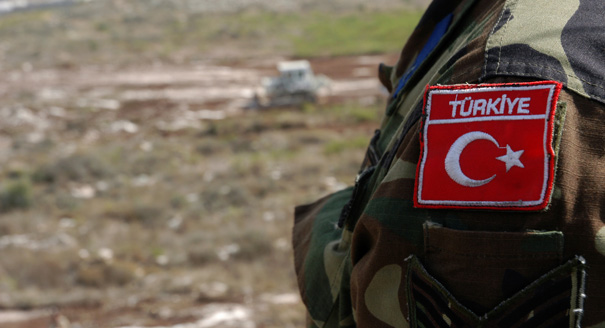
Source: Getty
The proxy war in Syria, the escalation of the Kurdish question, and the Islamic State’s terrorist activities are making Turkey more vulnerable to internal and external pressures.
Source: Cipher Brief
The recent wave of violence in Turkey can be grouped into three categories. The first is the operations led by Turkish security forces in parts of eastern and southeastern Turkey to clear neighborhoods of their PKK (The Kurdistan Worker’s Party) presence. This strategy emerged as a response to the second type of violence initiated by unilateral declarations of autonomy by PKK affiliates and their attempts to deny Turkish security forces access to these neighborhoods (by moats, barricades, booby traps etc.)—a decision which erupted after increasing hostilities between the PKK and Ankara subsequent to the Turkish general elections in June 2015.
The hostilities have resulted in a considerable number of internally displaced persons, some of whom eventually find the opportunity to return home, as the clashes usually last no more than a few weeks, but they find their former property in ruins. It can also be argued that the conflict is both inciting a feeling of rupture among the local Kurdish population, especially the youth, and diminishing the prospects for peace. Furthermore, the conflict has reached the capital in the form of high casualty suicide attacks conducted by an alleged offshoot of the PKK.The third type of violence relates to ISIS, which initially aimed to instigate Turkish-Kurdish tensions and has more recently conducted attacks against tourists. All three categories, especially attacks in Ankara and Istanbul, have instilled fear amongst the general population. This ongoing cycle of violence between Turkish security forces and the PKK has strengthened the ruling AKP’s hand by consolidating the conservative/nationalistic votes. At the same time, it has weakened the opposition pro-Kurdish HDP by forcing the party to abandon its Turkey-wide agenda and become trapped in the traditional pro-Kurdish agenda of its predecessors in the Kurdish political movement.
Both the Turkish government and the security establishment view the PKK as a more critical security threat than ISIS. ISIS is seen solely as a terrorism issue, while the PKK threat is viewed as a more significant, long-term threat. The PKK and its affiliate in Syria, known as the PYD, is gaining international legitimacy and recognition through their fight against ISIS. Ankara fears that the permanence of PYD beyond its borders would benefit the PKK both logistically and materially down the road. In the meantime, it appears that the PYD has secured the support of both the U.S.-led and the Russian-led camps in the Syrian civil war, leaving Turkey with virtually no allies, save for the Kurdish Regional Government in Iraq, to balance the PYD’s increasing momentum.
Due to the risks involved in a unilateral intervention in the Syrian civil war and the lack of international support, Turkey has been reluctant to intervene in Syria, much less fight against the PYD, which is seen by its NATO allies and the U.S. as an integral part of the anti-ISIS coalition. Yet if the PKK increasingly utilizes its connections with the PYD to conduct attacks in Turkey—by cross-border attacks or by using weapons acquired from the PYD against Turkish targets—Turkey may feel compelled to strike the PYD in Syria, which could lead to a larger scale conflict in the region.
The refugee issue presents another vulnerability for the country. For one, terrorists who have entered Turkey under the guise of refugees have been the alleged perpetrators of at least one attack (Sultanahmet, 2016) in Turkey. Though Turkish border control measures have been improving gradually, the Turkish-Syrian border and refugee influxes remain an exploitable means of smuggling terrorists, militants, and arms into the country. Moreover, once across the border, many refugees undergo only rudimentary background checks, and some remain undocumented. While this issue has not created the same widespread fear as it has in Europe, Turkey remains vulnerable due to the over 2.7 million refugees that it currently hosts.
Additionally, research conducted, especially in border towns, has underpinned a public perception that refugees may either be directly responsible for violence or potential sources of tension (most notably ethnic and sectarian). Furthermore, in addition to the direct financial burdens of hosting refugees in camps, which has cost Turkey upwards of $9 billion, a bigger concern will be the long-lasting and potentially permanent presence of refugees in Turkey and its effects on the economy, the labor market, unemployment, and inflation. Refugees have already been linked to rising rent prices and increasing rates of unemployment (though the latter may be limited to perceptions so far). Unless managed properly, they may present more economic risks to the country compared to their potential benefits. Potential underemployment, ghettoization, and disenfranchisement in the long term may compel refugees to move towards illicit economic activity or may act as a radicalizing factor.
The proxy war in Syria, the escalation of the Kurdish question, ISIS’ terrorist activities, and concerns about rising geopolitical threats have curbed investor sentiments in Turkey. Although long-term investors remain interested in Turkey, short-and-medium-term investors have started to pull back (with FDI dropping from $22 billion in 2007 to $12.5 billion in 2015). Particularly affected by the climate of insecurity has been Turkey’s tourism industry. Tourism is a crucial revenue stream for Turkey, accounting for nearly 4.5 percent of its $800 billion economy and playing a defining role in closing the multi-billion dollar current account gap. But in February 2016, foreign tourist arrivals in Turkey fell by 10.3 percent to 1.24 million, and Turkey's total tourism sector revenues are expected to fall by about 20 percent in 2016 compared to the previous year.

Senior Fellow, Carnegie Europe
Sinan Ülgen is a senior fellow at Carnegie Europe in Brussels, where his research focuses on Turkish foreign policy, transatlantic relations, international trade, economic security, and digital policy.
Recent Work
Sinan Ülgen

There is an elephant in the room when it comes to the EU’s upcoming security strategy: Donald Trump. Unless European leaders acknowledge the depth of the transatlantic crisis, true autonomy will remain out of reach.

Stefan Lehne
Europe’s industrial supply chains leave it vulnerable to global shocks. The EU needs a pragmatic green industrial strategy that balances durable partnerships and bolsters homegrown clean tech without sacrificing low-carbon ambition.


Milo McBride, Pauline Gerard

Defense tech innovations will be at the heart of Europe’s new security strategy. But so far, Brussels has been making moves without a broader plan, undermining readiness and credibility.

Raluca Csernatoni

When the U.S.-Iran memorandum of understanding was announced, the UK, France, Germany, and Italy declared their readiness to help demine the Strait of Hormuz and lift nuclear sanctions on Tehran. But does Europe need new tools to recover a diplomatic role?

Rym Momtaz, ed.
The Franco-German relationship is on the rocks again. But unlike previous moments of tension, the epochal changes on the world stage require that both step up investment in their bilateral ties.
Rym Momtaz