

Paper
Douglas H. Paal
{
  "authors": [
    "Douglas H. Paal"
  ],
  "type": "legacyinthemedia",
  "centerAffiliationAll": "dc",
  "centers": [
    "Carnegie Endowment for International Peace",
    "Carnegie China"
  ],
  "collections": [
    "China’s Foreign Relations",
    "U.S.-China Relations"
  ],
  "englishNewsletterAll": "asia",
  "nonEnglishNewsletterAll": "",
  "primaryCenter": "Carnegie China",
  "programAffiliation": "AP",
  "programs": [
    "Asia"
  ],
  "projects": [],
  "regions": [
    "North America",
    "United States",
    "East Asia",
    "China",
    "Taiwan"
  ],
  "topics": [
    "Foreign Policy",
    "Security"
  ]
}
Source: Getty
A wise course of policy for the United States, China, and Taiwan would be to focus on what can be done to maintain the high quality status quo than challenge the fundamental values of each other.
Source: Global Times
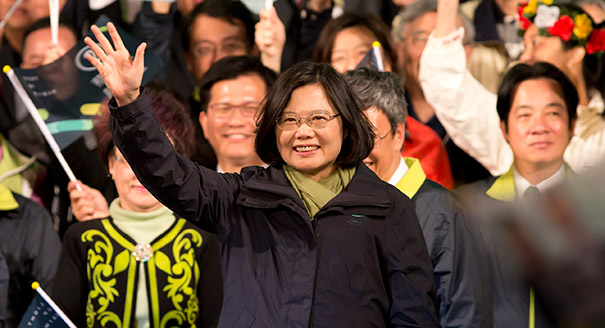
Since Taiwan's leader Tsai Ing-wen made a congratulatory phone call to US president-elect Donald Trump on December 2, a spate of commentary is discussing whether Taiwan's value to the US is growing or shrinking. Some who claim to be from the Trump camp argued that the next president doesn't see a need to be as deferential to the mainland concerning Taiwan, and the new administration will do more for the island.
Trump himself tweeted that the US sells arms to Taiwan, so why should he not talk directly to Taiwan's leader? But in a TV interview, he also argued that the "one China policy" in which relations with Taiwan are embedded should be negotiable together with other priorities such as trade. This has stirred fears in Taiwan and hopes in China that America's focus on Taiwan may be weakening in favor of other considerations.
Where is the US-Taiwan relationship headed in 2017? It's too early to try and guess the Trump administration's intentions. Its personnel selections and policies are still in flux and subject to internal debate and external criticism. In an atmosphere of uncertainty, such as today, it is my experience that the best option is to review the fundamentals of the Taipei-Beijing-Washington triangle and seek the sources of continuity and change.
Taiwan: Taiwan's recent election results have demonstrated that a majority of Taiwan residents want to enjoy the economic benefits of a reasonably close relationship with the mainland, but fear losing autonomy if the relations become too strong. Voters appear to believe that the previous administration of Ma Ying-jeou drifted too close to the mainland. The administration of Tsai Ing-wen balances between these forces by pledging to maintain the status quo while refusing to endorse explicitly or implicitly the concept of "one China."
After making the unprecedented congratulatory call to Trump, Tsai has played down its significance. Every Taiwan leadership has prioritized relations with Washington's leaders, as the sole source of outside military support for Taiwan, and that is not likely to change anytime soon. But the economic reality of Taiwan's codependency with the mainland will not change either.
China: Beijing's adherence to the goal of reunification with Taiwan appears undiminished. Over the past 20 years, China has deliberately strengthened its commercial and military capacity to influence events in Taiwan or to take action if it believes Taiwan has crossed the line toward permanent secession from the mainland. But China has also used the political foundation of the "1992 consensus" to provide a cloak of ambiguity within which to deal with Taiwan officials during the transition period toward the reunification it eventually seeks.
The new trend in cross-strait relations is becoming more negative. The phone call to Trump appears to have commenced the unwinding by Beijing of the so-called "diplomatic truce" with Taipei over competition for third countries to recognize one or the other capital. Beijing has moved cautiously, possibly testing Taipei's reaction and willingness to lose more of its "diplomatic partners." But the direction seems clear as of now. There will be a diplomatic price for what has happened. Beijing sees Taipei as trying to inch itself away from the mainland, and is sending a clear warning signal for Taipei to reconsider.
The United States: Washington is generally growing more skeptical of Beijing over a variety of issues, including intensifying strategic competition, regional frictions, and trade and investment irritants, thereby reducing tolerance to accommodate China, including over Taiwan. At the same time, both Clinton and Trump emphasized domestic priorities in their recent political campaigns, and Trump is expected to deliver on his pledge to "make America great again." How to focus on the domestic agenda while meeting challenges from China, Russia, and disorder in the Middle East is one of the major tasks of the Trump administration.
Trump's public statements tend to focus less on values than interests, continuing the pendulum swing tradition of US presidents trying to counterbalance what are seen as the excesses of their predecessors, in this case of Obama promoting liberal outcomes without follow-up, as in Libya. But no president has been able to escape the pull of both values and interests. And in this area, Taiwan is still of major concern to Americans as an embodiment of liberal values, capitalist and free market economics, and a working democratic system that stands in contrast with much of Asia. The carefully structured ambiguous US position regarding Taiwan's status is widely believed in the US to have helped preserve these valued elements of Taiwan's society, when backed by strength.
Chinese and other observers would do well to calculate the enduring respect in the US for Taiwan's system and not count on this changing, even under stress. Equally, US observers would do well to remember that China's formal commitment to reunification with Taiwan is unchanged and enjoys strong emotional support. A wise course of policy for all would be to focus on what can be done to maintain the high quality status quo than challenge the fundamental values of each other.
The mutual restraint among the three parties with regard to their maximalist goals has created space for creative relations for decades, while fully satisfying no party. The interests of the three may wax and wane, but they are not going to disappear and deserve to be treated with respect.
Distinguished Fellow, Asia Program
Paal previously served as vice chairman of JPMorgan Chase International and as unofficial U.S. representative to Taiwan as director of the American Institute in Taiwan.
Recent Work
Douglas H. Paal

Douglas H. Paal, Tong Zhao, Chen Qi, …
Carnegie does not take institutional positions on public policy issues; the views represented herein are those of the author(s) and do not necessarily reflect the views of Carnegie, its staff, or its trustees.

The EU can impose sanctions but struggles to enforce them without the United States. With Washington increasingly disinterested in backing European interests, the bloc must now fend for itself.


Nicu Popescu, Tiago Antunes

Russia is testing the waters of NATO’s mutual defense clause. What do strikes in Romanian territorial waters mean for the alliance’s posture toward Moscow?

Dimitar Bechev

With its public finances in shambles, the far right polling at 35 percent ahead of the 2027 presidential election, and a growing protest movement, is France’s crisis a threat to the EU’s geopolitical awakening?

Rym Momtaz, ed.

Ahead of a tough winter for Ukraine, Donald Trump’s swing back toward Russia bodes ill. But instead of panicking, Kyiv’s European allies are focusing on action.
Rym Momtaz

Funding Ukraine remains a priority for European leaders. As Russia’s war of aggression heads into another winter, two feasible options to mobilize support for Kyiv should be fast-tracked.


Vladyslav Rashkovan, Gregory P. Wilson