

Commentary
Judy Dempsey
{
  "authors": [
    "Judy Dempsey"
  ],
  "type": "legacyinthemedia",
  "centerAffiliationAll": "dc",
  "centers": [
    "Carnegie Endowment for International Peace",
    "Carnegie Europe"
  ],
  "collections": [
    "Brexit and UK Politics"
  ],
  "englishNewsletterAll": "ctw",
  "nonEnglishNewsletterAll": "",
  "primaryCenter": "Carnegie Europe",
  "programAffiliation": "EP",
  "programs": [
    "Europe"
  ],
  "projects": [],
  "regions": [
    "Europe",
    "Western Europe",
    "United Kingdom",
    "Iran"
  ],
  "topics": [
    "Political Reform",
    "Economy",
    "Trade"
  ]
}
Source: Getty
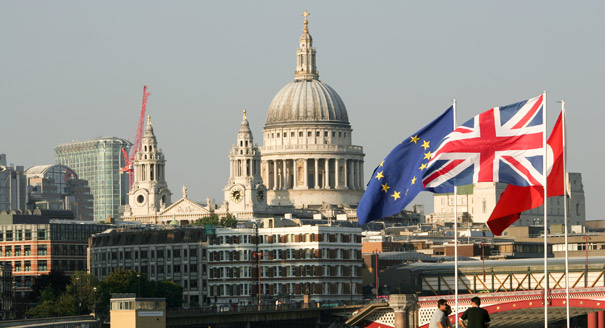
Potential difficulties might arise during the negotiations on Britain’s withdrawal from the EU, but the 27 remaining EU member states will speak with one voice.
Source: Bloomberg Markets
Carnegie Europe’s Judy Dempsey joined Bloomberg’s Guy Johnson on Bloomberg Markets: European Open to discuss the European Union’s draft guidelines for Brexit negotiations. Dempsey maintained that the 27 remaining members would be able to speak with one voice during trade talks, as they agree that a bilateral trade deal with London would not be on the table.

Nonresident Senior Fellow, Carnegie Europe
Judy Dempsey is a nonresident senior fellow at Carnegie Europe
Recent Work
Judy Dempsey
Judy Dempsey
Carnegie does not take institutional positions on public policy issues; the views represented herein are those of the author(s) and do not necessarily reflect the views of Carnegie, its staff, or its trustees.
Russia’s maximalist demands are preventing any serious attempt at ending the war in Ukraine. To make peace a realistic prospect, Putin must recognize that diplomacy is a two-way street.
Kadri Liik

Too many national interests, too many EU institutions, and too little political will are preventing Europe from acting in its own best interests.
Judy Dempsey

As the nuclear order rapidly evolves, what can Europeans and other key players do to strengthen deterrence and reduce risks?

Jamie Kwong, ed.
A sizeable funding shortfall looks increasingly likely to hit Ukraine in 2027. Can the Europeans, with their strained budgets and economies, come up with the cash without seizing frozen Russian assets?

Rym Momtaz, ed.
A blue wave has swept over the U.S. midterms, with Democrats regaining control of both houses of Congress. But Europeans hoping for a return to business as usual should think again.
Rym Momtaz