

Article
Hans-Dieter Lucas, Adam Thomson, Pierre Vimont
{
  "authors": [
    "Pierre Vimont"
  ],
  "type": "legacyinthemedia",
  "centerAffiliationAll": "dc",
  "centers": [
    "Carnegie Endowment for International Peace",
    "Carnegie Europe"
  ],
  "collections": [
    "EU Integration and Enlargement"
  ],
  "englishNewsletterAll": "ctw",
  "nonEnglishNewsletterAll": "",
  "primaryCenter": "Carnegie Europe",
  "programAffiliation": "EP",
  "programs": [
    "Europe"
  ],
  "projects": [],
  "regions": [
    "Europe",
    "Western Europe",
    "France",
    "Germany",
    "Iran"
  ],
  "topics": [
    "EU",
    "Political Reform"
  ]
}
Source: Getty
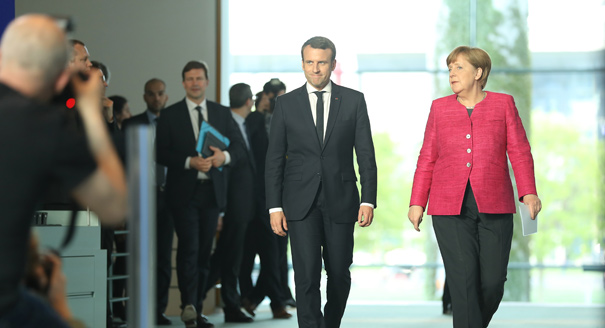
All eyes are on German Chancellor Angela Merkel and French President Emmanuel Macron to show the way to a rejuvenated Europe.
Source: Scottish Centre on European Relations
The German-French tandem is back at centre-stage in Europe. In the midst of the suddenly overwhelming wave of optimism flowing across the European Union, all eyes are set on the German and French leaders to show the way to a rejuvenated Europe.
There is no real surprise in this traditional pattern. When facing a crisis, or longing for some major breakthrough, European Member States have always looked for Berlin and Paris to deliver solutions as the two were the main influence when the whole European project was launched and have since then been the main driving force for progress. Usually this does not leave the other European partners without some degree of ambiguity where hope for success and concern over the excessive influence of these two partners mix together in an uneasy way.
Interestingly enough, both Angela Merkel and Emmanuel Macron have stepped in without much hesitation and seem to have effortlessly endorsed the responsibility of leading the drive for a more integrated Europe. For that purpose, they have gone through all the appropriate symbolic stages. Both went for an immediate first meeting in Berlin right after Emmanuel Macron's election. They then participated in a joint press conference at the end of the first European Council they both attended. They also announced a bilateral summit in Paris in mid-July with the purpose of agreeing on a roadmap for action for the months ahead.
More significantly, both sides seem genuinely focused in trying to bridge the gap on the issues where so far they have been distinctly apart. Both Merkel and Macron have been eager in the last two months to speak out openly about the topics where deep frictions exist between the two countries. But there is a clear will on behalf of both leaders to engage in a constructive dialogue without any of the hardened public stances seen in the past. Be it the consolidation of the euro zone, reciprocity in dealing with main partners in international trade, genuine advance in European security and defence or more solidarity in the face of migration pressures, the two sides look set for a down-to-earth cooperation with some reasonable prospects for progress.
Undoubtedly, there is a long road from good intentions to tangible results. Problems remain since the political attitudes which are at the heart of most of the differences observed in these areas have not shifted on either side. France has never been comfortable with an unrestricted free trade approach; its conception of a European defence insists on the need to promote more direct military operations on the ground. For its part, Germany remains sceptical when hearing about a trade policy more focused on reciprocity and fairness which, in its opinion, risks hindering some of the real achievements of Europe's trade policy. As for military interventions abroad, the German government still has to overcome the deep reservations at home for anything which looks like indulging in a ‘hard power’ Europe.
Rebuilding trust will be the name of the game between the two partners. On this matter, the ball is in the French camp as Macron wants to reform Europe with Germany's help while Merkel wants France first to reform itself. The French President is well aware of this pre-condition. He publicly acknowledged this priority for France and knows he has to deliver in the next few months significant breakthroughs on revising French labour market rules and bringing the French budget deficit under control at last. Success on these two challenges, which France has been painfully struggling with for some time, is not a foregone conclusion. Yet it is key to rekindling the trust that, to a large extent, had disappeared between the two nations. If a new spirit of mutual confidence can stem from the first reform efforts achieved by France, promoting European change will become a much easier task for both sides.
Even with a revived energy the capacity of the German-French partnership to engage the whole of the European Union into a true reform process will require a strong sense of inclusivity. There is the risk that the new European momentum triggered by Germany and France may foster divisions among member states. Some of them could feel under pressure from an ambitious integration plan they are not prepared to join, at least at this stage. Unless the two countries have in mind an untold objective of a two tier Union, France and Germany need to alleviate the growing concern over a possible break up of Europe's unity. Together they have to rekindle a true sense of solidarity among all partners. Where flexibility may be required, they have to reassure all member states that Berlin and Paris are not looking for a complete overhaul of the European Union.
More importantly, both leaders need to explain the kind of Europe they want to build up. As the debate on the future of the Union steps into areas like security and migration, where matters of sovereignty and national identity are at stake, the nature of the European project cannot only be limited any more to the single economic market, however highly sophisticated it may be. To go for a more political vision of the European construction implies at some point some real burden sharing in the migration field, a capacity to speak its own voice in trade and foreign affairs, and strategic autonomy in the security area. It implies both Berlin and Paris need to be ready to promote their conception of European integration and to convince the other Member States, notably their Eastern European partners, of the validity of their vision for the future.
The German-French tandem is definitely back into action. This should be seen as a positive development. When looking back at the EU's long and often painful road to integration, the importance of an active and sustained partnership between the two countries has been rarely contested. Today the addition of two complementary personalities, like those of Angela Merkel and Emmanuel Macron, brings together a deep sense of realism, a strong matter of fact attitude and a genuine commitment to concrete reform. It is a rare opportunity for Europe and it should not be missed.
This article was originally published by the Scottish Centre on European Relations.

Senior Fellow, Carnegie Europe
Pierre Vimont is a senior fellow at Carnegie Europe. His research focuses on the European Neighborhood Policy, transatlantic relations, and French foreign policy.
Recent Work


Hans-Dieter Lucas, Adam Thomson, Pierre Vimont
Pierre Vimont
Carnegie does not take institutional positions on public policy issues; the views represented herein are those of the author(s) and do not necessarily reflect the views of Carnegie, its staff, or its trustees.

The EU can impose sanctions but struggles to enforce them without the United States. With Washington increasingly disinterested in backing European interests, the bloc must now fend for itself.


Nicu Popescu, Tiago Antunes

Russia is testing the waters of NATO’s mutual defense clause. What do strikes in Romanian territorial waters mean for the alliance’s posture toward Moscow?

Dimitar Bechev

With its public finances in shambles, the far right polling at 35 percent ahead of the 2027 presidential election, and a growing protest movement, is France’s crisis a threat to the EU’s geopolitical awakening?

Rym Momtaz, ed.

Ahead of a tough winter for Ukraine, Donald Trump’s swing back toward Russia bodes ill. But instead of panicking, Kyiv’s European allies are focusing on action.
Rym Momtaz

Funding Ukraine remains a priority for European leaders. As Russia’s war of aggression heads into another winter, two feasible options to mobilize support for Kyiv should be fast-tracked.


Vladyslav Rashkovan, Gregory P. Wilson