

Paper
Douglas H. Paal
{
  "authors": [
    "Douglas H. Paal"
  ],
  "type": "commentary",
  "centerAffiliationAll": "dc",
  "centers": [
    "Carnegie Endowment for International Peace",
    "Carnegie China",
    "Carnegie Russia Eurasia Center"
  ],
  "collections": [],
  "englishNewsletterAll": "asia",
  "nonEnglishNewsletterAll": "",
  "primaryCenter": "Carnegie China",
  "programAffiliation": "AP",
  "programs": [
    "Asia"
  ],
  "projects": [],
  "regions": [
    "North America",
    "United States",
    "East Asia",
    "South Korea",
    "China",
    "Japan",
    "North Korea"
  ],
  "topics": [
    "Foreign Policy",
    "Nuclear Policy",
    "Arms Control",
    "Security",
    "Military"
  ]
}
Source: Getty
Thoughtful and respectful leadership, close consultation with affected parties, and a commitment of real resources to assemble necessary leverage present a better chance than anything on offer so far.
Source: South China Morning Post
Policy analysts are throwing ideas around for how to deal with North Korea. There are arguments to abandon the US alliance with South Korea and reunify the peninsula under a denuclearized regime, to acknowledge but freeze the North’s weapons programs, to persuade Beijing to solve the problem, to squeeze Chinese entities doing business with Pyongyang through secondary sanctions, or, in a contrary twist, to work with the North against China.
All these ideas and more have a major element in common. They are pipe dreams, not strategies.
North Korea has no intention to give up its nuclear weapons and the means to deliver them, unless compelled to do so. China will not sacrifice its unpleasant neighbor for fear of losing its buffer against US influence moving right up to its border with the peninsula. And the US has not assembled the leverage to change these calculations.By the same token, China’s proposal to suspend exercises in exchange for a suspension of the North’s testing is a non-starter, because it would further reduce American and South Korean leverage, and diminish the strength of the alliance precisely when it is most needed.
To change these circumstances requires a three-part strategy. The first requirement is to rebuild the leverage that has evaporated in the years since the North’s testing began. President Barack Obama did two things that showed part of the way forward. He authorized an increase in national missile defense launchers to defend the US, and made an offer of the Terminal High Altitude Area Defense (THAAD) anti-missile system to defend parts of South Korea. China was enraged by both of these actions, and is still trying to bludgeon Seoul into giving up on THAAD.
Therein lies a lesson: if you want to motivate China to move effectively against North Korea, Beijing needs to see and feel the costs to itself of not doing so.
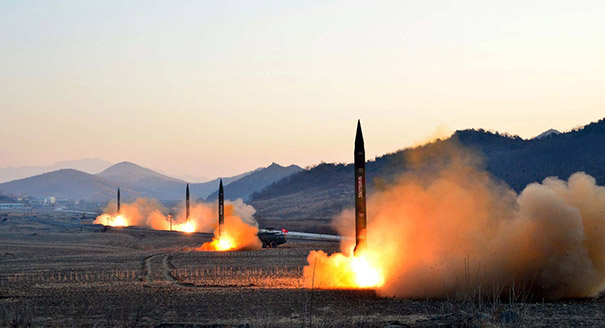
On the merits, Washington needs to energize efforts to make missile defenses more robust for South Korea, Japan and the US, to defend against North Korea’s rapidly improving offensive missile and nuclear capabilities. If that has the side benefit of motivating China while protecting these populations, so much the better.
The US should review the 1992 decision to withdraw tactical nuclear weapons from South Korea
Given the nuclear nature of the threat, moreover, the US should review the 1992 decision to withdraw tactical nuclear weapons from South Korea. When the US deployed Pershing missiles to Europe during the Reagan administration, there was a firestorm of political opposition, but in the end it forced the Soviet Union to withdraw its SS-20 missiles from Eastern Europe. The move produced the leverage needed to reduce the overall threat initiated by the other side.
The US should also re-examine its 1987 INF (Intermediate-Range Nuclear Forces ) Treaty with Moscow that banned such missiles. Russia is now reportedly violating the treaty. North Korea and China are deploying similar-range missiles that can hit American and other facilities in the Far East.
The US should consider renouncing the treaty and counterbalancing these forces.
The second element will be a diplomatic effort at outreach to North Korea. This is probably extremely distasteful after so many negotiating failures, and in the aftermath of US student Otto Warmbier’s death at the hands of the North, but is a necessary political requirement to win diplomatic support for or acquiescence to the tough measures that are also needed.
This can be done invisibly first, through intelligence agencies in the South, the US, North Korea, and perhaps China. There is a long history of effective communication in these circles. Or it can be done through an unfolding process of visible, unofficial “track 2” talks, followed by semi-official “track 1.5” conversations, leading hopefully to official talks on acceptable terms. Willingness to engage should be expressed publicly and credibly, and real opportunities seized if they emerge. US Secretary of State Rex Tillerson’s “four noes” about the future of the peninsula provide a start to assure North Korea and its neighbors that the US is not seeking unilateral advantage if real engagement ensues.
The third requirement is to initiate programs that threaten the existence of North Korea’s current system through covert or cyber means. The goal would be to change Kim Jong-un’s calculation of where the threats to his survival come from. Resources now being spent to accomplish these purposes are estimated to be relatively low (around US$3 million), nothing comparable to those deployed successfully against the Soviet presence in Eastern Europe in the 1980s. And the 1980s success was seen as a cheap victory.
North Korea presents challenges that are different from 1980s Eastern Europe, but it also has vulnerabilities that have yet to be extensively tested.
It will be a challenge for any American administration to meet the diverse needs of the new government in South Korea, those of Japan, and other parties, in executing a comprehensive strategy. But thoughtful and respectful leadership, close consultation with affected parties, and a commitment of real resources to assemble necessary leverage present a better chance than anything on offer so far.
This article was originally published in the South China Morning Post.

Distinguished Fellow, Asia Program
Paal previously served as vice chairman of JPMorgan Chase International and as unofficial U.S. representative to Taiwan as director of the American Institute in Taiwan.
Recent Work
Douglas H. Paal


Douglas H. Paal, Tong Zhao, Chen Qi, …
Carnegie does not take institutional positions on public policy issues; the views represented herein are those of the author(s) and do not necessarily reflect the views of Carnegie, its staff, or its trustees.

Ahead of a tough winter for Ukraine, Donald Trump’s swing back toward Russia bodes ill. But instead of panicking, Kyiv’s European allies are focusing on action.

Rym Momtaz

Funding Ukraine remains a priority for European leaders. As Russia’s war of aggression heads into another winter, two feasible options to mobilize support for Kyiv should be fast-tracked.


Vladyslav Rashkovan, Gregory P. Wilson

While the EU and European governments are embracing the much-lauded middle-power moment, this entails three difficult conundrums.

Richard Youngs

Europe is facing rising populism internally as well as external pressures from Russia, China, Turkey, and the United States.

Dimitar Bechev

Much has been said of the changes Brussels is trying to make to the EU enlargement process. Here’s why gradual integration might—or might not—be the answer.
Dimitar Bechev