

Commentary
Judy Dempsey
{
  "authors": [
    "Judy Dempsey"
  ],
  "type": "legacyinthemedia",
  "centerAffiliationAll": "dc",
  "centers": [
    "Carnegie Endowment for International Peace",
    "Carnegie Europe"
  ],
  "collections": [
    "Transatlantic Cooperation"
  ],
  "englishNewsletterAll": "ctw",
  "nonEnglishNewsletterAll": "",
  "primaryCenter": "Carnegie Europe",
  "programAffiliation": "EP",
  "programs": [
    "Europe"
  ],
  "projects": [],
  "regions": [
    "Europe",
    "North America",
    "United States",
    "Western Europe",
    "Iran"
  ],
  "topics": [
    "EU",
    "Security",
    "Foreign Policy"
  ]
}
Source: Getty
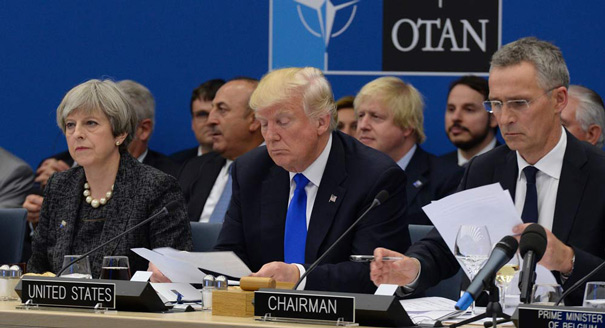
Despite his own destructive tendencies, the U.S. President may well prove to be the catalyst NATO and the EU need. The two organizations are starting to confront the reality of a post-Atlantic era.
Source: Washington Post
President Donald Trump is on a crusade to undermine the multilateral institutions that the United States and Europe built after 1945 – and there’s no question that he’s already eroding the trust between Washington and its European allies.
Yet the general outpourings of angst and indignation about the fate of the transatlantic community are obscuring an intriguing possibility: that the Trump phenomenon could actually prove to be good for the European Union and NATO. Both organizations have long acknowledged their own need for substantive reform – and then essentially waited for someone else to goad them into action. Despite his own destructive tendencies, Trump may well prove to be the catalyst they need.Until Trump came onto the scene, neither organization had to think or act strategically. The transatlantic relationship was taken for granted, as was the international rulebook. But now Trump is pushing European elites out of their comfort zone, forcing them to think through their security, defense and foreign policies.
Trade is a case in point. In recent years, the E.U. has been mired in a severe crisis of confidence. Yet Trump’s trade war threats have now achieved a remarkable and unintended result – uniting the 28 E.U.-member states around a common challenge. Every one of them knows that a trade war between the United States and Europe affects every single member state.
And that includes the right-wing governments of Poland and Hungary, which often profess sympathy with Trump due to his Euroskeptic identity politics. But just imagine what would happen to their economies if the president does go after Germany – which, he believes, is taking advantage of the tariff-free arrangements between the United States and Europe. The economies of Central and Eastern Europe have become inextricably tied to the German economy, so attacking German trade means undermining growth in Central and Eastern Europe. This is why the E.U., as a united bloc, is fighting tooth and nail to prevent a trade war by imposing its own tariffs and/or going through the World Trade Organization. No doubt Trump will try to undermine the WTO as well.
Then there is Russia. Despite Trump’s cozying up to President Vladimir Putin, not to mention their summit in Helsinki set for July 16, E.U. leaders last week agreed to extend the sanctions on Russia for another six months. Trump has so far failed to break E.U. unity over this issue. Russia is seen as a threat to many E.U. countries.
Yet for all those pluses, Europeans lack strong leaders, a strategic vision and the political will to deal with a post-Atlanticist era. Neither French President Emmanuel Macron nor German Chancellor Angela Merkel have enough support to push Europe forward. If the migration crisis could be cracked, however, Europe just might be on its way.
As for NATO, the summit looks set to be a nightmare for the member states. Trump will almost certainly be lecturing them once again about their alleged failures to meet their commitments.
One wonders whether he will be pleased when he’s informed NATO countries are spending more on defense. In 2017, European allies and Canada in 2017 spent an estimated $300 billion, up from $272 billion in 2014.
As for reaching the 2 percent of gross domestic product on their military budgets that was agreed during the 2014 summit in Wales, progress has been slow but steady. On average, Canada and the European nations have reached 1.45 percent of GDP (compared with the 3.57 percent spent by the United States).
Meanwhile, U.S. Defense Secretary Jim Mattis has been working hard behind the scenes to improve NATO’s deterrence capabilities. During last month’s meeting of NATO’s defense ministers he got them to accept the “NATO Readiness Initiative,” dubbed the “Four Thirties”.
By NATO standards, the plan is very ambitious. In 2020, NATO is supposed to have on the ready 30 mechanized battalions, 30 air squadrons and 30 combat vessels. And they all have to get their act together within 30 days or less. This is serious stuff.
NATO is doing all this because its leaders recognize they have to bolster their defenses against Russia, against hybrid warfare and the immense instability along the alliance’s southern flank. They don’t need Trump to tell them that. Furthermore, NATO is getting its act together because they know that, for the foreseeable future, NATO’s European allies have nowhere to go. The United States is their security guarantor.
E.U. Commission President Jean-Claude Juncker has been pushing for a European army, but that’s not going to happen. The only realistic alternative: plans by French President Emmanuel Macron for a European Intervention Initiative. This is a kind of coalition of the willing not hobbled by any of the E.U.’s institutions or member states. It will be tasked with quickly deploying troops in crisis scenarios near Europe’s borders.
“The goal: that our armed forces learn get to know each other and act together,” French Defense Minister Florence Parly said in a tweet. “Thanks to exchanges between staff and joint exercises, we will create a European strategic culture. We will be ready to anticipate crises and respond quickly and effectively.”
Yes, this is a modest beginning. But it’s just one more sign that the E.U. and NATO are starting to confront the reality of a post-Atlantic era. It’s long overdue.

Nonresident Senior Fellow, Carnegie Europe
Judy Dempsey is a nonresident senior fellow at Carnegie Europe
Recent Work
Judy Dempsey
Judy Dempsey
Carnegie does not take institutional positions on public policy issues; the views represented herein are those of the author(s) and do not necessarily reflect the views of Carnegie, its staff, or its trustees.

As we close out another season of Strategic Europe, it is worth taking stock of the deep shifts underway.

Rym Momtaz

The hybrid warfare landscape is evolving rapidly, leaving policymakers without clear strategies. To better inform their work in addressing emerging challenges, governments must dig deeper into the underlying dynamics at play.


Raluca Csernatoni, Alicia Wanless
The EU had to compromise to adopt a twenty-first sanctions package against Russia, exposing growing cracks in the union’s resolve. Is this latest, weaker round worth it to keep pressure on Moscow?
Rym Momtaz, ed.

Trump is distracted and Ukraine wants Europe to step up. The continent’s leaders must find their voice and assert it in talks with Russia.

Alissa de Carbonnel

Mounting economic strain and battlefield losses will not necessarily make the Kremlin less dangerous. They could instead push Moscow toward a more aggressive hybrid campaign designed to test NATO’s Eastern flank, exploit allied hesitation, and fracture European resolve.

Maksym Beznosiuk