

Commentary
Cornelius Adebahr
{
  "authors": [
    "Cornelius Adebahr"
  ],
  "type": "other",
  "centerAffiliationAll": "dc",
  "centers": [
    "Carnegie Endowment for International Peace",
    "Carnegie Europe"
  ],
  "collections": [
    "Europe’s Southern Neighborhood"
  ],
  "englishNewsletterAll": "ctw",
  "nonEnglishNewsletterAll": "",
  "primaryCenter": "Carnegie Europe",
  "programAffiliation": "EP",
  "programs": [
    "Europe"
  ],
  "projects": [],
  "regions": [
    "Middle East",
    "Europe",
    "Iran"
  ],
  "topics": [
    "EU",
    "Economy"
  ]
}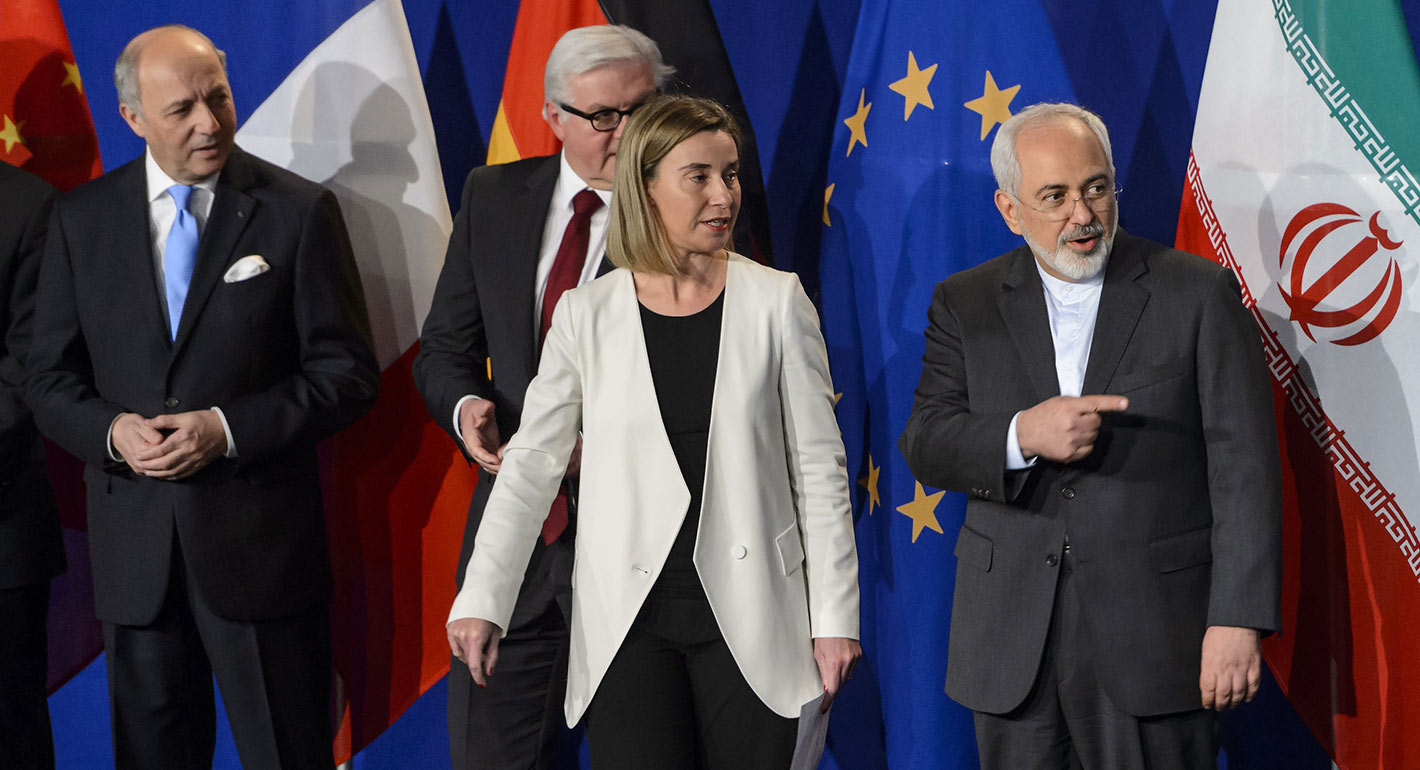
Source: Getty
Following Washington’s withdrawal from the Iran nuclear deal and the reimposition of U.S. sanctions, the prospects for EU economic relations with Tehran turned from promising to imperilled.
Source: Italian Institute for International Affairs (IAI)
In merely two years, the prospects for EU–Iran economic relations turned from promising to imperilled. The US presidential election of November 2016 dealt a first blow to the euphoria following the signing of the nuclear deal in July 2015. Already at that point, the Islamic Republic’s volatile business environment and the reluctance of European banks to provide finance had prevented many companies from following through on their deals. To this was added the increased uncertainty about whether and when the new US president would fulfil his election promises to tear the deal apart. The scale of business activity consequently was less than anticipated, or hoped for.
With Washington pulling out of the deal in May 2018 and fully re-imposing its sanctions by November, the EU’s approach aiming to salvage implementation of the nuclear deal has hit a stone wall. That is because various US sanctions now effectively prevent any economic activity by European companies in Iran. Washington’s so-called “primary sanctions” had legitimately remained under the deal, banning US companies, including banks, from engaging in nearly all nonhumanitarian trade (i.e., excluding food and drugs) with Iran and in particular in any business relation with the Islamic Revolutionary Guards Corps (IRGC). Most importantly, US “secondary sanctions” are also in force again, threatening the companies of third countries – from Europe to India to South Korea and Japan – with considerable fines or a ban on access to the US market should they fail to cease their activities in Iran. What was thus considered a “warming up” period of European companies (re-)establishing relations with their Iranian counterparts soon turned decidedly cool again.
This article was first published in the IAI Papers series in the framework of a joint research project run by the Foundation for European Progressive Studies (FEPS) and the Istituto Affari Internazionali (IAI) entitled “Europe and Iran in a Fast-changing Middle East: Confidence Building Measures, Security Dialogue and Regional Cooperation.”. FEPS and IAI retain copyright over the article.

Former Nonresident Fellow, Carnegie Europe
Cornelius Adebahr was a nonresident fellow at Carnegie Europe. His research focuses on foreign and security policy, in particular regarding Iran and the Persian Gulf, on European and transatlantic affairs, and on citizens’ engagement.
Recent Work
Cornelius Adebahr

Cornelius Adebahr, Barbara Mittelhammer
Carnegie does not take institutional positions on public policy issues; the views represented herein are those of the author(s) and do not necessarily reflect the views of Carnegie, its staff, or its trustees.

The European Commissioner for Trade is headed to China. But after President Xi’s bridge-building visit to Washington, can a more isolated EU overcome Beijing’s stranglehold on critical raw materials? Who will blink first?

Rym Momtaz, ed.

European NATO countries are wrestling with the possibility of U.S. disengagement from the alliance. With the continent’s security increasingly uncertain, governments must restore the credibility of their collective defense.



Hans-Dieter Lucas, Adam Thomson, Pierre Vimont

The domestic impacts of how long it is taking to end the war in Ukraine have pushed the French electorate to the political extremes and compromised the country’s diplomatic capacity.
Rym Momtaz

Before the next wave of EU enlargement takes place, the union needs to grapple with thorny questions of how power is distributed among its members.


Emil Sondaj Hansen, Ditte Brasso Sørensen

The new U.S.–Denmark–Greenland agreement will help Washington exert political, economic, and financial dominance under the guise of security. Yet, it acknowledged Copenhagen’s and Nuuk’s sovereignty on the island.

Marc Pierini