

Article
C. Raja Mohan, Darshana M. Baruah
{
  "authors": [
    "C. Raja Mohan"
  ],
  "type": "legacyinthemedia",
  "centerAffiliationAll": "",
  "centers": [
    "Carnegie Endowment for International Peace",
    "Carnegie India"
  ],
  "collections": [],
  "englishNewsletterAll": "",
  "nonEnglishNewsletterAll": "",
  "primaryCenter": "Carnegie India",
  "programAffiliation": "",
  "programs": [],
  "projects": [
    "Security Studies"
  ],
  "regions": [
    "United States",
    "Afghanistan",
    "India",
    "South Asia"
  ],
  "topics": [
    "Foreign Policy",
    "Security"
  ]
}
Source: Getty
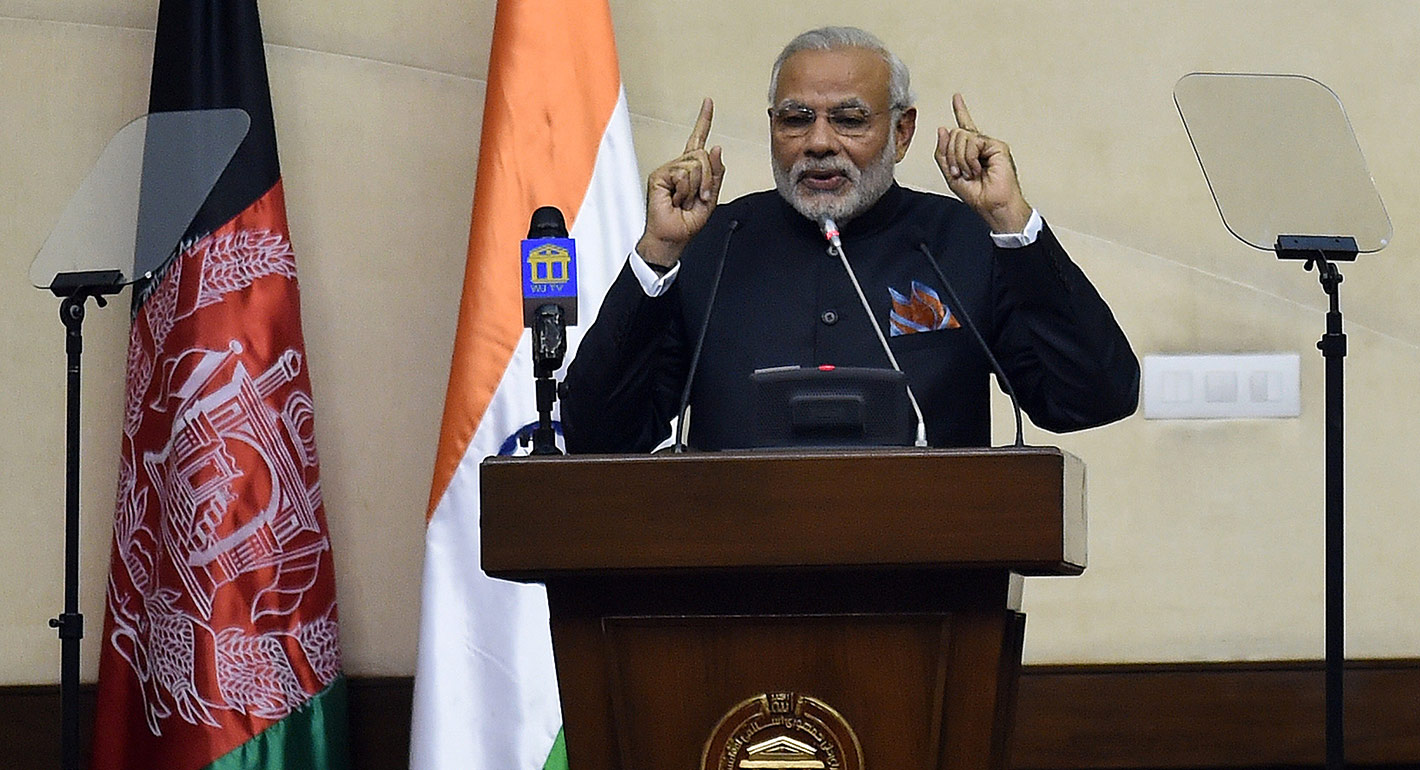
Unlike his predecessors, who asked India to downsize its presence in Afghanistan in order to placate Pakistan, U.S. President Trump is asking India to do more.
Source: Indian Express
In his outburst ridiculing the role of US friends and partners in Afghanistan last week, President Donald Trump got the history of the country and the region all wrong. The editorial board of the ‘The Wall Street Journal’, which generally supports Trump, called the comment “slander against allies” and said it cannot recall “a more absurd misstatement of history by an American President”.
That, however, is unlikely to make an impression on the US President. For, his comments are consistent with the concerns that Trump has repeatedly articulated during his presidential campaign and ever since he occupied the White House. They can be summed up in one simple question: Why is the US fighting a war thousands of miles away when the conflict in Afghanistan has far greater consequences for its neighbours?
Talking about the Indian role, Trump had said, “I get along very well with India and Prime Minister Modi. But he is constantly telling me he built a library in Afghanistan. Library! That’s, like, five hours of what we spend (in Afghanistan)”. It is no surprise that Trump’s gripe has drawn much outrage in India. Here again, facts are not really important to Trump’s argument.
When the leader of the world’s most powerful nation is afflicted by victimhood, there is not much anyone can do. The idea that other nations are “taking advantage” of America is central to Trump’s worldview. That this conviction, right or wrong, is shaping foreign and security policies of the Trump Administration must necessarily be an important part of the strategic calculus of other nations, including India.
Trump’s thinking on putting “America First” has two components. One is that America is wasting its blood and treasure on distant conflicts and that it must focus on rebuilding itself. The other is that America bears too much of the burden of securing the world. Trump now insists that America’s friends and partners must begin to pick up a fair share of the burden.
Over the last two years, Trump has repeatedly confronted long-standing allies in Europe and Asia, like Germany and Japan, with this argument. To make matters more complicated, Trump has added a trade dimension to his argument on the uneven distribution of security costs. The US President points to the massive trade surpluses enjoyed by US allies and asks why they are not doing enough for their own security. Trump thinks America is being had — twice over — on both trade and security.
India’s trade surplus might not be too large, but it nevertheless has one with the US. It stands at about $20 billion for the first 10 months of 2018. Put that together with the fact that India is next door to Afghanistan and you can see the source of Trump’s venting against India.
This is not an argument that Delhi can win by citing facts about the size of India’s assistance to Afghanistan. What Delhi needs is an understanding of Trump’s challenge to the long-standing tenets of US foreign policy and its consequences for our region.
Trump’s criticism of allies, his call for American retrenchment from costly foreign commitments, and his challenge to economic multilateralism stand in direct opposition to the dominant consensus within the American establishment. Since the end of the Second World War, bearing the burden of global leadership, sustaining a liberal trading regime and promoting democratic values has been the tripod on which American foreign policy had rested.
Trump’s unconventional arguments during the presidential campaign had alarmed the US establishment. Many, however, had hoped that he would mellow in office and veer back to the mainstream. Trump, however, has shocked the world by a decisive attempt to alter the course of America’s international relations.
He pulled out of the Trans-Pacific Partnership, renegotiated the North American Free Trade Agreement with Canada and Mexico, mounted pressure on the World Trade Organisation and unleashed a tariff war with China. Washington and much of the world had thought these measures “unthinkable”.
Trump also withdrew from the 2015 Paris agreement on limiting climate change, reneged on the nuclear deal with Iran, and discarded long-standing US policy by shifting the US embassy from Tel Aviv to Jerusalem. He has pressed US allies to raise their defence expenditure or face potential downsizing of US military commitments.
That Trump is a very different American President is not in doubt. Trump’s comments on Afghanistan must be seen as part of a sweeping attempt to overhaul American foreign policy. He may or may not succeed, but the effort to change the direction of US foreign policy is real.
When he took charge of the US two years ago, Trump’s instinct was to pull American troops out of Afghanistan. But General HR McMaster, the national security adviser, and General James Mattis, the defence secretary, persuaded Trump not to. The president signed off on a new framework to Afghanistan and South Asia in the summer of 2017. But it was quite clear that Trump had put American policy towards Afghanistan on a short leash.
The new approach was to mount military and political pressure on the Taliban and Pakistan and give a freer hand to US military forces in Afghanistan. Quite clearly, Trump is not impressed with the results so far and his patience is wearing thin.
Whatever form the retrenchment might take, there is no question that an important phase in Afghanistan is coming to an end. The US presence in Afghanistan for the last 17 years has worked well for India. Now as the US reduces its military footprint in Afghanistan, India must cope with the turbulence that is bound to follow.
In the Middle East, American retrenchment has led to growing assertion of regional powers — including Iran, Saudi Arabia, United Arab Emirates and Turkey. Much the same is likely to happen in Afghanistan. Unlike his predecessors, who asked India to downsize its presence in Afghanistan in order to placate Pakistan, Trump is asking India to do more. That’s an invitation for India to adopt a vigorous strategy in Afghanistan and take on larger responsibilities for regional security. There is no reason why India would want to turn down this invitation.
This article was originally published in the Indian Express.
Former Nonresident Senior Fellow, Carnegie India
A leading analyst of India’s foreign policy, Mohan is also an expert on South Asian security, great-power relations in Asia, and arms control.
Recent Work

C. Raja Mohan, Darshana M. Baruah


Alexander Gabuev, Paul Haenle, C. Raja Mohan, …
Carnegie does not take institutional positions on public policy issues; the views represented herein are those of the author(s) and do not necessarily reflect the views of Carnegie, its staff, or its trustees.
The EU can impose sanctions but struggles to enforce them without the United States. With Washington increasingly disinterested in backing European interests, the bloc must now fend for itself.
Nicu Popescu, Tiago Antunes
Russia is testing the waters of NATO’s mutual defense clause. What do strikes in Romanian territorial waters mean for the alliance’s posture toward Moscow?

Dimitar Bechev
With its public finances in shambles, the far right polling at 35 percent ahead of the 2027 presidential election, and a growing protest movement, is France’s crisis a threat to the EU’s geopolitical awakening?

Rym Momtaz, ed.
Ahead of a tough winter for Ukraine, Donald Trump’s swing back toward Russia bodes ill. But instead of panicking, Kyiv’s European allies are focusing on action.
Rym Momtaz
Funding Ukraine remains a priority for European leaders. As Russia’s war of aggression heads into another winter, two feasible options to mobilize support for Kyiv should be fast-tracked.

Vladyslav Rashkovan, Gregory P. Wilson