

Other
- +5
Frances Z. Brown, Zainab Usman, Erin Jones, …
{
  "authors": [
    "Ashley Quarcoo"
  ],
  "type": "questionAnswer",
  "centerAffiliationAll": "dc",
  "centers": [
    "Carnegie Endowment for International Peace",
    "Malcolm H. Kerr Carnegie Middle East Center"
  ],
  "collections": [
    "Violence and Conflict"
  ],
  "englishNewsletterAll": "democracy",
  "nonEnglishNewsletterAll": "",
  "primaryCenter": "Carnegie Endowment for International Peace",
  "programAffiliation": "DCG",
  "programs": [
    "Democracy, Conflict, and Governance"
  ],
  "projects": [],
  "regions": [
    "North Africa",
    "Sudan"
  ],
  "topics": [
    "Political Reform",
    "Democracy",
    "Security"
  ]
}
Source: Getty
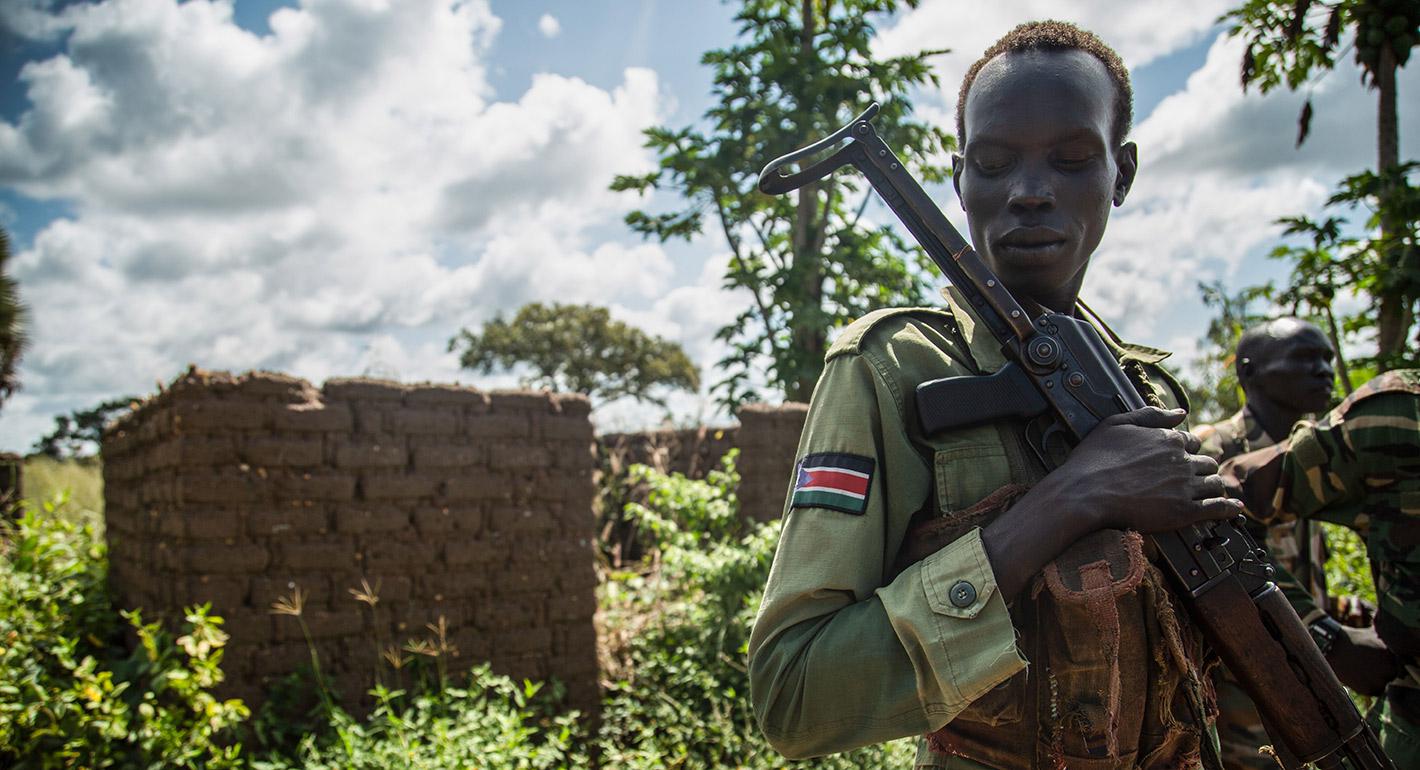
Within two years of its formation in 2011, bad blood between South Sudan’s two most powerful leaders had flared into violence. On the six-year anniversary of hostilities breaking out, a revamped peace deal looks like the country’s best chance of restoring order.
South Sudan is the world’s newest country, gaining independence in 2011 after a decades-long civil war. Yet the euphoria of that moment was short-lived, ending in December 2013 when an internal political dispute between South Sudanese President Salva Kiir and then vice president Riek Machar exploded into a lengthy ethnic conflict.
Six years later, an estimated 400,000 people have been killed and over 4 million have been forced from their homes. Today, the country is struggling to achieve its second attempt at a peace agreement. Although this deal has suffered setbacks, it is probably South Sudan’s best hope for peace.

The conflict began when a political quarrel between South Sudanese President Salva Kiir and then vice president Riek Machar led to the eruption of violence between both leaders’ presidential guards, who were each drawn from the two largest ethnic groups in South Sudan. Kiir later called the clash a thwarted coup d’état.
As the conflict dragged on, the two camps splintered into various armed rebel groups. The 2018 peace agreement now includes twelve armed and political groups as signatories.
The spark for the 2013 conflict lay in Riek Machar’s alleged plans to challenge Salva Kiir as leader of the ruling Sudan People’s Liberation Movement (SPLM). Kiir subsequently sacked Machar and his supporters from the cabinet.
Longstanding ethnic divisions within South Sudan’s security forces led to the easy fragmentation of the military on each side of this political dispute. Those from the Dinka ethnic group supported Kiir, and those from the Nuer ethnic group joined Machar. The conflict spread quickly, and ethnically motivated violence between the Dinka and the Nuer engulfed large parts of the country.
In August 2015, the Intergovernmental Authority on Development, a trade bloc made up of eight countries in the region, brokered the first peace effort, the Agreement on the Resolution of the Conflict in South Sudan. But the deal immediately ran into obstacles from both sides, particularly after Kiir issued a unilateral decree that increased the number of states in South Sudan from ten states, as laid out in the peace agreement, to twenty-eight and then thirty-two states.
Why the argument over states? The number of states, and their boundaries, would determine how land and resources would be shared out between the warring factions’ political and ethnic strongholds.
Fighting between the two rival forces resumed in June 2016, leading Machar to flee the country on foot. The fresh violence destabilized new parts of the country and further complicated the political and security arenas with new breakaway factions and armed groups.
In September 2018, both parties signed the Revitalized Agreement on the Resolution of the Conflict in South Sudan. The revamped deal seeks to offer a roadmap to resolve these thorny issues. It recommends including new entrants into the conflict in an expanded transitional government and integrating the many armed groups into a single security force. It also calls for an Independent Boundaries Committee to establish the number and boundaries of states in the leadup to the formation of the new government.
The new peace agreement’s biggest achievement is that the September 2018 ceasefire has largely held. For the first time in five years, the people of South Sudan have enjoyed a prolonged, if fragile, period of peace.
However, that peace may now be under threat. The main signatories to the agreement failed to meet a key ceasefire milestone of naming a government of national unity, missing a May deadline, as well as a second extension through November 12.
Though the parties have agreed on a further one hundred–day deferral, the delay in naming the government betrays the main parties’ lack of confidence that critical outstanding issues, including the question of the number and boundaries of states, will be resolved in their favor.
Rivalry between Sudan and Uganda has played a pivotal role in dragging out the conflict in South Sudan. Uganda has long supported Sudanese rebel groups, including the Sudan People’s Liberation Army (a guerilla movement that eventually morphed into South Sudan’s national army) during the Sudanese civil war.
Meanwhile, Sudan supported Ugandan rebel groups, including the Lord’s Resistance Army. After the 2013 conflict boiled over in South Sudan, Uganda and Sudan each picked a side. Uganda supplied troops to support Salva Kiir and the government of South Sudan, while Sudan provided limited support to Riek Machar and his faction, the Sudan People’s Liberation Movement in Opposition.
Yet today, both countries have incentives to support peace. Sudan, facing a deep economic crisis that ousted longtime ruler Omar al-Bashir, needs the transit fees it charges South Sudan for use of its oil export pipeline. In his December 2019 visit to South Sudan, newly appointed Sudanese Prime Minister Abdalla Hamdock stated that Sudan is seeking a “very strategic” relationship with its southern neighbor. Uganda, which at one point harbored over 1 million South Sudanese refugees, would prefer South Sudan to become a stable trade partner.
Both countries played an instrumental role in bringing the parties to the table to sign the refreshed 2018 peace deal and in negotiating the latest one hundred–day extension for naming a unity government. Their continued involvement as brokers of the peace agreement, though self-interested, will be crucial to the deal’s survival.
To resuscitate the shaky agreement, there must be progress on forming the transitional government by the new February 2020 deadline. Such progress would also reassure the international community that this time, the parties intend to make sure that peace sticks.
There are several more milestones that could derail peace. These include putting security agreements into action, including the integration of government and rebel forces into a single national army, and the provision of security arrangements in Juba to allow the exiled former vice president Riek Machar to return safely to South Sudan.
However, the biggest boost to solving these issues would be a breakthrough on the question of states and their boundaries. The tight one hundred-day timeline will make this no small feat for the parties and international mediation teams. The likely best option will be to outline a plan for making a final decision on states and boundaries, rather deciding what to do now. The longer that the ceasefire holds on the ground, the higher the stakes of returning to violence becomes.
Former Nonresident Scholar, Democracy, Conflict, and Governance Program
Ashley Quarcoo was a nonresident scholar with the Carnegie Endowment for International Peace’s Democracy, Conflict and Governance Program. She is also the senior director for democracy programs and pillars with the Partnership for American Democracy.
Recent Work

Frances Z. Brown, Zainab Usman, Erin Jones, …
Ashley Quarcoo, Medina Husakovic
Carnegie does not take institutional positions on public policy issues; the views represented herein are those of the author(s) and do not necessarily reflect the views of Carnegie, its staff, or its trustees.

Russia is testing the waters of NATO’s mutual defense clause. What do strikes in Romanian territorial waters mean for the alliance’s posture toward Moscow?

Dimitar Bechev

With its public finances in shambles, the far right polling at 35 percent ahead of the 2027 presidential election, and a growing protest movement, is France’s crisis a threat to the EU’s geopolitical awakening?

Rym Momtaz, ed.

Europe is facing rising populism internally as well as external pressures from Russia, China, Turkey, and the United States.
Dimitar Bechev

A notable degree of participative democracy has firmly arrived in Europe. But to have more far-reaching impact, democratic deliberation needs to move into a radically new phase.

Richard Youngs

The domestic impacts of how long it is taking to end the war in Ukraine have pushed the French electorate to the political extremes and compromised the country’s diplomatic capacity.
Rym Momtaz