

Q&A
Suzanne Maloney, Aaron David Miller, Karim Sadjadpour
{
  "authors": [
    "Karim Sadjadpour"
  ],
  "type": "questionAnswer",
  "centerAffiliationAll": "dc",
  "centers": [
    "Carnegie Endowment for International Peace",
    "Malcolm H. Kerr Carnegie Middle East Center"
  ],
  "collections": [
    "Iranian Proliferation"
  ],
  "englishNewsletterAll": "menaTransitions",
  "nonEnglishNewsletterAll": "",
  "primaryCenter": "Carnegie Endowment for International Peace",
  "programAffiliation": "MEP",
  "programs": [
    "Middle East"
  ],
  "projects": [],
  "regions": [
    "North America",
    "United States",
    "Middle East",
    "Iran",
    "Israel",
    "Eastern Europe",
    "Ukraine"
  ],
  "topics": [
    "Political Reform",
    "Economy",
    "Security",
    "Military",
    "Nuclear Policy"
  ]
}
Source: Getty
Both events also could force Washington to rethink or revive its Middle East partnerships.
This Q&A was adapted from a Carnegie live event on the global fallout of the Ukraine crisis, moderated by NPR’s Mary Louise Kelly, and has been edited for clarity and brevity. See more Carnegie events here.
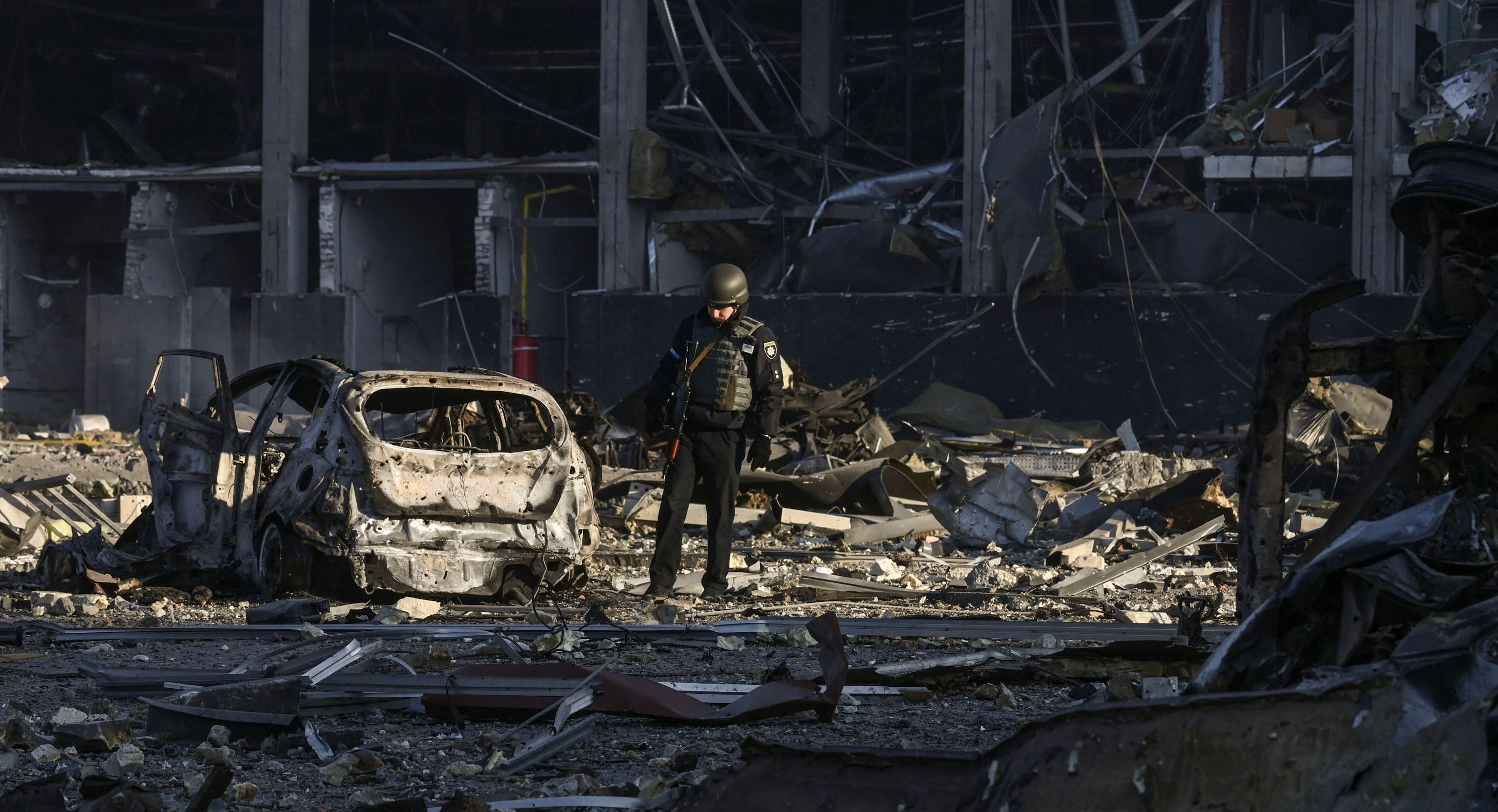
Mary Louise Kelly: You are sitting in Tehran watching Ukraine—a country that voluntarily gave up its nuclear weapons in exchange for security assurances—being pulverized. There is no appetite in the West for a no-fly zone because [Russia is] a nuclear superpower, and who wants to go in direct combat with that? What lesson do you take away if you’re Iran, and you are at a table where the West is trying to get you to give up your nuclear ambitions?
Karim Sadjadpour: You could add to Iran’s data points two leaders, Muammar Gaddafi and Saddam Hussein, who gave up their nuclear programs and were deposed by force.
I think the challenge Iran has is that it probably recognizes that its nuclear program has been totally penetrated by U.S. and Israeli intelligence. They’ve had many clandestine facilities over the years that have been either sabotaged or publicly revealed. So I’ve always thought that Iran’s aspirations are to pursue the Japan model: to be a screwdriver-turn away from having a nuclear weapon, but to not actually cross that threshold, like North Korea. I’m sure there is probably much more robust debate in Iran about what the endgame should be.
I think this Russian invasion of Ukraine will sharpen the debate in Washington about our values versus our interests in many regions of the world, but in particular the Middle East and the U.S. relationship with its long-time partners in the Persian Gulf, Saudi Arabia, and the United Arab Emirates.
After the assassination of Jamal Khashoggi a few years ago, President [Joe] Biden referred to [Saudi Arabia] as a pariah during the campaign [and said] that we should isolate it. But we’re now seeing as oil prices go up that we need Saudi Arabia. We need our major energy partners in the region.
I had a senior official in one of the Persian Gulf countries say to me last December, “If you guys are entering a new cold war. . . .” And at that time he meant a new war with China—didn’t even think about an additional aspect of that with Russia. But he said, “If you’re entering a new cold war, you need to have a big-tent strategy. You should not be pushing your partners and your allies away.”
Five or ten years ago, we may have said, “Well, it’s an empty threat that these countries would ever abandon their partnerships with the United States and tilt toward Beijing and Moscow,” but nowadays, it’s not as black and white as it was before. China can offer them 5G technology, things that we haven’t been able to offer them yet. China offers them help on drones, which is where they’re getting hammered by Iran. There’s talk of China buying a stake in Saudi Aramco. So I think it’s really going to force a difficult debate in the United States: do we continue to emphasize our values and human rights, or do we simply need these partners more than ever?
What’s going to further amplify that debate is when and if this Iran nuclear deal is revived. And I think it is a pretty strong likelihood that it will be revived, because suddenly Iran will be getting a major cash windfall. Among the things they’re going to double down on are their regional proxies, like the Houthis in Yemen, Hezbollah in Lebanon, Shia militias in Iraq, the Assad regime [in Syria]—all of whom constitute a threat to our long-time regional partners in both the Gulf and in Israel.
Mary Louise Kelly: What about Israel? As you watch Israel trying to navigate [the Ukraine] conflict, they have a new prime minister who is giving [French President Emmanuel] Macron a run for his money and trying to be the diplomatic peacemaker-in-chief shuttling around. Hedging their bets? How would you describe where they fit in here?
Karim Sadjadpour: Israel is in a unique position because they have a close relationship with [Russian President Vladimir] Putin and [President Volodymyr] Zelensky—a Jewish leader of Ukraine—and there being a very strong Ukrainian Jewish community in Israel and a Jewish community in Ukraine. [Israeli Prime Minister Naftali Bennett] has probably been, I would argue, more effective than Macron as an intermediary. Like many countries, Israel doesn’t benefit from this war, an embargo against Russia, rising oil prices.
I would say, to the credit of Israel’s leadership and Bennett, although they do have major differences with the United States, particularly about the revival of the Iran nuclear deal, they’ve managed those differences in a way behind closed doors that has been much more effective and less partisan than Prime Minister [Benjamin] Netanyahu managed those differences.
Mary Louise Kelly: I want to talk about one character who is in the center of all this. I interviewed you a couple months ago on the two-year anniversary of the assassination of Qassem Soleimani. I was asking you who replaced him. And you said, “Well, he’s not replaceable.” You quoted something from [Henry] Kissinger. Do you remember what I’m talking about?
Karim Sadjadpour: Yes. In his memoirs years ago, [Kissinger] said before he went into government, when he was a professor at Harvard, he thought that the individual didn’t really matter in history—that nations ultimately pursue their own natural interests, regardless of who was in power. He said it was only after he served in government when he reached the opposite conclusions: that the individual actually matters profoundly in history, and individuals can really shape history.
We absolutely see that in the person of Vladimir Putin. Now, we saw that in the United States with [former president] Donald Trump. I’ve long joked with my students at Georgetown University that if I were to redo my education, I’d probably study psychology rather than political science, because certainly when it comes to the Middle East, the psychology of individual leaders and then traumatized societies has been a much better indicator of things than studying the interests of nation-states.
Watch the full event below, and see more Carnegie events here.

Senior Fellow, Middle East Program
Karim Sadjadpour is a senior fellow at the Carnegie Endowment for International Peace, where he focuses on Iran and U.S. foreign policy toward the Middle East.
Recent Work


Suzanne Maloney, Aaron David Miller, Karim Sadjadpour

Aaron David Miller, Karim Sadjadpour, Robin Wright
Carnegie does not take institutional positions on public policy issues; the views represented herein are those of the author(s) and do not necessarily reflect the views of Carnegie, its staff, or its trustees.

With its public finances in shambles, the far right polling at 35 percent ahead of the 2027 presidential election, and a growing protest movement, is France’s crisis a threat to the EU’s geopolitical awakening?

Rym Momtaz, ed.

Ahead of a tough winter for Ukraine, Donald Trump’s swing back toward Russia bodes ill. But instead of panicking, Kyiv’s European allies are focusing on action.
Rym Momtaz

Funding Ukraine remains a priority for European leaders. As Russia’s war of aggression heads into another winter, two feasible options to mobilize support for Kyiv should be fast-tracked.


Vladyslav Rashkovan, Gregory P. Wilson

While the EU and European governments are embracing the much-lauded middle-power moment, this entails three difficult conundrums.

Richard Youngs

Europe is facing rising populism internally as well as external pressures from Russia, China, Turkey, and the United States.

Dimitar Bechev