

Commentary
With its public finances in shambles, the far right polling at 35 percent ahead of the 2027 presidential election, and a growing protest movement, is France’s crisis a threat to the EU’s geopolitical awakening?
Rym Momtaz, ed.
{
  "authors": [
    "Ronald A. Klain"
  ],
  "type": "commentary",
  "centerAffiliationAll": "",
  "centers": [
    "Carnegie Endowment for International Peace"
  ],
  "collections": [],
  "englishNewsletterAll": "",
  "nonEnglishNewsletterAll": "",
  "primaryCenter": "Carnegie Endowment for International Peace",
  "programAffiliation": "",
  "programs": [],
  "projects": [],
  "regions": [
    "North America",
    "United States",
    "East Asia",
    "South Korea",
    "Oceania",
    "Australia"
  ],
  "topics": [
    "Democracy",
    "Economy",
    "Security"
  ]
}
Source: Getty
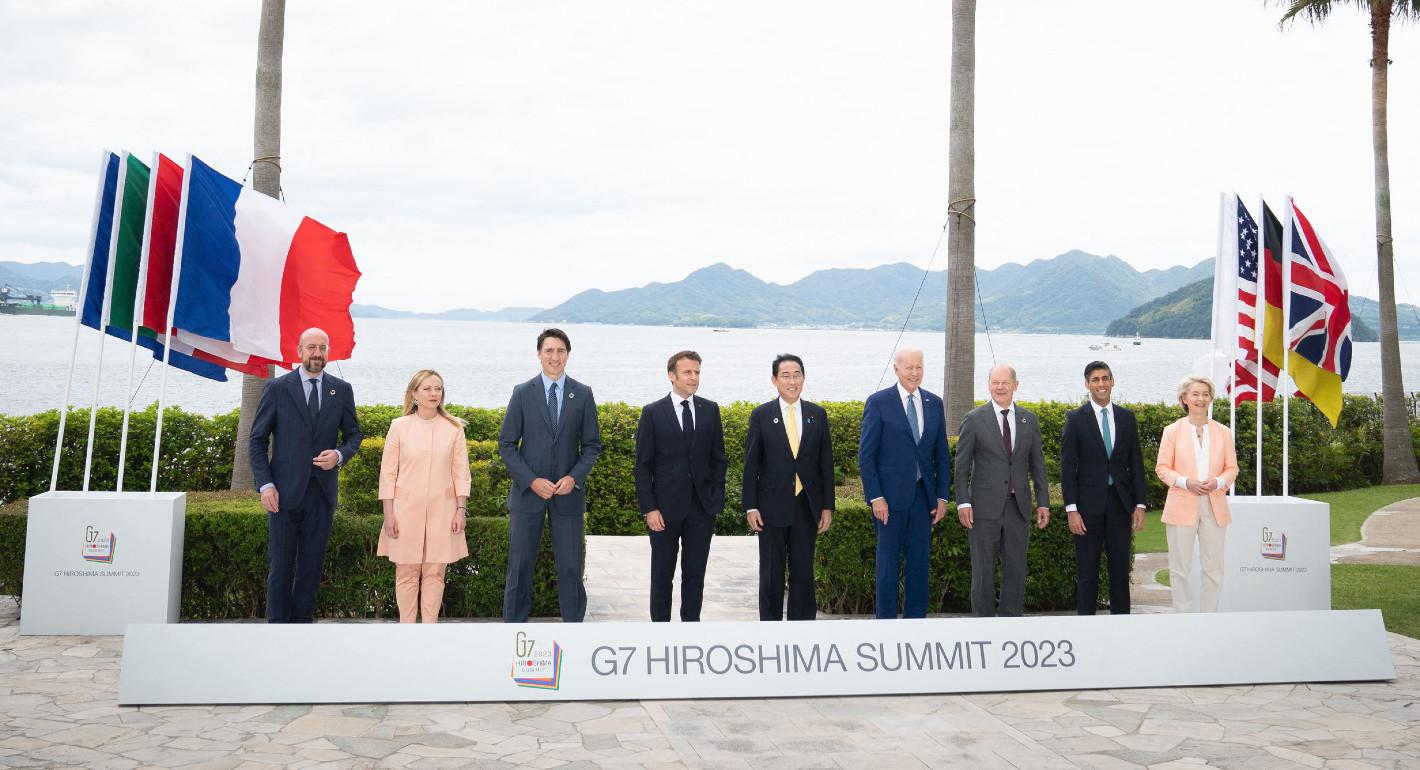
The G7 was created fifty years ago in a different geopolitical era. Now is the moment to expand the core group.
At a dangerous time in the world—with violence in the Middle East and escalating economic and security challenges to the democratic market economies from Russia and China—national alignments continue to shift. A headline in the New York Times last month proclaimed, “With Putin by His Side, Xi Outlines His Vision of a New World Order”—a disconcerting pronouncement at any time, especially now. And just a few weeks ago, the BRICS nations—Brazil, Russia, India, China, and South Africa—moved to expand their ranks by inviting Saudi Arabia and the UAE to join their group of emerging economies. In issuing the invitation, Russian President Vladimir Putin said, “I would like to assure all our colleagues that we will continue the work that we started today on expanding the influence of BRICS in the world.” Chinese President Xi Jinping said that the expansion would “inject new impetus into the BRICS cooperation mechanism and further strengthen the power of world peace and development.”
While the United States has strong—and indeed strengthening—relations with key BRICS members, such as India and Brazil, the addition of more nations to a group dominated by Russia and China raises the question: shouldn’t the democratic free-market countries try to grow their team as well? For the United States, the “core team” for more than fifty years has been the other G7 members: Canada, France, Germany, Italy, Japan, the United Kingdom. The G7 was created before the end of the Cold War and in a different geopolitical moment, and aside from an ill-fated effort to add Russia in the late 1990s, its membership has not changed. But as the world faces the economic fallout from Russia’s attack on Ukraine and rising economic and geopolitical tensions with China, and given the complexities of working within the G20, perhaps now is the time to add some new countries to the G7 core group.
Given that the group is already Eurocentric, with Japan the only Asian member, and given the challenge posed by China, adding additional nations in that region seems sensible. The two largest economies by GDP that are neither BRICS members nor existing G7 members are South Korea and Australia, both of which would be excellent additions. U.S. President Joe Biden’s administration has devoted considerable efforts to strengthening ties with both nations, as critical economic and security partners in the region.
South Korea’s innovative and growing economy is not only a global leader in semiconductors and technology products, but Seoul is also making major investments in new manufacturing facilities in the United States and Europe—signs of lasting mutual interest and alignment.
As the Ukraine war has increased ties between Russia and North Korea—and U.S. tensions with China have made South Korea’s ties with its number one trade partner more difficult—the case for having South Korea at the table as a full member of the G7 (and not just an oft-invited guest) seems especially compelling. It should have a say when the world’s major democratic free market economies plot strategy for dealing with the challenges posed by Putin and Xi—and anything that strengthens economic ties between South Korea and the existing G7 nations will create more jobs and more innovation in those nations. Likewise, as the United States works to improve relations between Japan and South Korea—overcoming their historical tensions—giving South Korean officials a seat at the G7 table on the same terms as Japan will help soften any domestic South Korean opposition to closer relations with Japan. South Korea’s economy deserves its spot in the G7, and this moment in history makes including South Korea in the group the right thing to do.
And if we are going to grow the G7, why not go to a G9, and add Australia as well? Australia’s GDP is as large as South Korea’s, and although its level of investment in the United States and Europe does not match South Korea’s surge in semiconductors, electric vehicle batteries, and auto manufacturing of recent years, it is the anchor democratic free-market country of the southern Pacific. Australia’s inclusion in the G7 would add to the group’s geographic coverage as Canberra embraces its key role vis-à-vis China—a point that U.S. leaders frequently made during the recent Australian state visit to Washington.
The G9 would have to make clear to partners in the so-called Global South that this expansion can benefit them, too, by enabling the United States and democracies with advanced economies to work together to solve global challenges that are among the concerns they share, including climate change and pandemic readiness. Adding Australia and South Korea would bring technological know-how, resources, and two additional, competent governments to the table to strengthen the G7 toolkit.
The G7 has served the United States and the world well for fifty years. But the world has changed, and so too should this elite grouping. Let’s strengthen this platform for democratic free-market nations by adding South Korea and Australia and making it a G9.
Ronald A. Klain served as White House chief of staff from January 2021 to February 2023. He is now a partner at the law firm of O’Melveny & Myers LLP and a nonresident scholar at the Carnegie Endowment for International Peace. The views expressed here are solely his own and not necessarily shared by his firm or CEIP.
Ronald A. Klain
Carnegie does not take institutional positions on public policy issues; the views represented herein are those of the author(s) and do not necessarily reflect the views of Carnegie, its staff, or its trustees.

With its public finances in shambles, the far right polling at 35 percent ahead of the 2027 presidential election, and a growing protest movement, is France’s crisis a threat to the EU’s geopolitical awakening?

Rym Momtaz, ed.

Ahead of a tough winter for Ukraine, Donald Trump’s swing back toward Russia bodes ill. But instead of panicking, Kyiv’s European allies are focusing on action.
Rym Momtaz

While the EU and European governments are embracing the much-lauded middle-power moment, this entails three difficult conundrums.

Richard Youngs

Europe is facing rising populism internally as well as external pressures from Russia, China, Turkey, and the United States.

Dimitar Bechev

A notable degree of participative democracy has firmly arrived in Europe. But to have more far-reaching impact, democratic deliberation needs to move into a radically new phase.
Richard Youngs