• Research
  • Strategic Europe
  • About
  • Experts
Carnegie Europe logoCarnegie lettermark logo
EUUkraine
  • Donate
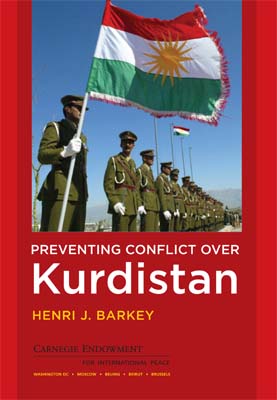
Preventing Conflict Over Kurdistan
Report

Preventing Conflict Over Kurdistan

The invasion of Iraq has surfaced long-suppressed nationalist aspirations among the Kurds. If ignored or mishandled, Kurdish aspirations have the potential to ignite violence and instability in Iraq and the region.

Link Copied
By Henri J. Barkey
Published on Feb 9, 2009

Additional Links

Full Text - English

The invasion of Iraq has surfaced long-suppressed nationalist aspirations among the Kurds, most notably the emergence of the federal Kurdistan Regional Government (KRG). If ignored or mishandled, Kurdish aspirations have the potential to ignite violence and instability in Iraq, as well as the region, at a particularly delicate time, a new report by the Carnegie Endowment concludes.

Henri Barkey calls for renewed attention to the Kurdish issue to prevent conflict and prescribes a fresh U.S. approach. The United States must move quickly—as American forces withdraw from Iraq, U.S. influence in the region will wane.  

U.S. policy recommendations:

  • Break the deadlock between the Iraqi government and the KRG over oil and gas revenue sharing and refugee resettlement. This will go a long way toward rebuilding trust and preventing Kirkuk from becoming a flashpoint—the first priority for the United States. 
  • Continue to support the federal system outlined in Iraq’s constitution and avoid any suggestion that Iraq be partitioned.
  • Solidify the dialogue between Turkey and the KRG through U.S. involvement. Warming relations between Turkey and the KRG would stabilize the region and aid in a smooth U.S. troop withdrawal.
  • Demobilize the Kurdistan Workers’ Party (PKK) and encourage its fighters to disarm or defect under a joint political and military effort coordinated by the KRG, Turkey, and the United States.
  • Work with European allies to resolve Turkey’s internal Kurdish disputes. Supporting Turkey’s counterterrorism program and its bid for EU accession, and providing development assistance in Turkey’s Kurdish regions would allow the U.S. and Europe to address problems from both sides. 

Barkey concludes:

“The United States has to take the lead, because it remains, despite its mistakes, the only power with the requisite capacities to cajole, convince, and pressure governments and groups to act. Left to their own devices, none of the parties has shown much ability to move forward, even if the right ideas and solutions are apparent, or sustain progress once achieved. The United States can approach matters with a broader outlook and vision concerning the linkages among the issues, attributes often missing in local parties.”

About the Author

Henri J. Barkey

Former Visiting Scholar, Middle East Program

Barkey served as a member of the U.S. State Department Policy Planning Staff, working primarily on issues related to the Middle East, the Eastern Mediterranean, and intelligence from 1998 to 2000.

    Recent Work

  • Article
    Winners and Losers in Turkey’s Election

      Henri J. Barkey

  • Article
    The Road to Turkey’s June Elections: Crises, Strategies, and Outcomes

      Henri J. Barkey

Henri J. Barkey
Former Visiting Scholar, Middle East Program
Henri J. Barkey
North AmericaUnited StatesMiddle EastIranTürkiyeIraqSyriaSecurityForeign Policy

Carnegie does not take institutional positions on public policy issues; the views represented herein are those of the author(s) and do not necessarily reflect the views of Carnegie, its staff, or its trustees.

More Work from Carnegie Europe

  • Commentary
    Strategic Europe
    Europe on Iran: Gone with the Wind

    Europe’s reaction to the war in Iran has been disunited and meek, a far cry from its previously leading role in diplomacy with Tehran. To avoid being condemned to the sidelines while escalation continues, Brussels needs to stand up for international law.

      Pierre Vimont

  • Commentary
    Strategic Europe
    Taking the Pulse: Can European Defense Survive the Death of FCAS?

    France and Germany’s failure to agree on the Future Combat Air System (FCAS) raises questions about European defense. Amid industrial rivalries and competing strategic cultures, what does the future of European military industrial projects look like?

      • Rym Momtaz

      Rym Momtaz, ed.

  • Commentary
    Strategic Europe
    Macron Makes France a Great Middle Power

    France has stopped clinging to notions of being a great power and is embracing the middle power moment. But Emmanuel Macron has his work cut out if he is to secure his country’s global standing before his term in office ends.

      • Rym Momtaz

      Rym Momtaz

  • Commentary
    How Can Europe Renew a Stalled Enlargement Process?

    Despite offering security benefits to candidates and the EU alike, the enlargement agenda appears stalled. Why is progress not being made, and is it time for Europe to rethink its approach?

      Sylvie Goulard, Gerald Knaus

  • Turkey Erdogan Caucasus Central Asia
    Article
    How Turkey Can Help the Economies of the South Caucasus to Diversify

    Over the past two decades, regional collaboration in the South Caucasus has intensified. Turkey and the EU should establish a cooperation framework to accelerate economic development and diversification.

      • Feride Inan
      • Güven Sak
      • Berat Yücel

      Feride İnan, Güven Sak, Berat Yücel

Get more news and analysis from
Carnegie Europe
Carnegie Europe logo, white
Rue du Congrès, 151000 Brussels, Belgium
  • Research
  • Strategic Europe
  • About
  • Experts
  • Projects
  • Events
  • Contact
  • Careers
  • Privacy
  • For Media
  • Gender Equality Plan
Get more news and analysis from
Carnegie Europe
© 2026 Carnegie Endowment for International Peace. All rights reserved.