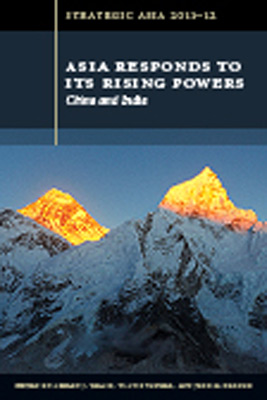
Strategic Asia 2011-2012: Asia Responds to Its Rising Powers - China and India
Asian states are adopting new strategies to preserve their national interests, prompted by the rising power of India and China. These strategies have implications for U.S. interests and leadership in the Asia-Pacific.
Co-edited and introduced by Ashley Tellis, with chapters by leading Asia specialists including Dmitri Trenin, director of the Carnegie Moscow Center, this book, the eleventh volume in NBR’s Strategic Asia series, explores how Asian states are responding to the rise of China and India and the strategies these states are pursuing to preserve their national interests. In each chapter, a leading expert investigates how a country or region perceives China’s and India's growth based on geopolitical, economic, cultural, military, and historical interactions and draws implications for U.S. interests and leadership in the Asia-Pacific.
Ashley J. Tellis, Senior Associate at the Carnegie Endowment for International Peace and Research Director of the Strategic Asia Program at NBR, served in the U.S. Department of State as senior adviser to the Undersecretary of State of Public Affairs, and previously as senior adviser to the Ambassador at the U.S. Embassy in India. He also served on the National Security Council Staff as special assistant to the President and senior director for Strategic Planning and Southwest Asia. He is the author of India’s Emerging Nuclear Posture (2001) and co-author of Interpreting China’s Grand Strategy: Past, Present, and Future (2000), as well as the co-editor of seven most recent volumes of Strategic Asia, published by NBR.
Travis Tanner is the Senior Project Director and Director of the Pyle Center for Northeast Asian Studies at the National Bureau of Asian Research.
Jessica Keough is the Publications Director at the National Bureau of Asian Research.
Carnegie does not take institutional positions on public policy issues; the views represented herein are those of the author(s) and do not necessarily reflect the views of Carnegie, its staff, or its trustees.
The closure of the Strait of Hormuz has triggered a global energy crisis, but Europe is stuck in reaction mode. Without more strategic foresight, the EU will remain dependent on fossil fuels and will never be truly secure.
Debate is heating up on how Turkey could be integrated into a common European defense framework. Commercial and industrial deals offer a better chance at alignment than sweeping political efforts.
After spending much of 2025 trying to placate Donald Trump, some European leaders are starting to change posture. But is even a hostile Washington still so important to Europe that the U.S. president’s outbursts are worth putting up with?
European leaders have now not only lost faith in Donald Trump’s U.S. presidency, but also in America’s hegemony as a whole. But short-term challenges make an immediate divorce unwise.
Countries face several hurdles in joining the EU, including the final stage of ratifying their accession treaties. Procedural reforms and substantive adjustments could help move the process forward.