

Commentary
The EU had to compromise to adopt a twenty-first sanctions package against Russia, exposing growing cracks in the union’s resolve. Is this latest, weaker round worth it to keep pressure on Moscow?
Rym Momtaz, ed.
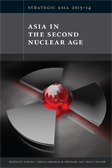
It is important to understand the role of nuclear weapons in the grand strategies of key Asian states and the impact of these capabilities—both established and latent—on regional and international stability.
Source: National Bureau of Asian Research
Co-edited and introduced by Ashley J. Tellis, the 2013-14 Strategic Asia volume examines the role of nuclear weapons in the grand strategies of key Asian states and assesses the impact of these capabilities—both established and latent—on regional and international stability. In each chapter, a leading expert explores the historical, strategic, and political factors that drive a country's calculations vis-a-vis nuclear weapons and draws implications for American interests.
Order this book, or read the introduction by Ashley J. Tellis for free.
Ashley J. Tellis is a Senior Associate at the Carnegie Endowment for International Peace and Research Director of the Strategic Asia Program at NBR, served in the U.S. Department of State as senior adviser to the Undersecretary of State of Public Affairs, and previously as senior adviser to the Ambassador at the U.S. Embassy in India. He also served on the National Security Council Staff as special assistant to the President and senior director for Strategic Planning and Southwest Asia. He is the author of India’s Emerging Nuclear Posture (2001) and co-author of Interpreting China’s Grand Strategy: Past, Present, and Future (2000), as well as the co-editor of the ten most recent volumes of Strategic Asia, published by NBR.
Abraham Denmark is Vice President for Political and Security Affairs at the National Bureau of Asian Research.
Travis Tanner was the Senior Project Director and Director of the Pyle Center for Northeast Asian Studies at the National Bureau of Asian Research.
Former Senior Fellow
Ashley J. Tellis was a senior fellow at the Carnegie Endowment for International Peace.
Abraham M. Denmark
National Bureau of Asian Research
Travis Tanner
NBR
Carnegie does not take institutional positions on public policy issues; the views represented herein are those of the author(s) and do not necessarily reflect the views of Carnegie, its staff, or its trustees.
The EU had to compromise to adopt a twenty-first sanctions package against Russia, exposing growing cracks in the union’s resolve. Is this latest, weaker round worth it to keep pressure on Moscow?

Rym Momtaz, ed.

Trump is distracted and Ukraine wants Europe to step up. The continent’s leaders must find their voice and assert it in talks with Russia.

Alissa de Carbonnel

Mounting economic strain and battlefield losses will not necessarily make the Kremlin less dangerous. They could instead push Moscow toward a more aggressive hybrid campaign designed to test NATO’s Eastern flank, exploit allied hesitation, and fracture European resolve.

Maksym Beznosiuk

Over the past ten years, NATO has held almost as many summits as it did during the entirety of the Cold War. Are they still useful, or is it time to stop holding annual meetings?
Rym Momtaz, ed.
Nearly a year and a half after Europeans leaned into sucking up to Trump, the strategy has produced some benefits when it comes to Ukraine.
Rym Momtaz