

Commentary
Judy Dempsey
{
  "authors": [
    "Judy Dempsey"
  ],
  "type": "commentary",
  "blog": "Strategic Europe",
  "centerAffiliationAll": "",
  "centers": [
    "Carnegie Endowment for International Peace",
    "Carnegie Europe"
  ],
  "collections": [],
  "englishNewsletterAll": "",
  "nonEnglishNewsletterAll": "",
  "primaryCenter": "Carnegie Europe",
  "programAffiliation": "",
  "programs": [],
  "projects": [],
  "regions": [
    "Europe",
    "Middle East"
  ],
  "topics": [
    "EU",
    "Security"
  ]
}
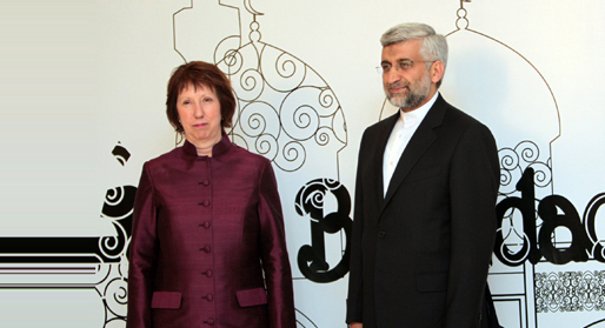
Source: Getty
Every week leading experts answer a new question from Judy Dempsey on the international challenges shaping Europe’s role in the world.
Every week leading experts answer a new question from Judy Dempsey on the international challenges shaping Europe’s role in the world.
The EU has been trying to persuade Iran to give up its nuclear program for many years. It is not a question of whether Catherine Ashton or Javier Solana is leading the team, but rather, one of whether we are framing the discussions in the right context? The Iranian leadership is worried about regime change, something propagated by Israel and the neo-cons in the U.S. Only the U.S. can deal with that issue, but the U.S. has had no direct dealings with Iran for over forty years. Despite all the problems of such a move, the EU should encourage the US to reach out directly to Tehran. As Harvard professor of diplomacy Nick Burns recently argued, how can we contemplate war with a country when we have not had diplomatic contacts for four decades? There is also a need to take into account the geopolitical situation of Iran, surrounded by nuclear weapon states and having been the object of a WMD attack by one of its neighbors in the 1990s. Regardless of the regime in Tehran, any national security advisor would have to take into account advantages of following the nuclear path. To move Iran away from this path there has to be a greater understanding and acknowledgement of Iran’s security concerns, its proud history, its legitimate claims to be a regional leader, and its political and economic concerns. Framing the discussions in this manner and offering Iran a much more attractive trade and economic package might just give the EU some prospect of success.
Ashton has already succeeded by getting talks back on the rails with Iran. That has been no easy feat.
Getting back to talks doesn't guarantee results. Iran is still enriching. Israel is still pondering taking pre-emptive action. Other flare-ups can be expected from the US election campaign. Romney is trying to use the issue against Obama for being insufficiently “tough”.
Even with international war drums in the background, Ashton has managed to get the EU on center stage as the Western policy brain on how to move the talks forward.
At the same time, the EU can't be categorized as a dove that only wants talks for the sake of talks. The EU comes to the table with the credibility of having enacted comprehensive sanctions on Iranian oil as well as insurance for shipping it (and most of these insurance instruments are conducted in the City of London, inside the EU). Thus, the clock isn't ticking just for the West. The Iranians come to the negotiation feeling the economic freeze of sanctions.
So far, Ashton’s efforts make it so that talks with Iran are increasing the strategic trust necessary for moving forward.
Catherine Ashton’s major role seems to be stringing out the talks with Iran until after the American elections without conceding on the imposition of sanctions. Both the U.S. and the Iranians seem to have a common objective in stringing out the talks. The Iranians want to continue to develop their nuclear capability while avoiding any military strikes on their facilities, all the while weakening the impending new sanctions. The Obama Administration wants to get past the November elections without being forced into another major military operation or risk a sharp increase in the price of oil. Ashton and the EU want to do all they can to avoid unilateral military action by the U.S. and Israel and want to prevent further nuclear proliferation in the region. The best that Ashton can hope for is to kick the can down the road to mid-November with the hope that a second Obama Administration will be able to contain the Iranians and the Israelis. All the parties involved seem to have an interest in her succeeding in this minimal objective. The real test will come after November.
If anyone can salvage the Iranian nuclear talks, it’s the European Union.
Europe, and Europe only, can persuade the United States to ignore Israeli requests to present Iran with demands that seem designed to be rejected. Calling upon Iran to end its uranium enrichment program, to ship abroad its 20 percent enriched uranium, and to dismantle the Qom enrichment facility is unrealistic today and may continue to be so in future. If the P5+1 insist on any of these conditions later this month in Moscow, negotiations may break down before they even begin.
The EU’s potential influence, however, does not only lie in the fact that it has Washington’s ear. It also hinges on the value of its carrot to the Iranians—the removal of sanctions. The EU could present a roadmap for the gradual dismantlement of sanctions as and when Iran moves forward on meeting Western demands half way, such as halting its enrichment at 20 percent. It is highly unlikely that Iran would accept even this scaled down Western demand without an element of reciprocity.
The EU is thus critical in framing the upcoming Moscow talks not as a take-it-or-leave-it type of process, but one of genuine negotiation. As always, the condicio sine qua non for all this to happen is that the EU stands united. Such unity is predicated on the convergence between the big three member states, but leadership and initiative on Ashton’s part may also be a key element of success.

Nonresident Senior Fellow, Carnegie Europe
Judy Dempsey is a nonresident senior fellow at Carnegie Europe
Recent Work
Judy Dempsey
Judy Dempsey
Carnegie does not take institutional positions on public policy issues; the views represented herein are those of the author(s) and do not necessarily reflect the views of Carnegie, its staff, or its trustees.

Are Germany’s economic, industrial, and political struggles becoming a liability for the EU’s ability to rise to the geopolitical moment?

Rym Momtaz, ed.

European Commission President Ursula von der Leyen is about to give her annual address on the state of the EU. Here’s what she won’t—but should—say.
Rym Momtaz

The aftermath of the Ceuta crisis shows Europe has drawn the wrong lessons. Rather than doubling down on failed migration policies, the EU needs to address the underlying roots of such episodes.

Richard Youngs

An overwhelming victory by a far-right-wing party in a small state in eastern Germany will have major repercussions for Chancellor Friedrich Merz’s coalition.
Judy Dempsey

Canadian Prime Minister Mark Carney has twice inspired praise for standing up to U.S. President Donald Trump: at the 2026 World Economic Forum in Davos and on Canada-U.S. trade negotiations. Is Carney showing a third way better than the EU has in dealing with the Trump administration?
Rym Momtaz, ed.