

Commentary
Judy Dempsey
{
  "authors": [
    "Judy Dempsey"
  ],
  "type": "commentary",
  "blog": "Strategic Europe",
  "centerAffiliationAll": "",
  "centers": [
    "Carnegie Endowment for International Peace",
    "Carnegie Europe"
  ],
  "collections": [],
  "englishNewsletterAll": "",
  "nonEnglishNewsletterAll": "",
  "primaryCenter": "Carnegie Europe",
  "programAffiliation": "",
  "programs": [],
  "projects": [],
  "regions": [
    "Europe"
  ],
  "topics": [
    "Climate Change",
    "EU"
  ]
}
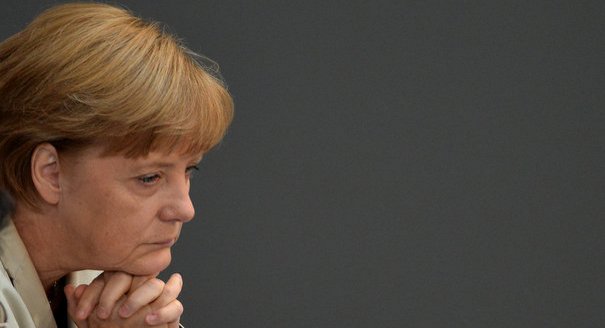
Source: Getty
Right now, the euro looks more likely to survive than it has for a number of months. Yet the price to pay may be the return of inflation to Germany, and to the rest of Europe.
Chancellor Angela Merkel got what she wanted from the Federal Constitutional Court on Wednesday. The country’s highest court ruled that Germany could go ahead and ratify the European Stability Mechanism (ESM). Once that happens, the bailout fund can begin.
"It is a good day for Germany. A good day for Europe," Mrs. Merkel told parliament.
This view was echoed across most of the political spectrum, business, and academia. The rest of Europe also sighed a huge sigh of relief. Had the court rejected the ESM, the entire eurozone would have been thrown into crisis.
But was it really a good day for the euro, or Germans’ belief in it?
From the very beginning, the German architects of the euro designed what they hoped would be a strong currency.
In return for giving up the much-loved and revered Deutsche Mark, Germany’s central bankers wanted the European Central Bank (ECB) to pursue the same strict and tight monetary policies which the Bundesbank, or central bank, had stood for since the end of the 1940s. That meant, above all, keeping inflation under control.
Low inflation became such a central part of Germany’s post-war identity in reaction to the great inflation of 1923 that wiped out the savings of millions of Germans and became one of the factors that helped Hitler’s rise to power.
This popular fear of inflation was just one reason for Merkel’s tough stance towards bailing out indebted eurozone countries. She also knows what inflation would mean for German competitiveness and for the cost of borrowing.
That is why Merkel, like most of Germany’s public, is skeptical about the bond-buying scheme that ECB President Mario Draghi has been pushing for several weeks.
It is possible the chancellor could have stopped it.
Even though the ECB is independent, it would have been difficult for Draghi to go against Berlin’s veto, given that Germany holds a 27 percent stake in the bank.
The president of the Bundesbank, Jens Weidmann, also fought long and hard to defend Germany’s monetary policy position against the ECB’s more flexible position, which Berlin fears could soften the euro as a currency.
In the end, Weidmann was outvoted, with all the other members of the ECB council approving the bond-buying scheme. And Merkel, having voiced her reservations, decided not to make an issue of it either. Allowing the ECB to buy up bonds to save the euro must have seemed politically easier than trying to push new rescue packages through the Bundestag.
Wednesday’s Constitutional Court decision did not make that any less complicated, either, by stipulating that the German commitment of a maximum of €190 billion to the ESM can only be increased with the approval of the German representative and that the German parliament be fully informed.
The Draghi scheme in combination with Germany’s court decision has already had a noticeable effect on the financial markets, pushing the euro to a four-month-high against the U.S. Dollar and bringing down the cost of borrowing for highly indebted countries like Spain, Portugal, Italy, and Greece.
But this does not resolve the problem that the ECB could end up with a mountain of very dubious bonds. Even worse, the measures could end up injecting entirely too much money into the financial system. Eventually, prices would have to go up.
The euro has not yet become a soft currency. Nor is Europe unstable.
But as a union, it is highly uncertain and highly insecure in terms of how it projects itself. The euro crisis has exposed the vulnerabilities of this group of disparate nation states, giving, for example, ample room to populists to exploit them. National leaders have either been weak or slow to deal with those fall-outs.
These were not issues that Helmut Kohl, the conservative German chancellor, envisaged when he agreed to give up the Deutschemark for the euro. He believed, or at least he hoped, that a euro currency would make Europe more integrated, stronger and anchored to a tough monetary policy, despite the huge risks.
Merkel, in turn, must be hoping that Wednesday’s ruling by the Federal Constitutional Court judges will reassure the markets and keep the eurosceptics in her party at bay.
She may have bought time. Right now, the euro looks more likely to survive than it has for a number of months. Yet the price to pay may be the return of inflation to Germany, and to the rest of Europe. Merkel had made her calculations.

Nonresident Senior Fellow, Carnegie Europe
Judy Dempsey is a nonresident senior fellow at Carnegie Europe
Recent Work
Judy Dempsey
Judy Dempsey
Carnegie does not take institutional positions on public policy issues; the views represented herein are those of the author(s) and do not necessarily reflect the views of Carnegie, its staff, or its trustees.

The aftermath of the Ceuta crisis shows Europe has drawn the wrong lessons. Rather than doubling down on failed migration policies, the EU needs to address the underlying roots of such episodes.

Richard Youngs

An overwhelming victory by a far-right-wing party in a small state in eastern Germany will have major repercussions for Chancellor Friedrich Merz’s coalition.
Judy Dempsey

Canadian Prime Minister Mark Carney has twice inspired praise for standing up to U.S. President Donald Trump: at the 2026 World Economic Forum in Davos and on Canada-U.S. trade negotiations. Is Carney showing a third way better than the EU has in dealing with the Trump administration?

Rym Momtaz, ed.

The EU’s responses to two recent incidents expose the gulf between European perceptions and capabilities. Unless the union can bridge that gap, it will never become a real geostrategic power.
Rym Momtaz

In supporting Europe’s far-right, MAGA and Russia both want the same thing: a weaker EU. Europe must defend itself without abandoning the openness these forces exploit.

Armida van Rij