

Commentary
Judy Dempsey
{
  "authors": [
    "Judy Dempsey"
  ],
  "type": "commentary",
  "blog": "Strategic Europe",
  "centerAffiliationAll": "",
  "centers": [
    "Carnegie Endowment for International Peace",
    "Carnegie Europe"
  ],
  "collections": [],
  "englishNewsletterAll": "",
  "nonEnglishNewsletterAll": "",
  "primaryCenter": "Carnegie Europe",
  "programAffiliation": "",
  "programs": [],
  "projects": [],
  "regions": [
    "Europe",
    "North America"
  ],
  "topics": [
    "EU",
    "Security"
  ]
}
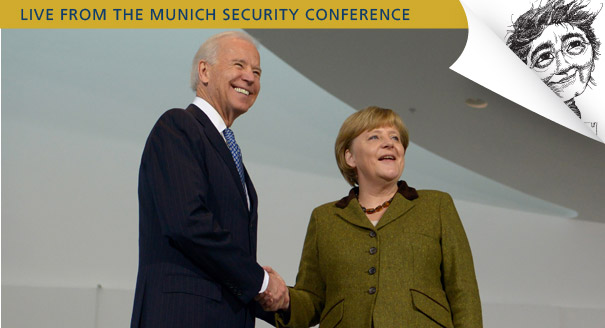
Source: Getty
Europeans worry that in security affairs, the United States will no longer be the willing partner it used to be.
Every year, the same nagging question is raised, sometimes loudly, sometimes more discreetly at the Munich Security Conference (MSC). What can be done to strengthen or even rebuild the transatlantic relationship?
The question is rarely answered.
Europeans don’t know what they want from the transatlantic relationship besides a permanent security guarantee. The Obama administration is no longer sure what it can ask of Europeans, especially when it concerns defense issues.
This year, the MSC takes place in a strange and unusual political atmosphere.
On the one side are Europeans who are hampered by falling defense expenditure. Even more importantly, they still aren’t thinking strategically about the challenges and threats facing them. Look at how badly the EU and NATO reacted to Mali.
On the other side is the United States.
The Obama administration, faced with daunting domestic problems, is tired of nagging Europe into investing more and more wisely in defense. It is tired of picking up the slack. It is tired of being taken for granted. Above all, it is tired of being the willing partner.
And that is the difference this year in Munich: while Europe remains unable, the United States is becoming unwilling.
That is why the private gatherings and bilateral meetings are important. They set the atmosphere for the public MSC debates, even if there, ministers and diplomats resort to a more diplomatic language.
Right from the beginning, these meetings show two main concerns preoccupying Europeans.
The first concerns American commitment to missile defense; the second is about U.S. engagement in Afghanistan.
Take missile defense.
There is a concern among some of Europe’s top security officials that Congress might not agree to fund its contribution of 400 million dollars for the system.
If the United States does not pay, there is no way Europeans will dig deep into their pockets. Then what will become of Europe’s ability to defend itself against a missile attacks? A U.S. official tried to convince his audience that all was well with Congress over funding missile defense. The audience was not entirely convinced.
And then there is Afghanistan. NATO is ending its combat mission there at the end of next year. It plans to establish a follow-on force to train and advise the Afghan military. In addition to the NATO training mission, the United States is planning to maintain a special presence in Afghanistan after 2014 to combat terrorism.
Europeans fear that even during the withdrawal period, the United States will either start to focus too much on this new agenda or else concentrate its troops too much in Kabul to be able to protect the European forces still out there. In other words, with the Americans speeding up their withdrawal, Europeans fear they will not be able to depend on a robust U.S. presence as they draw down themselves.
I am sure there will be other big issues cropping up during this weekend in Munich: the euro crisis, Syria, and Mali are certain to be among them. Will they show a similar widening of the transatlantic gap? This conference is bound to get very interesting.


Nonresident Senior Fellow, Carnegie Europe
Judy Dempsey is a nonresident senior fellow at Carnegie Europe
Recent Work
Judy Dempsey
Judy Dempsey
Carnegie does not take institutional positions on public policy issues; the views represented herein are those of the author(s) and do not necessarily reflect the views of Carnegie, its staff, or its trustees.
Trump is distracted and Ukraine wants Europe to step up. The continent’s leaders must find their voice and assert it in talks with Russia.

Alissa de Carbonnel

Mounting economic strain and battlefield losses will not necessarily make the Kremlin less dangerous. They could instead push Moscow toward a more aggressive hybrid campaign designed to test NATO’s Eastern flank, exploit allied hesitation, and fracture European resolve.

Maksym Beznosiuk

Over the past ten years, NATO has held almost as many summits as it did during the entirety of the Cold War. Are they still useful, or is it time to stop holding annual meetings?

Rym Momtaz, ed.
Nearly a year and a half after Europeans leaned into sucking up to Trump, the strategy has produced some benefits when it comes to Ukraine.
Rym Momtaz
Far-right leader Marine Le Pen can—and will—run in France’s next presidential election. What does the outcome of her appeal against a 2025 embezzlement conviction mean for the country’s political future?
Catherine Fieschi