

Commentary
Russia is testing the waters of NATO’s mutual defense clause. What do strikes in Romanian territorial waters mean for the alliance’s posture toward Moscow?
Dimitar Bechev
{
  "authors": [],
  "type": "commentary",
  "blog": "Strategic Europe",
  "centerAffiliationAll": "",
  "centers": [
    "Carnegie Endowment for International Peace",
    "Carnegie Europe"
  ],
  "collections": [],
  "englishNewsletterAll": "",
  "nonEnglishNewsletterAll": "",
  "primaryCenter": "Carnegie Endowment for International Peace",
  "programAffiliation": "",
  "programs": [],
  "projects": [],
  "regions": [
    "Europe",
    "Middle East"
  ],
  "topics": [
    "EU",
    "Security"
  ]
}
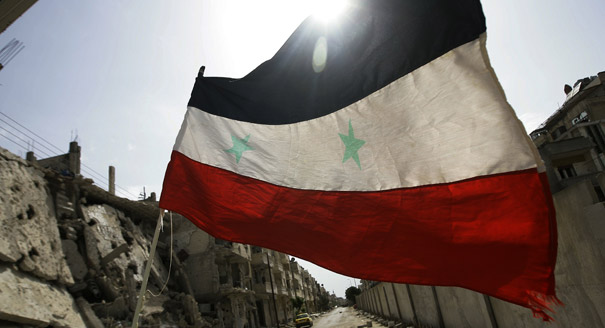
Source: Getty
Civil wars are notoriously long and bloody. While both sides in Syria still believe in victory, the international community can only try to contain the worst of the crisis.
Current international efforts to get the parties in the Syrian conflict to negotiate have to be considered futile. Not only do civil wars rarely end in negotiated settlements—fewer than 30 percent do—but the chances of such a settlement are particularly low during the first three years of the conflict.
Both Kofi Annan and Lakhdar Brahimi, respectively the previous and current UN and Arab League special envoys for Syria, were sent on what was essentially a mission impossible because both sides in the conflict still believe they can win the war. For them, the “cost” of a settlement seems higher than the cost of continuing the fighting. Sadly, time and timing are the critical factors in negotiating a successful settlement, not the cost in human or economic terms.
What can be done now to increase the likelihood of a negotiated settlement?
For a start, both sides in the conflict have their own assessment of the likelihood of victory. This perception is subjective and difficult to influence from the outside. Both sides need to become more skeptical about their chances of victory if a solid basis for negotiations is to be created: the settlement needs to be the best option for both parties.
Sanctions like those that have been imposed are one option. Although they will rarely succeed in changing a regime’s policy, they can increase its perceived cost. Similarly, the EU’s recent refusal to arm opposition forces in Syria may reduce the rebels’ subjective probability of victory and therefore contribute to the likelihood of negotiations, even if that notion seems counterintuitive.
A continuous supply of weapons to both sides—whether from Russia, Iran or the Gulf States—only maintains the parties’ perception that fighting is a better option than negotiating. This explains why, in terms of statistical probability, an external supply of weapons lengthens a civil war.
Once both sides have stopped considering victory to be the likeliest outcome, the most critical element for a successful settlement is the presence of a guarantor able to enforce the agreed framework. This element has been absent from current negotiation attempts and partly explains their futility. What is needed is a guarantor who ideally has a strong interest in peace as well as the necessary financial and military capacity to enforce it. Without such a guarantor, as well as the realization by both sides that victory is not an option, negotiations are simply useless.
If decisionmakers cannot wait for a negotiated settlement, there are two other options on the table. (They should, however, be aware that neither is likely to shorten the overall conflict—civil wars are notoriously longer than international conflicts, lasting an average of seven years.)
The first option would be to help one side win the war. That is how over 70 percent of civil wars end, but in the case of Syria it is tricky because both sides have external supporters who may cancel each other out. The help extended to the Syrian rebels would have to be more effective than simply sending weapons, as the rebels’ current disadvantage is more strategic than logistical.
Like its Libyan counterpart in 2011, the Free Syrian Army needs functioning command-and-control structures, cohesion, and tactical knowledge more than Man-portable air-defense systems (MANPADs). Sending trainers and advisers to act on the ground would not only be cost-effective but would reflect more strategic thinking. As for the political wing, the Syrian National Coalition, virtually nothing can be done to create a political consensus from the outside—except to reduce the likelihood of victory.
The second option is a full-scale military intervention. But make no mistake: while often seen as a panacea to civil conflict, this has limited impact on the conflict structure. And, given Russia’s position and likely veto, it would not have the legitimacy of a UN Security Council resolution.
This option only works when adequately manned; in a country the size of Syria this would mean a force of 320,000 troops. Otherwise it would simply make things worse. For now, those states capable of taking on such a mission are not eager to do so, and those eager to do so are not capable.
Whatever option policymakers choose, they should not forget that civil wars are by their nature difficult to solve and have a mysterious inner clock that is hard to work against. Lowering public expectations in Europe and the Arab world, while containing spillover effects on Lebanon and Jordan through humanitarian aid, is the best option for now.
Dr. Florence Gaub is a researcher and lecturer at the NATO Defense College in Rome. The views represented in this article are the author’s own and do not represent the views of the North Atlantic Treaty Organization (NATO) or the NATO Defense College.
Carnegie does not take institutional positions on public policy issues; the views represented herein are those of the author(s) and do not necessarily reflect the views of Carnegie, its staff, or its trustees.

Russia is testing the waters of NATO’s mutual defense clause. What do strikes in Romanian territorial waters mean for the alliance’s posture toward Moscow?

Dimitar Bechev

With its public finances in shambles, the far right polling at 35 percent ahead of the 2027 presidential election, and a growing protest movement, is France’s crisis a threat to the EU’s geopolitical awakening?

Rym Momtaz, ed.

Ahead of a tough winter for Ukraine, Donald Trump’s swing back toward Russia bodes ill. But instead of panicking, Kyiv’s European allies are focusing on action.
Rym Momtaz

While the EU and European governments are embracing the much-lauded middle-power moment, this entails three difficult conundrums.

Richard Youngs

Much has been said of the changes Brussels is trying to make to the EU enlargement process. Here’s why gradual integration might—or might not—be the answer.
Dimitar Bechev