

Commentary
Judy Dempsey
{
  "authors": [
    "Judy Dempsey"
  ],
  "type": "commentary",
  "blog": "Strategic Europe",
  "centerAffiliationAll": "",
  "centers": [
    "Carnegie Endowment for International Peace",
    "Carnegie Europe"
  ],
  "collections": [],
  "englishNewsletterAll": "",
  "nonEnglishNewsletterAll": "",
  "primaryCenter": "Carnegie Europe",
  "programAffiliation": "",
  "programs": [],
  "projects": [],
  "regions": [
    "Europe"
  ],
  "topics": [
    "EU"
  ]
}
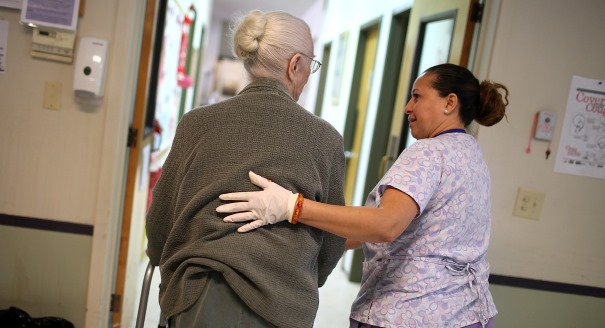
Source: Getty
The German city of Nuremberg is holding a huge fair on how to care for the old. The demographic challenge is possibly the most daunting task ahead for Germany and Europe.
For anyone wanting an inkling of the demographic problems facing Germany, the annual Altenpflege Fair is an ideal starting point.
The elderly-care exhibition, which opened Tuesday in the southern German city of Nuremberg, is huge. Six hundred exhibitors from fifteen countries have set up stands. Over 34,000 experts registered to promote their products and share experiences about how to look after old people. Above all, throughout the three days, experts have the chance to debate the demographic challenges affecting Europe’s biggest and most successful economy.
Actually, “challenges” is a misnomer. Germany, and by implication Europe, is facing a demographic time bomb. If Germany wants to retain its competitive edge, remain one of the world’s leading exporters, and continue as the bulwark of Europe’s economy, it has to find ways to deal with its aging population and falling birth rate. Otherwise, Germany, and Europe, will pay a very high price—particularly as many other European countries will, sooner or later, face the same problem.
The statistics are shocking.
A 2009 report by the Federal Statistics Office, Germany’s Population by 2060, which is used as a benchmark by healthcare experts, assesses what Germany’s population and age structure will look like by 2060. It is worth highlighting the report’s main findings.
In 2008, people under twenty years of age made up 19 percent of the population. Those aged between twenty and sixty-five comprised 61 percent. One-fifth were sixty-five or over. The number of people aged eighty or over was about 4 million, or 5 percent of the population.
By 2060, as life expectancy rises, every third person will be at least sixty-five years old. Ten million people, or about 14 percent of the population, will be aged eighty or over.
At the same time, the working-age population—those between twenty and sixty-five years of age—which encompasses about 50 million today, will shrink dramatically. By 2060, it will fall to 33 million unless there is sufficient immigration to stem that decline. There is no chance that the birth rate, currently around 1.40 per woman, could rise enough to compensate for that development.
Those with a short-term view can shrug off these figures: 2060 is a long way off.
But industry and healthcare experts, demographers, and university deans cannot afford to bury their heads in the sand. Slowly, they are trying to take stock of what they have to do now about Germany’s demographic time bomb.
Industry is facing a serious labor shortage. In 2012, according to the Cologne Institute for Economic Research, a think tank, there was already a shortage of 210,000 mathematicians, engineers, scientists, and IT specialists.
The Association of German Engineers (VDI), which represents the engineering and technology sectors, recently reported that there were 80,500 vacancies for engineers. When companies advertise for electrical or mechanical engineers, it takes an average of one hundred fourteen days to fill the position! What is more, the VDI pointed out that, in comparison with other EU countries, Germany has the largest share of older engineers.
The healthcare system for the aged is in deep trouble, too. The German Federal Association of Private Social Service Providers, a lobby group, estimates that there are at present more than 30,000 vacancies for skilled staff to look after the elderly. This shortage could rise to 220,000 by 2020, according to Bernd Meurer, the association’s president.
Care centers and associations for the elderly are doing everything possible to attract staff. But the status and pay of such work (around €8 an hour for unskilled and €12 for skilled employees) is low. Verdi, a trade union, has consistently campaigned for a minimum wage in this sector, with limited success.
Private and state-run homes for the elderly have set up training and language programs in Poland and Germany’s other eastern neighbors in a bid to attract staff and keep wages low. But, given the demographic trends across Europe, these countries will soon need trained staff to look after their own senior citizens.
At the Nuremberg fair, this year’s organizers set up a career center stand aimed at attracting young people into the profession. To succeed, say experts, the sector will have to radically bolster its pay and status.
With industry and the elderly-care sector requiring a young, skilled workforce, Germany and other EU countries need to adopt a creative and welcoming immigration and integration policy. Governments must stand up to populist, anti-immigration politicians instead of pandering to them—or they risk witnessing their countries’ economic decline.

Nonresident Senior Fellow, Carnegie Europe
Judy Dempsey is a nonresident senior fellow at Carnegie Europe
Recent Work
Judy Dempsey
Judy Dempsey

Canadian Prime Minister Mark Carney has twice inspired praise for standing up to U.S. President Donald Trump: at the 2026 World Economic Forum in Davos and on Canada-U.S. trade negotiations. Is Carney showing a third way better than the EU has in dealing with the Trump administration?

Rym Momtaz, ed.

The EU’s responses to two recent incidents expose the gulf between European perceptions and capabilities. Unless the union can bridge that gap, it will never become a real geostrategic power.
Rym Momtaz

In supporting Europe’s far-right, MAGA and Russia both want the same thing: a weaker EU. Europe must defend itself without abandoning the openness these forces exploit.

Armida van Rij

As we close out another season of Strategic Europe, it is worth taking stock of the deep shifts underway.
Rym Momtaz
The EU had to compromise to adopt a twenty-first sanctions package against Russia, exposing growing cracks in the union’s resolve. Is this latest, weaker round worth it to keep pressure on Moscow?
Rym Momtaz, ed.