

Commentary
Judy Dempsey
{
  "authors": [
    "Judy Dempsey"
  ],
  "type": "commentary",
  "blog": "Strategic Europe",
  "centerAffiliationAll": "",
  "centers": [
    "Carnegie Endowment for International Peace",
    "Carnegie Europe"
  ],
  "collections": [
    "Turkey’s Transformation"
  ],
  "englishNewsletterAll": "",
  "nonEnglishNewsletterAll": "",
  "primaryCenter": "Carnegie Europe",
  "programAffiliation": "",
  "programs": [],
  "projects": [],
  "regions": [
    "Middle East",
    "Europe",
    "Türkiye",
    "Western Europe"
  ],
  "topics": [
    "Foreign Policy",
    "EU",
    "Security",
    "Global Governance"
  ]
}
Source: Getty
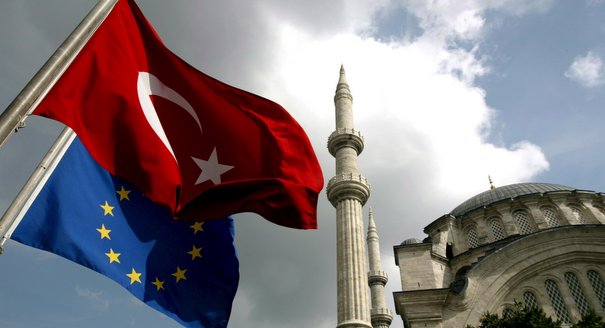
From domestic issues to foreign policy matters, Turkey deserves the EU’s attention for a number of reasons. Europe cannot afford an unstable, drifting southeastern neighbor.
There are several very good reasons why Europe should reach out to Turkey.
One of them is obvious. The mass demonstrations currently engulfing Turkey’s cities show that a large and courageous number of Turkish people are attached to the same values as Western Europeans. Turks are taking to the streets to counter what they see as an increasingly authoritarian and sectarian style of government.
This alone would deserve the EU’s support. Every day now, Turkish crowds are disproving the argument—so cherished by EU countries like Germany, France, the Netherlands, or Austria—that Turkey simply does not fit in with Europe.
But there are other motives for engagement, too.
First, promises must be kept. The EU has been stringing Turkey along for many years. The fact that France recently lifted its veto over two chapters of Turkey’s EU accession negotiations doesn’t count for much if so many other member states continue to drag their feet. This must stop if Europe wants to retain its credibility vis-à-vis the Turkish people.
Then, Prime Minister Recep Tayyip Erdoğan’s record in office deserves some credit. While it is true that he has been stalling on judicial reform and clamping down on press freedom, he also has some remarkable achievements to show.
In his ten years in power, Erdoğan has never been an easy interlocutor for European leaders. But, against all the odds, he pushed ahead with economic and political reforms—as the EU demanded. He has removed the military from the center of power and sent it back to its barracks—another EU demand. And he has given the Kurds access to Kurdish-language radio—again, another EU demand.
Erdoğan also opened up secret channels of negotiations with Abdullah Öcalan, the imprisoned leader of the Kurdistan Workers’ Party (PKK), to try to end the long and bitter Kurdish conflict. Recall that, last March, Öcalan called on PKK forces to observe a ceasefire and withdraw from Turkey. That was a huge shift in Turkish-Kurdish relations. The EU welcomed it, too.
Beyond domestic reforms, there also is a foreign-policy reason why the EU should reach out to Turkey at this particular moment. This reason is counterintuitive.
The EU needs to help Turkey because Ankara’s foreign policy is adrift in a potentially dangerous way. Given Turkey’s size and strategic importance in a highly combustible region, Europe needs to anchor Turkey to the West. That means being sincere about the country’s accession negotiations.
The most important issue in Turkey’s region is the Syrian conflict, which broke out over two years ago. Back then, Erdoğan hoped that Bashar al-Assad, the Syrian president, would introduce political reforms and engage the opposition.
Indeed, Erdoğan was pinning his hopes on his personal friendship with Assad, which in turn would vindicate his foreign-policy doctrine of “zero problems” with Turkey’s neighbors.
Assad’s refusal to heed Erdoğan’s advice was a big dent in the “zero problems” strategy, besides being a personal setback for Erdoğan. His massive disappointment explains why he then chose to give full backing to the Syrian opposition—despite widespread domestic criticism of that turnaround.
For Erdoğan’s Turkish critics, this hard line meant that Turkey would not be able to play the role of honest broker in any final settlement that might include Assad.
Erdoğan’s other ambitions, from mediating in the standoff between Iran and the West over Tehran’s nuclear program to trying to normalize relations with Armenia, did not go well, either. Above all, the idea that Turkey could become a major strategic player in the region was called into question.
To say now that Turkey got what it deserved from a misconceived and overambitious policy would be easy—but wrong. From a European perspective, Turkey remains a hugely important mediator between East and West, Christianity and Islam. If it manages to revive its historical friendship with Israel, it can also be an important partner for a wider Middle East settlement.
Europe cannot afford a Turkey that is unstable, that gives the generals the slightest opportunity to insinuate themselves back to power, or that allows its foreign policy to drift further. In turn, Turkey needs Europe because Turkey would be much stronger—strategically but also economically and politically—if it were linked institutionally to Europe.
Now is the time for Europe to talk Turkey.

Nonresident Senior Fellow, Carnegie Europe
Judy Dempsey is a nonresident senior fellow at Carnegie Europe
Recent Work
Judy Dempsey
Judy Dempsey
Carnegie does not take institutional positions on public policy issues; the views represented herein are those of the author(s) and do not necessarily reflect the views of Carnegie, its staff, or its trustees.

Are Germany’s economic, industrial, and political struggles becoming a liability for the EU’s ability to rise to the geopolitical moment?

Rym Momtaz, ed.

European Commission President Ursula von der Leyen is about to give her annual address on the state of the EU. Here’s what she won’t—but should—say.
Rym Momtaz

The aftermath of the Ceuta crisis shows Europe has drawn the wrong lessons. Rather than doubling down on failed migration policies, the EU needs to address the underlying roots of such episodes.

Richard Youngs

An overwhelming victory by a far-right-wing party in a small state in eastern Germany will have major repercussions for Chancellor Friedrich Merz’s coalition.
Judy Dempsey

Canadian Prime Minister Mark Carney has twice inspired praise for standing up to U.S. President Donald Trump: at the 2026 World Economic Forum in Davos and on Canada-U.S. trade negotiations. Is Carney showing a third way better than the EU has in dealing with the Trump administration?
Rym Momtaz, ed.