

Commentary
Judy Dempsey
{
  "authors": [
    "Judy Dempsey"
  ],
  "type": "commentary",
  "blog": "Strategic Europe",
  "centerAffiliationAll": "",
  "centers": [
    "Carnegie Endowment for International Peace",
    "Carnegie Europe"
  ],
  "collections": [],
  "englishNewsletterAll": "",
  "nonEnglishNewsletterAll": "",
  "primaryCenter": "Carnegie Europe",
  "programAffiliation": "",
  "programs": [],
  "projects": [],
  "regions": [
    "Eastern Europe",
    "Ukraine"
  ],
  "topics": [
    "Democracy",
    "EU",
    "Foreign Policy"
  ]
}
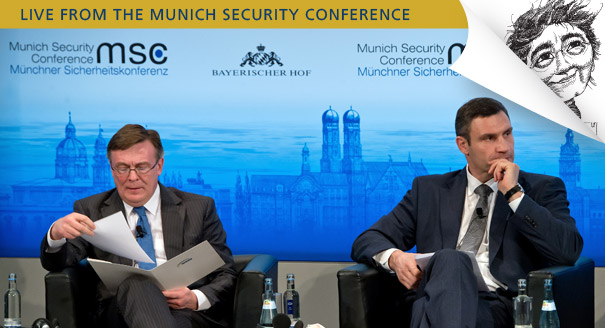
Source: Getty
Ukrainian opposition leader Vitali Klitschko makes a powerful case for a European future for his country, and calls for meaningful political and economic reforms.
Ukraine’s opposition has been criticized on many counts. That it is divided. That it is has associated with nationalist and radical groups that have sprung up over the past few weeks. That it has no program.
Vitali Klitschko (pictured, right), one of the leaders of Ukraine’s opposition, tried to put an end to these criticisms during a surprise visit to this year’s Munich Security Conference.
During a major panel discussion on the EU’s Eastern neighborhood, Klitschko, speaking in German (and later in English), made a powerful case for why his country wanted to be part of Europe. It wasn’t about access to EU funds. It was about values.
“Look at our neighbors that are members of the European Union,” the former boxing world champion told his audience. “Look at what they have done, what kind of political and economic systems they have built.” Over the past two months, Ukrainian protesters have shown their determination and courage to implement political change, Klitschko said.
“The Ukrainian people have shown that they are able to defend their European dream,” he continued. “Ukrainians come to the streets to protest with European banners because they fear European values will die in their country.”
Under such immense pressure, Ukraine’s president, Viktor Yanukovych, has now met some of the opposition’s demands. But Klitschko believes that the government has not gone far enough. He wants over 300 prisoners to be released and the whereabouts of 27 people who are reported missing to be made public. He also wants a return to Ukraine’s 2004 constitution, which gave the president far fewer powers, and for the country’s next presidential election, scheduled for 2015, to be brought forward.
Were early elections to take place, the opposition would have to put aside its differences and agree on one candidate to stand against Yanukovych. The opposition leaders would have to convince the public that they have a long-term political and economic program for Ukraine. More importantly, they would have to show that they can rein in extremists whose violence and antidemocratic slogans discredit genuine democrats, playing into the hands of Yanukovych.
Turning to the president’s record, Klitschko told conference participants that the government had made too many promises of political and economic reform in the past, with little in the way of results. “Yanukovych can’t just exert pressure and fear among the opposition,” Klitscho said. Indeed, one of the biggest changes since the pro-Western Orange Revolution of 2004 has been precisely that: the Ukrainian people have lost their fear.
Leonid Kozhara, Ukraine’s foreign minister, who was also on the panel at the summit in Munich (pictured, left), tried to persuade his audience that the government had already gone a long way to meet the opposition’s demands. Now, he said, it was the turn of the opposition to share “responsibility.”
“We are ready to talk about constitutional reform and an amnesty,” Kozhara said. “We did everything. I support peaceful protesters on the Maidan [Kiev’s Independence Square]. I don’t support extremists. I don’t support Nazi-like slogans. There are extremists among the opposition who are attacking the police with Molotov cocktails.”
Klitschko replied: “We want to implement European reforms that we have talked about for years. But the president stopped them and said he had another way. Nobody explained why.”
Klitschko insisted that the conflict was about demonstrating for European integration. “For almost two months, day and night, people have stayed on the streets. People are saying they have had enough with this system. They do not see the future.”
It is very hard to know how the crisis in Ukraine will be resolved. “The solution has to be found by Ukrainians themselves, with some friends,” Klitschko said. “We want to lower the temperature because, if not, it could trigger a crisis in the whole region. This is something that we want to avoid.”
As the panel came to an end, Klitschko received a long applause from an audience impressed with how he made the case for the demonstrators. But those who accompanied Klitschko to Munich recognize that the support he received in the Bavarian capital will not end the standoff in Ukraine.

Nonresident Senior Fellow, Carnegie Europe
Judy Dempsey is a nonresident senior fellow at Carnegie Europe
Recent Work
Judy Dempsey
Judy Dempsey
Carnegie does not take institutional positions on public policy issues; the views represented herein are those of the author(s) and do not necessarily reflect the views of Carnegie, its staff, or its trustees.

Before the next wave of EU enlargement takes place, the union needs to grapple with thorny questions of how power is distributed among its members.


Emil Sondaj Hansen, Ditte Brasso Sørensen

A summer of escalation in the Black Sea has hurt Ukraine economically and is exacerbating world food security. A truce is needed—as is a broader reframing of Europe’s Ukraine strategy.

Thomas de Waal

Are Germany’s economic, industrial, and political struggles becoming a liability for the EU’s ability to rise to the geopolitical moment?

Rym Momtaz, ed.

European Commission President Ursula von der Leyen is about to give her annual address on the state of the EU. Here’s what she won’t—but should—say.
Rym Momtaz

The aftermath of the Ceuta crisis shows Europe has drawn the wrong lessons. Rather than doubling down on failed migration policies, the EU needs to address the underlying roots of such episodes.

Richard Youngs