

Commentary
In supporting Europe’s far-right, MAGA and Russia both want the same thing: a weaker EU. Europe must defend itself without abandoning the openness these forces exploit.
Armida van Rij
{
  "authors": [
    "Roderick Parkes"
  ],
  "type": "commentary",
  "blog": "Strategic Europe",
  "centerAffiliationAll": "",
  "centers": [
    "Carnegie Endowment for International Peace",
    "Carnegie Europe"
  ],
  "collections": [],
  "englishNewsletterAll": "",
  "nonEnglishNewsletterAll": "",
  "primaryCenter": "Carnegie Europe",
  "programAffiliation": "",
  "programs": [],
  "projects": [],
  "regions": [
    "North America",
    "United States",
    "Russia",
    "Eastern Europe",
    "Western Europe",
    "Europe"
  ],
  "topics": [
    "EU",
    "Foreign Policy"
  ]
}

Source: Getty
The Ukraine crisis has prompted Western leaders to invent a new diplomatic language. Here is a lexicon of the most useful phrases that make up the West’s new rhetorical repertoire.
The war of words raging around Crimea must be bewildering to observers outside Europe, so here is a handy guide for deciphering the EU’s position. What follows is a phrase book of the various dialects of the West’s new diplomatic lingua franca, Desperanto.
“It’s always the same with the Russians: they consider that countries that once belonged to their empire should always be under a certain control.” (Gallic)
It’s always the same with the French, too. As usual, Paris is trying hard to focus EU efforts on its former colonies Syria, Mali, and the Central African Republic. But a failure by France’s EU partners to deal with Moscow in the East is jeopardizing the South’s civilizational development. France wants Britain to live up to its security guarantees in Ukraine if only to prevent nuclear proliferation and Russian meddling in North Africa.
“This cannot be the way in the twenty-first century to conduct international affairs.” (Anglo-Saxon)
Geography is so twentieth-century. As an outward-looking maritime power, Britain sees the world in terms of trading routes and markets. It had hoped that the EU would transform Europe from geopolitical hot spot into money supermarket—allowing London to focus on the G8 and its own lucrative money-laundering sector. So Britain is dismayed that EU-Russia tensions are now disrupting its withdrawal from Afghanistan, digging up old security guarantees, and drawing it into distant territorial disputes.
“After Ukraine will be Moldova, and after Moldova . . .” (Balto-Slavic)
Welcomed into the EU by a British government keen to slow the bloc’s political integration and loosen its own commitments, the Baltic and Central European member states have ideas of their own. Indeed, countries like Poland and Lithuania want to speed up Europe’s political integration and deepen mutual commitments: they would rather have EU-wide protection from a rapacious Russia than ask Germany for support, since Berlin is always liable to negotiate with Moscow over their heads.
“I don’t discuss my telephone calls.” (Germanic)
As it demonstrated when it brought Poland and Lithuania into the EU as a kind of Eastern buffer, Germany can be strangely tempted to mirror Russian thinking. Global affairs are divvied up among regional hegemons, with each one respecting the others’ sensitivities and spheres of influence. But Berlin knows that embracing its own status as a regional hegemon would effectively reduce the EU’s status to that of an empire. So Germany claims that its Western partners’ bad behavior (read the NSA spying scandal) pushed it into picking up the phone to Moscow for a private chat.
“All parties should behave responsibly to protect Ukraine’s sovereignty and territorial integrity.” (Indo-European)
As an “unidentified political object,” the EU has been able to expand its territory and influence in the East. But Russia now seems to be aping the EU’s modus operandi. By setting up a mirror Eurasian union, Moscow has created a zone of limited sovereignty where secessionism and bottom-up change are tacitly encouraged. Faced with this Anti-EU, it is hard for Brussels to act without being accused of hypocrisy. The EU’s every move is potentially irresponsible and provocative.
“Any breach of international law would entail costs.” (U.S. English)
The United States is terrified by its own mortality: there is much speculation that its mix of weakness and unilateralism has come at the cost of the Western order and America’s place at the heart of it. Washington cannot allow itself to exacerbate this trend by being dragged into a conflict in Europe as it seeks to concentrate on other hot spots, engaging in a protracted economic war with Russia that hands the West over to China, or being involved with a weak organization that unwittingly undermines international rules.
Usually, Desperanto is broadcast loudly to a domestic audience. But what might a fully sequenced conversation sound like?
It goes like this: France draws the EU’s attention to events in Syria. Britain follows France’s lead and tries to extricate itself from the East. Feeling exposed by Britain’s failure to engage in the East, Lithuania and Poland panic as Russia goes unchallenged. Berlin steps into the vacuum, picking up the phone to Moscow and guaranteeing EU support for “federal solutions” for Ukraine. The EU suddenly starts looking even more like the mirror image of Russia and its Eurasian union. The United States walks away. Desperanto joins the ranks of well-meaning but impractical projects.
Roderick Parkes heads the EU Program at the Polish Institute of International Affairs.
Roderick Parkes
Stiftung Wissenschaft und Politik
Carnegie does not take institutional positions on public policy issues; the views represented herein are those of the author(s) and do not necessarily reflect the views of Carnegie, its staff, or its trustees.

In supporting Europe’s far-right, MAGA and Russia both want the same thing: a weaker EU. Europe must defend itself without abandoning the openness these forces exploit.

Armida van Rij

As we close out another season of Strategic Europe, it is worth taking stock of the deep shifts underway.

Rym Momtaz
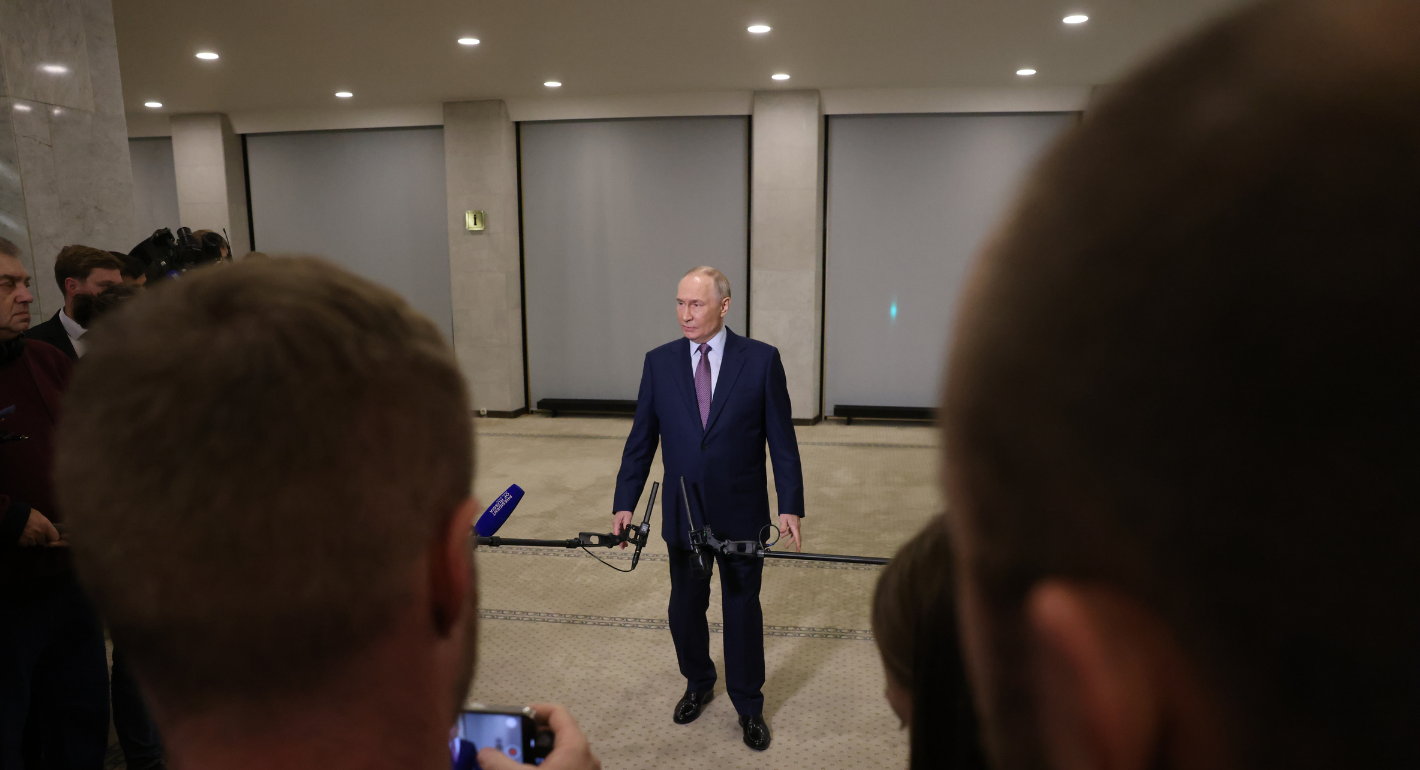
The EU had to compromise to adopt a twenty-first sanctions package against Russia, exposing growing cracks in the union’s resolve. Is this latest, weaker round worth it to keep pressure on Moscow?
Rym Momtaz, ed.

Trump is distracted and Ukraine wants Europe to step up. The continent’s leaders must find their voice and assert it in talks with Russia.

Alissa de Carbonnel

Mounting economic strain and battlefield losses will not necessarily make the Kremlin less dangerous. They could instead push Moscow toward a more aggressive hybrid campaign designed to test NATO’s Eastern flank, exploit allied hesitation, and fracture European resolve.

Maksym Beznosiuk