

Commentary
The aftermath of the Ceuta crisis shows Europe has drawn the wrong lessons. Rather than doubling down on failed migration policies, the EU needs to address the underlying roots of such episodes.
Richard Youngs
{
  "authors": [
    "Oliver Thränert",
    "Martin Zapfe"
  ],
  "type": "commentary",
  "blog": "Strategic Europe",
  "centerAffiliationAll": "",
  "centers": [
    "Carnegie Endowment for International Peace",
    "Carnegie Europe"
  ],
  "collections": [],
  "englishNewsletterAll": "",
  "nonEnglishNewsletterAll": "",
  "primaryCenter": "Carnegie Europe",
  "programAffiliation": "",
  "programs": [],
  "projects": [],
  "regions": [
    "Eastern Europe",
    "North America",
    "United States",
    "Russia",
    "Ukraine",
    "Western Europe",
    "Europe"
  ],
  "topics": [
    "Security",
    "Foreign Policy",
    "EU"
  ]
}
Source: Getty
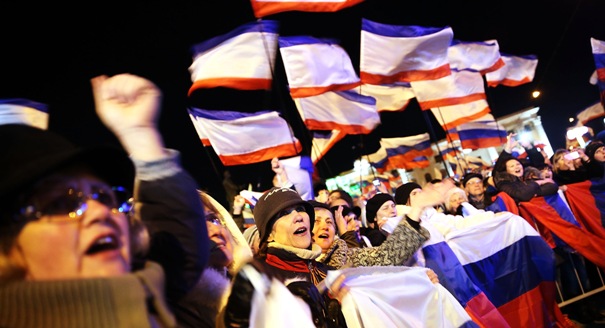
Russia’s annexation of Crimea is indicative of a fundamentally weakened West. But could it also, paradoxically, give the West a stronger role in global affairs?
Russian President Vladimir Putin’s coup de main in Crimea is a classic game changer. It poses a dilemma for politicians and analysts alike. On the one hand, the intervention has a history and follows a path dependency that has continuously led toward greater confrontation between Russia and the West. On the other hand, if only because of its magnitude, it is a foreign policy revolution.
The Crimea episode therefore embodies both continuity and change, making it both an analyst’s dream and nightmare. It confirms the diagnosis of a fundamentally weakened West; yet twenty years from now, historians may well point to the spring of 2014 as the trigger for a strengthened West with an enhanced role in international affairs.
Every year, the Center for Security Studies at the Swiss Federal Institute of Technology (ETH) in Zurich identifies and analyzes key developments in international affairs for its flagship publication, Strategic Trends. The 2014 issue consists of five consciously unrelated chapters that highlight critical but not interdependent trends.
Analysts strive to understand and explain events. Every think tank is glad when its forecasts are confirmed by real-life developments—and Strategic Trends does describe Putin’s Russia as a continuing and dedicated antagonist of the West. Yet the scope of the Ukraine crisis and its potential geopolitical consequences surprised the report’s authors as much as most other observers.
Written before Russian “self-defense forces” seized Crimea, the chapters of Strategic Trends 2014 describe aspects of the long-expected shift in the geopolitical balance. This shift is different and far more evolved and complex than the well-established narrative of emerging nations, especially in Asia, gradually replacing Western influence in regions, markets, and policy issues.
Beyond a mere decline of Western influence, the chapters of the volume reflect a basic insecurity over the future direction of these geopolitical shifts. Increasing U.S. disengagement from Europe and Europe’s struggle to live up to its geostrategic aspirations are long-expected developments that could provide a secure framework to interpret global events. Yet these processes are themselves in a state of unpredictable flux.
Taken together, Strategic Trends 2014 highlights elements of a world in which the West is losing ground. As a result, the global order faces not necessarily decreasing stability but increasing strategic insecurity.
Enter Crimea. The Ukraine crisis could create a totally new dynamic and potentially reverse the role of the West. If NATO and EU needed an external antagonist to rediscover common ground, they may have found it.
For NATO, the crisis comes as a godsend. It breathes new life into an alliance that is looking beyond 2014 and the end of major operations such as in Afghanistan. The conflict is likely to reinforce the trend within NATO toward a greater focus on Article 5, the mutual defense clause of the alliance’s treaty. At the same time, contradictions that have long existed within NATO may become more virulent. Examples include discussions about missile defense and the stationing of U.S. nuclear forces in Europe.
The EU’s conduct during the Ukraine crisis brings out both the best and the worst of the union. The bloc moves slowly, always trying to balance divergent interests. However, when really pressed by circumstances, it acts with force, unity, and determination. Having now mastered the devastating euro crisis by establishing new financial rules that move the union closer to a quasi-state than ever before, the Ukraine crisis may well be the next step on a revived path toward “ever closer union.”
Yet there is an irony. The unlikely victim of this foreign policy crisis may well be European foreign policy. While the EU’s success in devising and implementing sanctions against Moscow has so far been impressive, potential military measures to support Eastern European states are discussed in one organization only: NATO.
The EU’s Common Security and Defense Policy has made great advances in stabilization and capacity-building missions beyond Europe’s borders. But it is NATO that assesses threat levels, analyzes Moscow’s military posture, and deploys symbolic air assets to the East. If a Cold War analogy is fitting, then it is that of European political and economic integration under NATO’s military protection.
The Ukraine crisis strengthens the West through the EU and NATO—at least in the short term, but likely longer. While Strategic Trends 2014 refused to sing the tune of a “decline of the West,” the diminishing relative power of the EU and the United States was hard to refute. And the perception of a weakened West was definitely the background of Putin’s reasoning—whatever else it entailed. The long-term effects, however, could well turn this diagnosis upside down.
Oliver Thränert is head of the think tank at the Center for Security Studies, ETH Zurich, and a nonresident senior fellow at the German Institute for International and Security Affairs.
Martin Zapfe is head of the Global Security Team at the Center for Security Studies, ETH Zurich.
Oliver Thränert
Martin Zapfe
Center for Security Studies
Carnegie does not take institutional positions on public policy issues; the views represented herein are those of the author(s) and do not necessarily reflect the views of Carnegie, its staff, or its trustees.

The aftermath of the Ceuta crisis shows Europe has drawn the wrong lessons. Rather than doubling down on failed migration policies, the EU needs to address the underlying roots of such episodes.

Richard Youngs

An overwhelming victory by a far-right-wing party in a small state in eastern Germany will have major repercussions for Chancellor Friedrich Merz’s coalition.

Judy Dempsey

Canadian Prime Minister Mark Carney has twice inspired praise for standing up to U.S. President Donald Trump: at the 2026 World Economic Forum in Davos and on Canada-U.S. trade negotiations. Is Carney showing a third way better than the EU has in dealing with the Trump administration?

Rym Momtaz, ed.

The EU’s responses to two recent incidents expose the gulf between European perceptions and capabilities. Unless the union can bridge that gap, it will never become a real geostrategic power.
Rym Momtaz

In supporting Europe’s far-right, MAGA and Russia both want the same thing: a weaker EU. Europe must defend itself without abandoning the openness these forces exploit.

Armida van Rij