

Commentary
Dmitri Trenin
{
  "authors": [
    "Dmitri Trenin"
  ],
  "type": "commentary",
  "blog": "Strategic Europe",
  "centerAffiliationAll": "",
  "centers": [
    "Carnegie Endowment for International Peace",
    "Carnegie Europe",
    "Carnegie Russia Eurasia Center"
  ],
  "collections": [],
  "englishNewsletterAll": "",
  "nonEnglishNewsletterAll": "",
  "primaryCenter": "Carnegie Russia Eurasia Center",
  "programAffiliation": "",
  "programs": [],
  "projects": [],
  "regions": [
    "Russia",
    "Eastern Europe",
    "Ukraine",
    "Western Europe",
    "Europe"
  ],
  "topics": [
    "EU",
    "Foreign Policy"
  ]
}
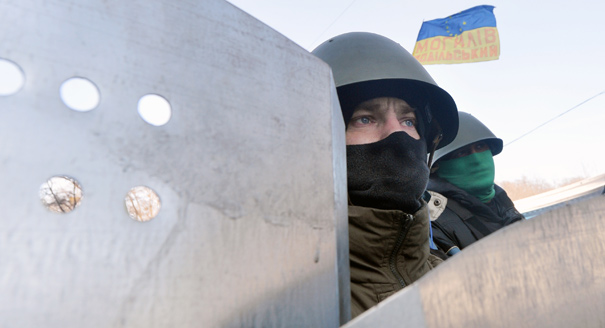
Source: Getty
What originated as the European Union’s modest Eastern Partnership program is likely to be the end of the notion of the “lands between” Russia and the EU.
Until the crisis in Ukraine, the EU and Russia were not geopolitical competitors. In one “big bang” enlargement in 2004, the EU expanded its membership to include ten new countries, many of them former Soviet satellites and three republics of the former Soviet Union.
In the subsequent years, EU membership was granted or promised to several other countries in southeast Europe, including Russia’s historical allies. Moscow’s reaction to this was muted or, in some cases, barely noticeable—in sharp contrast to its response to many of the same nations’ accession to NATO. The only issue arose when Kaliningrad, a Russian exclave, became surrounded by EU territory, and a transit agreement had to be negotiated.
Why is Ukraine different? To the Russian establishment, and to President Vladimir Putin personally, Ukraine lies east of the line that marks the extent of Western civilization in Europe.
Putin was prepared to live with a Ukraine that was essentially a buffer zone between Russia and the EU. Even the prospect of Yulia Tymoshenko replacing the ousted President, Viktor Yanukovych, as the end result of the February 21 agreement did not worry Putin too much. He had dealt with Tymoshenko as prime minister. He had even preferred her to Yanukovych in the 2010 presidential elections. He would deal with her again, if necessary.
Putin, of course, loathed the method of change of leadership in Ukraine: revolutionary violence is always a bad example, particularly next door, but he looked forward to continuing his tactical maneuvering in Ukraine in an effort to eventually win it over to his side.
Then something unexpected happened. The radical nationalists in Ukraine’s Right Sector coalition refused to support the February 21 accord and Yanukovych, abandoned by the oligarchs, in turn abandoned his own supporters and fled from Kiev.
The power of these radicals demonstrated to Putin how much Ukraine had changed since the Orange revolution a decade ago. He saw a threat of Galicia, or western Ukraine, which lies west of Europe’s “civilizational boundary,” taking over the entire country and turning it into an anti-Russian force. He also watched the EU, whose three foreign ministers had witnessed the February 21 accord, to wash its hands off it when the radicals scrapped it. Immediately, Moscow’s policies changed from passive to hyperactive and contingency plans long prepared for the possibility of Ukraine making a decisive step toward NATO membership have apparently been activated.
With Crimea now incorporated into the Russian Federation, Putin may have no need to execute his authority to send the Russian military forces into eastern or southern Ukraine. This does not mean, however, that the geopolitical battle for Ukraine between the West and Russia is now over, with Crimea going to Moscow and Kiev aligning itself with Washington and Brussels. As before, Moscow can live with a Ukraine that is “neutral” while having close links with Russia, but it will not accept a Ukraine that is leaning to the West. The only compromise the Kremlin would consider is allowing Galicia to secede and join the West on its own, in whatever way and form it wants.
The battle for Ukraine promises to be a long and hard one. This, however, will not be the only battleground between Russia and the West. Moldova exhibits some striking similarities with Ukraine. Transnistria, a region attached to the Soviet Moldovan republic by Stalin and which broke away from Chisinau even before the breakup of the Soviet Union, wants to join Russia. By contrast, the government in Chisinau is looking west, both to the EU and now also to NATO. But it is being challenged by a pro-Russian communist-led opposition. The stalemate along the Dniester river and the periodic alternation in power in Chisinau of pro-western and pro-Russian parties will not continue indefinitely. The Ukrainian crisis and the Crimea annexation have changed the pace of developments there as well.
Thus, what originated as the European Union’s modest Eastern Partnership program has inspired civic and nationalist movements, demolished delicate balances within elites, presented Russia with a specter of Western threat, and provoked a geopolitical avalanche. The result, in the long run, is likely to be the end of the notion of the “lands between” Russia and the EU. Hard and painful choices are now unavoidable.
Former Director, Carnegie Moscow Center
Trenin was director of the Carnegie Moscow Center from 2008 to early 2022.
Recent Work
Dmitri Trenin
Dmitri Trenin
Carnegie does not take institutional positions on public policy issues; the views represented herein are those of the author(s) and do not necessarily reflect the views of Carnegie, its staff, or its trustees.

Before the next wave of EU enlargement takes place, the union needs to grapple with thorny questions of how power is distributed among its members.


Emil Sondaj Hansen, Ditte Brasso Sørensen

A summer of escalation in the Black Sea has hurt Ukraine economically and is exacerbating world food security. A truce is needed—as is a broader reframing of Europe’s Ukraine strategy.

Thomas de Waal

Are Germany’s economic, industrial, and political struggles becoming a liability for the EU’s ability to rise to the geopolitical moment?

Rym Momtaz, ed.

European Commission President Ursula von der Leyen is about to give her annual address on the state of the EU. Here’s what she won’t—but should—say.
Rym Momtaz

The aftermath of the Ceuta crisis shows Europe has drawn the wrong lessons. Rather than doubling down on failed migration policies, the EU needs to address the underlying roots of such episodes.

Richard Youngs