

Commentary
Judy Dempsey
{
  "authors": [
    "Judy Dempsey"
  ],
  "type": "commentary",
  "blog": "Strategic Europe",
  "centerAffiliationAll": "",
  "centers": [
    "Carnegie Endowment for International Peace",
    "Carnegie Europe"
  ],
  "collections": [],
  "englishNewsletterAll": "",
  "nonEnglishNewsletterAll": "",
  "primaryCenter": "Carnegie Europe",
  "programAffiliation": "",
  "programs": [],
  "projects": [],
  "regions": [
    "Eastern Europe",
    "North America",
    "United States",
    "Caucasus",
    "Russia",
    "Georgia",
    "Ukraine",
    "Western Europe",
    "Moldova",
    "Europe"
  ],
  "topics": [
    "Security",
    "Foreign Policy",
    "EU"
  ]
}
Source: Getty
Vladimir Putin is drawing new borders between Russia’s neighborhood and the West. Yet that will not deter the peoples of Eastern Europe from aspiring to Western values.
Russia’s annexation of Crimea and its amassing of thousands of troops on its border with Ukraine have given NATO a new sense of purpose.
The U.S.-led alliance’s Eastern members, led by Poland and the Baltic states, have asked the organization to beef up their defenses. For the first time since the Soviet Union collapsed in 1991, Eastern Europeans can’t take their safety and security for granted.
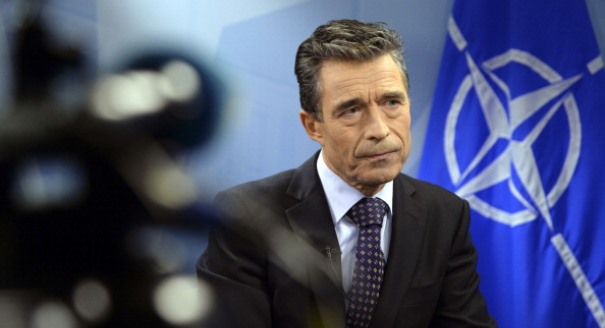
NATO Secretary General Anders Fogh Rasmussen has been quick to oblige. He has already called on the 28-member alliance to bolster the air defenses of the Baltic states and improve Romania’s defenses, too.
Rasmussen himself has clear ideas about what should be done. Writing in the German newspaper Die Welt, he said that NATO was open to Ukraine. “The right of sovereign states to determine their own way forward is one of the foundations of modern Europe,” the former Danish prime minister wrote.
Rasmussen’s message was directed at a German public that still does not grasp the geostrategic importance of events in Ukraine and is hesitant about imposing tougher sanctions on the Kremlin.
German Foreign Minister Frank-Walter Steinmeier was quick to rebuke Rasmussen. “NATO membership for Ukraine is not pending,” he said. Foreign policy, he added, was not supposed to become “militarized.” The expression he used is significant because it has a particular resonance with pacifists and those who advocate diplomacy and the minimum of soft power instruments to deal with crises.
So far, Steinmeier’s attempts to deescalate the crisis with Russia have failed. Indeed, the more Berlin pushes for diplomacy, the more it gives Russian President Vladimir Putin time to consolidate his grip over Eastern Europe.
In effect, what is happening in the region is that Russia is successfully imposing new demarcation lines between what it considers its own sphere of influence and the West. These lines could delineate the new post–Cold War borders.
These frontiers are entirely different from those that existed during the Cold War. Then, NATO was right up against the Warsaw Pact, the Soviet Union’s military alliance, with Germany the strategic focal point of both sides. There was no cordon sanitaire or buffer zone. Moldova, Georgia, Ukraine, and Belarus were satellites of the Soviet Union and closely controlled members of the Moscow-led pact.
Today, Germany is no longer on the front line. NATO and the EU have expanded to bring in Germany’s immediate Eastern neighbors. But farther east, several countries are alone and unable to withstand any Russian military pressure.
In effect, the region east of NATO could become Russia’s glacis, a playground for Moscow to make land grabs. That’s what Russia has done in Crimea as well as in the Georgian provinces of Abkhazia and South Ossetia. Russia’s next step could be to consolidate its grip over Moldova’s breakaway region of Transnistria.
The EU will not be able to shore up these countries. The EU can sign economic, trade, and political accords and try to support the pro-democracy and civil-society movements that yearn for their countries to move closer to Europe. But only NATO can provide the security component that would keep Putin from exerting military and economic pressure on Ukraine and Moldova.
NATO’s big member states, such as Germany, Britain, France, and Italy, are highly reluctant to even consider offering Georgia—the most pro-NATO country in the region—NATO’s Membership Action Plan.
That plan puts any signatory on the path to joining the alliance, and once a country is a member, it benefits from the mutual security guarantee enshrined in the organization’s Article 5. In practice, that could mean NATO defending Georgia against Russia—something that neither the United States nor any other NATO country would be prepared to do today.
It would be an entirely different matter if Russia amassed its troops on the borders of Estonia or Latvia. NATO would have no option but to defend those countries, which are already members. Russia knows that.
Whatever Rasmussen says, NATO’s security guarantee will not be extended to countries beyond its current borders. That does make it seem as if countries like Ukraine, Moldova, or Georgia were—to use a cynical expression—up for grabs.
Yet no cheap replay of the Cold War will make the peoples of these countries give up their aspirations of democracy and freedom, prosperity and sovereignty, security and stability. Putin will soon realize that even without any further action by NATO, his attempts to regain a lost empire will be resisted.

Nonresident Senior Fellow, Carnegie Europe
Judy Dempsey is a nonresident senior fellow at Carnegie Europe
Recent Work
Judy Dempsey
Judy Dempsey
Carnegie does not take institutional positions on public policy issues; the views represented herein are those of the author(s) and do not necessarily reflect the views of Carnegie, its staff, or its trustees.

European Commission President Ursula von der Leyen is about to give her annual address on the state of the EU. Here’s what she won’t—but should—say.

Rym Momtaz

The aftermath of the Ceuta crisis shows Europe has drawn the wrong lessons. Rather than doubling down on failed migration policies, the EU needs to address the underlying roots of such episodes.

Richard Youngs

An overwhelming victory by a far-right-wing party in a small state in eastern Germany will have major repercussions for Chancellor Friedrich Merz’s coalition.
Judy Dempsey

Canadian Prime Minister Mark Carney has twice inspired praise for standing up to U.S. President Donald Trump: at the 2026 World Economic Forum in Davos and on Canada-U.S. trade negotiations. Is Carney showing a third way better than the EU has in dealing with the Trump administration?
Rym Momtaz, ed.

The EU’s responses to two recent incidents expose the gulf between European perceptions and capabilities. Unless the union can bridge that gap, it will never become a real geostrategic power.
Rym Momtaz