

Commentary
Judy Dempsey
{
  "authors": [
    "Judy Dempsey"
  ],
  "type": "commentary",
  "blog": "Strategic Europe",
  "centerAffiliationAll": "",
  "centers": [
    "Carnegie Endowment for International Peace",
    "Carnegie Europe"
  ],
  "collections": [],
  "englishNewsletterAll": "",
  "nonEnglishNewsletterAll": "",
  "primaryCenter": "Carnegie Europe",
  "programAffiliation": "",
  "programs": [],
  "projects": [],
  "regions": [
    "Russia",
    "Eastern Europe",
    "Western Europe",
    "Europe"
  ],
  "topics": [
    "Climate Change",
    "Foreign Policy",
    "EU",
    "Security"
  ]
}
Source: Getty
European leaders speak a lot about reducing their energy dependence on Russia and increasing energy security. What most actually do is the opposite.
Since Russia’s annexation of Crimea, there is hardly a European government that does not support an energy policy that would make Europe less dependent on Russia.
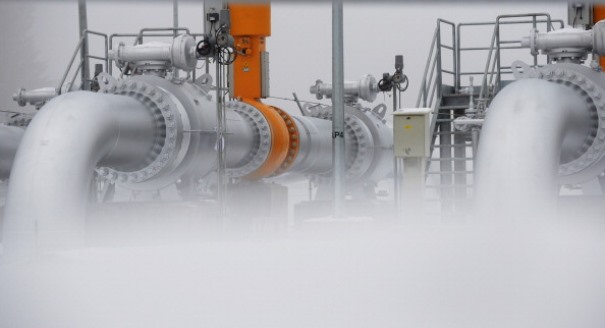
Or so it would seem. The reality is that despite their rhetoric, not all EU countries are prepared to weaken their links to Gazprom, Russia’s state-owned energy giant and the Kremlin’s powerful foreign policy instrument. The result is that Moscow can continue to play member states off against each other and weaken the EU’s response to what Russia is doing in Ukraine.
Consider what happened on April 29, just days after the United States and the EU imposed a fresh set of sanctions on Russia.
OMV’s chief executive officer, Gerhard Roiss, had no qualms in justifying the deal. “It’s not about importing more gas but about the fact that gas can be transported to Europe,” he told the Wiener Zeitung.
Austria is one of many EU countries that want Ukraine to reduce its dependence on Russian gas so that the Kremlin cannot blackmail the government in Kiev so easily. Yet Austria itself is prepared to become even more dependent on Russian gas. Even today, 52 percent of the gas Austria consumes is imported from Russia.
Vienna is not alone in its dependence on Russian gas. Sofia also staunchly supports the South Stream project. Bulgarian Foreign Minister Kristian Vigenin said his government would do everything possible to ensure the pipeline was built. Both he and the economy minister, Dragomir Stoynev, believe South Stream to be of major importance and regard Russia as Bulgaria’s strategic partner. Bulgaria is 100 percent dependent on Russia for its gas consumption.
“Regardless of our desire to help stabilize Ukraine, we see that the situation there is unlikely to be calm in the long term,” Vigenin told Russian news agency ITAR-TASS. “Bulgaria and a number of other EU member states should not be held hostage to this lack of stability,” he added.
The other countries that have signed up to building the onshore section of South Stream are Croatia, Greece, Hungary (which earlier this year signed a big nuclear deal with Russia), Slovenia, and non–EU member Serbia.
South Stream’s shareholders consist of Gazprom (which has a 50 percent stake) and Europe’s powerful energy companies—Italy’s Eni (20 percent), Germany’s Wintershall Holding (15 percent), and France’s EDF (15 percent). Eni has been the only partner to raise any doubts about the feasibility of South Stream. The rest support the project wholeheartedly.
This was clear when energy ministers from the G7 countries met in Rome on May 6. Their statement stressed the need for energy security but did not call South Stream into question and mentioned Russia only once. “In the medium term, the diversification of sources and routes for fossil fuels is essential. No country should depend totally on one supplier. Nor should energy be used as a means of political coercion or a threat to security,” the communiqué stated.
But that is exactly what is happening, not only in the case of South Stream but also in any case where Gazprom can dictate its gas price. The greater a country’s dependence on Russian gas, the greater the chance for the Kremlin to set the price and increase its influence on the country.
This is where Günther Oettinger comes in. As the EU’s commissioner for energy, Oettinger is determined to challenge the legality of South Stream.
In an interview with the Financial Times on May 5, he insisted he would not grant Gazprom any exemptions from the EU’s competition rules. Oettinger said that Gazprom and the other companies in the consortium must adhere to the EU’s Third Energy Package, which is designed to break supply chains built on monopolies. The legislative package also requires Gazprom to allow other suppliers access to South Stream to encourage greater competition in Europe’s energy markets.
Of course, Gazprom is fighting the energy package tooth and nail. It has announced that it will challenge it at the World Trade Organization. Gazprom even tried to threaten the EU, saying that the measures would “create a serious obstacle for ensuring stable supplies of Russian gas to the EU, including a threat to the construction of new infrastructure, such as under the South Stream project.”
So far, Oettinger has not given in. Instead, he has lent support to Donald Tusk’s idea of an EU energy union to purchase Russia gas. The Polish prime minister believes such a union would strengthen Europe’s energy security and give the EU a stronger hand in negotiating gas prices.
“We want a uniform gas price in the European common market,” Oettinger said at a press conference in Warsaw with Tusk. “The game of divide et impera or a game of this type proposed by Moscow cannot and will not be accepted by EU member states.”
Brave words—but unfortunately, the examples of Austria, Bulgaria, and South Stream’s other supporters show that national governments are nowhere near as united as Oettinger would like them to be.
Despite the Ukraine crisis, Russia has been able to use its energy power to divide and rule in Europe. Rather than making great new plans, Oettinger, who has only months left in office before the European Commission is replaced, should implement the Third Energy Package as fast as possible.

Nonresident Senior Fellow, Carnegie Europe
Judy Dempsey is a nonresident senior fellow at Carnegie Europe
Recent Work
Judy Dempsey
Judy Dempsey
Carnegie does not take institutional positions on public policy issues; the views represented herein are those of the author(s) and do not necessarily reflect the views of Carnegie, its staff, or its trustees.

An overwhelming victory by a far-right-wing party in a small state in eastern Germany will have major repercussions for Chancellor Friedrich Merz’s coalition.
Judy Dempsey

Canadian Prime Minister Mark Carney has twice inspired praise for standing up to U.S. President Donald Trump: at the 2026 World Economic Forum in Davos and on Canada-U.S. trade negotiations. Is Carney showing a third way better than the EU has in dealing with the Trump administration?

Rym Momtaz, ed.

The EU’s responses to two recent incidents expose the gulf between European perceptions and capabilities. Unless the union can bridge that gap, it will never become a real geostrategic power.
Rym Momtaz

In supporting Europe’s far-right, MAGA and Russia both want the same thing: a weaker EU. Europe must defend itself without abandoning the openness these forces exploit.

Armida van Rij
As we close out another season of Strategic Europe, it is worth taking stock of the deep shifts underway.
Rym Momtaz