

Commentary
Judy Dempsey
{
  "authors": [
    "Judy Dempsey"
  ],
  "type": "commentary",
  "blog": "Strategic Europe",
  "centerAffiliationAll": "",
  "centers": [
    "Carnegie Endowment for International Peace",
    "Carnegie Europe"
  ],
  "collections": [],
  "englishNewsletterAll": "",
  "nonEnglishNewsletterAll": "",
  "primaryCenter": "Carnegie Europe",
  "programAffiliation": "",
  "programs": [],
  "projects": [],
  "regions": [
    "North America",
    "United States",
    "Western Europe",
    "Europe"
  ],
  "topics": [
    "Security",
    "Military",
    "Foreign Policy",
    "EU"
  ]
}
Source: Getty
Barack Obama’s new foreign policy doctrine has left America’s allies confused. Europeans should respond by forging their own robust security policy.
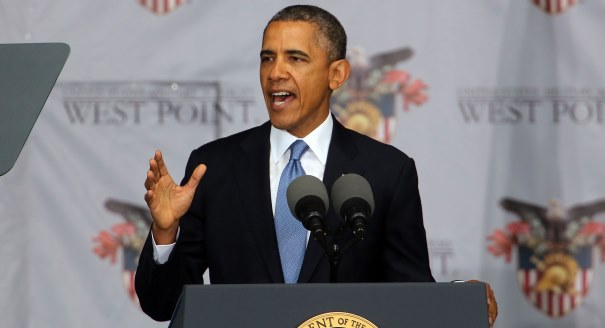
Before U.S. President Barack Obama delivered his foreign policy speech on May 28 to new graduates of the U.S. Military Academy at West Point, he had come under a huge amount of flak from all sides of the political divide.
When it came to American leadership and its role in the world, few analysts knew what Obama stood for or what he believed in. His speech was supposed to allay such criticism. It will hardly do that. In attempting to please all constituencies, from those who oppose war to those who want America to exert leadership, Obama has left his allies confused and authoritarian regimes relieved.
One of the most important aspects of Obama’s speech was the retreat from hard power. As he told the class of 2014, “you are the first class to graduate since 9/11 who may not be sent into combat in Iraq or Afghanistan.” No wonder the young men and women applauded.
Iraq is mired in sectarianism, corruption, and insecurity. Those struggling for human rights and the rule of law in Afghanistan dread the day when the bulk of U.S. troops leave the country later this year. There are big question marks over the wisdom of the 2011 NATO-led bombing campaign in Libya given the turmoil in the country today. Above all—and this is very important for the Europeans—America’s war on terror clashed with America’s values.
Obama is now trying to repair the damage wreaked by the war on terror.
Since 9/11, successive U.S. administrations have run roughshod over human rights. Torture, targeted killings, and renditions were condoned. Detainees were not, and are still not, tried before the courts but instead are put before military tribunals—if their cases are processed at all. To this day, despite so many pleadings by human rights organizations and lawyers, those detainees on hunger strike at Guantánamo Bay are being force-fed.
Obama was right to say that he intended to close the Guantánamo detention camp. But he promised that when he was first elected president in 2008. In previous speeches, Obama has admitted that the war on terror, and especially Guantánamo, damaged America’s standing in the world. Indeed, the war on terror downgraded values, dignity, and basic decency to such a degree that many countries, particularly in the Middle East, came to despise the United States, which had so long espoused the values of freedom and tolerance.
European governments are not blameless either.
For far too long, most European leaders were relieved to have America do their dirty work. Yes, they condemned the existence of Guantánamo Bay, its appalling practices, and the disregard of the rule of law. They also called for the camp to be closed. But how many European governments then helped Obama shut it down when he asked his allies to take some of the detainees? A mere handful.
Europeans were also relieved when, in 2011, U.S. special forces killed al-Qaeda leader Osama bin Laden. In short, for all the criticism of Obama’s policies, more often than not Europeans were prepared to support them.
Yet when Obama decided not to intervene in Syria, despite the many thousands of civilian deaths there, European governments went along with that too. They were neither politically nor militarily prepared to act without the United States. With few exceptions, European leaders have also been mute over how the values that defined the transatlantic relationship have become eroded.
Of course, the United States is not going to abandon hard power or its leadership in the world.
“America must always lead on the world stage. If we don’t, no one else will,” Obama said. “U.S. military action cannot be the only—or even primary—component of our leadership in every instance,” he added. And in a gesture to his critics and the UN Security Council, he said that regardless of international opinion, the United States would use military force, unilaterally if necessary. “America should never ask permission to protect our people, our homeland, or our way of life.”
Yet behind these words is a retreat to a special kind of soft power. Obama wants to establish new counterterrorism partnership fund designed to train and “facilitate partner countries on the front lines.” He intends to work with European allies “to train a functioning security force and border patrol in Libya and [support] French operations in Mali.” There was very little mention of the role of NATO.
Obama also justified Washington’s soft power policy toward Ukraine, saying U.S. sanctions on Russia proved that such kind of pressure was effective. But for all that, it is hard to see Russian President Vladimir Putin and authoritarian regimes in Central Asia and elsewhere shaking in their boots over Obama’s doctrine.
European leaders should not feel vindicated by Obama’s speech. They have been wobbly over Russia and inconsistent over defending their values. If anything, they should realize that the United States is no longer going to do the running for the Europeans. Since that is the case, what about the Europeans replying to Obama with their own foreign and security policy doctrine?

Nonresident Senior Fellow, Carnegie Europe
Judy Dempsey is a nonresident senior fellow at Carnegie Europe
Recent Work
Judy Dempsey
Judy Dempsey
Carnegie does not take institutional positions on public policy issues; the views represented herein are those of the author(s) and do not necessarily reflect the views of Carnegie, its staff, or its trustees.

A summer of escalation in the Black Sea has hurt Ukraine economically and is exacerbating world food security. A truce is needed—as is a broader reframing of Europe’s Ukraine strategy.

Thomas de Waal

Are Germany’s economic, industrial, and political struggles becoming a liability for the EU’s ability to rise to the geopolitical moment?

Rym Momtaz, ed.

European Commission President Ursula von der Leyen is about to give her annual address on the state of the EU. Here’s what she won’t—but should—say.
Rym Momtaz

The aftermath of the Ceuta crisis shows Europe has drawn the wrong lessons. Rather than doubling down on failed migration policies, the EU needs to address the underlying roots of such episodes.

Richard Youngs

An overwhelming victory by a far-right-wing party in a small state in eastern Germany will have major repercussions for Chancellor Friedrich Merz’s coalition.
Judy Dempsey