

Commentary
Nathalie Tocci, Jan Techau
{
  "authors": [
    "Jan Techau"
  ],
  "type": "commentary",
  "blog": "Strategic Europe",
  "centerAffiliationAll": "",
  "centers": [
    "Carnegie Endowment for International Peace",
    "Carnegie Europe"
  ],
  "collections": [],
  "englishNewsletterAll": "",
  "nonEnglishNewsletterAll": "",
  "primaryCenter": "Carnegie Europe",
  "programAffiliation": "",
  "programs": [],
  "projects": [],
  "regions": [
    "North America",
    "United States",
    "Western Europe",
    "Europe"
  ],
  "topics": [
    "Security",
    "EU",
    "Foreign Policy"
  ]
}
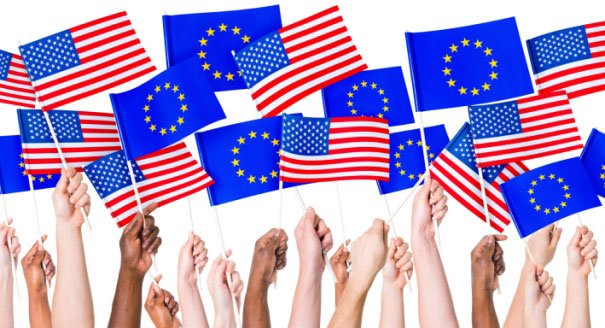
Source: Getty
The key to revamping the transatlantic relationship is simple: Europeans must do more. That means becoming more united and reducing their dependency on the United States.
Why is transatlanticism such a painful undertaking for Europeans? It should be an easy ride, given that 90 percent of the relationship is routinized, tested, and trustful. There is a huge overlap of interests, and the two sides’ values systems are more closely aligned than in any other geostrategic partnership. But it ain’t so simple. No other topic, not even conflagrations in the Middle East, creates as much heated debate in the old world as Europe’s relationship with the United States.
Why is this so? The answer is clearer than you might think. It goes far beyond the usual chagrin of Guantánamo Bay, Iraq, spy scandals, or drone warfare. Other European partners do far worse things, and yet such relationships often live with fewer tensions. Some people assume it might have to do with the fact that Europeans expect more from democratic America than from, say, Russia or China. But a mere game of double standards can’t explain the negative vibes that can be picked up with scary regularity in conferences and conversations.
The big underlying problem Europeans have with the transatlantic relationship is that it is one of dependency. Everything they do, from European integration to trade, from foreign policy to refining (and sometimes reforming) welfare states, Europeans do beneath the American security umbrella. Geostrategically, their entire Disneyland-like enclave of stable politics, peaceful conflict resolution, and cooperative external relations relies on U.S. extended deterrence, NATO’s article 5 mutual defense guarantee, and the (shrinking) presence of U.S. troops on European soil.
Europeans resent dependency. Nobody likes being dependent, but dependency on such a high level breeds contempt. This contempt is only heightened by a general European discomfort with American-style modernity and its egalitarian, individualist, small-state, popular culture.While this culture was invented in Europe, it is Americans who turned it into the irresistible, powerful civilizational model that it is today. Everybody loves it, but it also feels so good to hate it. It feels even better to hate it when you can take the moral high ground and condemn the United States for making the hard choices an international guarantee power must make, some of which inevitably go wrong or require morally murky arrangements.
Transatlanticists try to work against this negative psychology by tirelessly pointing at shared values, conjuring up the picture of a West united around a normative civilizational project. But this narrative cannot equalize what is unequal. The differences in power, influence, and weight become only more obvious. The values story has become stale and boring.
To make things worse, Europeans do everything they can to increase their dependence on U.S. power on a daily basis. Despite a small recent upsurge, European nations continue to reduce their own capabilities to defend themselves in a world that is getting more volatile and risky, not less. Europeans keep delegating the protection of their vital global interests to the United States. In other words, they silently rely on America to keep rolling out the subsidies forever.
For a long time, this was a great deal for both sides. Europeans saved money, put in a token contribution, and built their peaceful polities back home. America, in return, became a European veto power, cementing its status as a player with global reach. But now, that deal is coming apart, as America is weary of footing the bill alone, and Europe is unwilling and incapable of shedding its subsidies mentality.
The key to revamping the relationship lies in one thing alone: Europe needs to do more. European countries need to get real about the global state of affairs, become more united, reduce their dependency, and turn themselves into a real partner. For in this lies the trick: by becoming stronger and more self-reliant, Europe would not actually destroy the transatlantic relationship, but improve it. That would make Europe both less dependent and more interesting and useful as a partner.
In its current state, the transatlantic relationship is defined more by what the partners don’t do together than by what they do together. With the exception of Iran, they haven’t created a coordinated effort on the Middle East and the countries of the Arab Spring. They are both “pivoting” toward Asia, but they haven’t compared notes. They sleepwalked separately into the quagmire that is Eastern Europe and are now barely united in crisis management.
Europe and the United States keep talking about sharing military capabilities in NATO (also known as “smart defense”), but they don’t do it. And they are about to fail to create a transatlantic free trade agreement—lightheartedly, as if this were not a once-in-a-generation project of enormous geopolitical relevance. And these are just the obvious cases.
The responsibility to save the relationship lies with both sides, but it lies with Europeans more. Can Europeans, in their current state, start to deliver? Skepticism prevails. Their internal politics have just become more disruptive as the horse-trading over the EU’s top jobs enters full swing. Their economy is still too weak. The EU’s institutional framework is under attack. Its key powers are in seemingly unstoppable decline (France), absent-minded (Britain), or in self-righteous denial about the urgency of the matter (Germany).
And yet, it is exactly this kind of Europe that needs to unite around a shared transatlantic agenda. The combination of the Ukraine crisis, the Arab Spring, the ISIS insurgency in Iraq, an upcoming NATO summit, and leadership renewal in the EU offers a great opportunity to do so. Let’s hope reality kicks in soon enough. The great thing is that by becoming more meaningful, the transatlantic relationship would also get a whole lot less painful.

Director, Europe Team, Eurasia Group
Techau is director with Eurasia Group's Europe team, covering Germany and European security from Berlin. Previously, he was director of Carnegie Europe.
Recent Work

Nathalie Tocci, Jan Techau
Jan Techau
Carnegie does not take institutional positions on public policy issues; the views represented herein are those of the author(s) and do not necessarily reflect the views of Carnegie, its staff, or its trustees.

As we close out another season of Strategic Europe, it is worth taking stock of the deep shifts underway.

Rym Momtaz
The EU had to compromise to adopt a twenty-first sanctions package against Russia, exposing growing cracks in the union’s resolve. Is this latest, weaker round worth it to keep pressure on Moscow?
Rym Momtaz, ed.

Trump is distracted and Ukraine wants Europe to step up. The continent’s leaders must find their voice and assert it in talks with Russia.

Alissa de Carbonnel

Mounting economic strain and battlefield losses will not necessarily make the Kremlin less dangerous. They could instead push Moscow toward a more aggressive hybrid campaign designed to test NATO’s Eastern flank, exploit allied hesitation, and fracture European resolve.

Maksym Beznosiuk

Over the past ten years, NATO has held almost as many summits as it did during the entirety of the Cold War. Are they still useful, or is it time to stop holding annual meetings?
Rym Momtaz, ed.