

Commentary
Judy Dempsey
{
  "authors": [
    "Judy Dempsey"
  ],
  "type": "commentary",
  "blog": "Strategic Europe",
  "centerAffiliationAll": "",
  "centers": [
    "Carnegie Endowment for International Peace",
    "Carnegie Europe"
  ],
  "collections": [
    "Europe’s Eastern Neighborhood"
  ],
  "englishNewsletterAll": "",
  "nonEnglishNewsletterAll": "",
  "primaryCenter": "Carnegie Europe",
  "programAffiliation": "",
  "programs": [],
  "projects": [],
  "regions": [
    "Russia",
    "Europe",
    "Eastern Europe",
    "Ukraine"
  ],
  "topics": [
    "Security",
    "Foreign Policy"
  ]
}
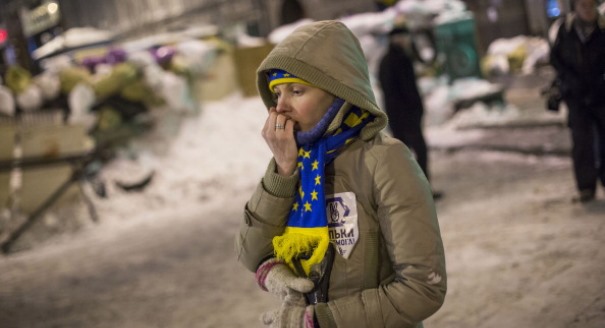
Source: Getty
A buffer zone in eastern Ukraine perpetuates Russia’s influence over that part of the country—and over Ukrainian politics.
The last thing that Europe needs is another frozen conflict. But that is what is happening in eastern Ukraine after Russian and Ukrainian leaders met in Minsk on September 19 to agree to a buffer zone between Ukrainian forces and pro-Russian rebels.
That deal, and an earlier ceasefire reached on September 5, is welcome news for local residents. Since fighting began several months ago, thousands of people have fled the region, over 2,500 have been killed, and many homes, villages, towns, and cities have been destroyed or badly damaged.
But for Ukraine’s president, Petro Poroshenko, the accord reached in the Belarusian capital amounts to a defeat. He has de facto ceded control of a part of his country that will become a new political playground for Russia. In short, there is now another frozen conflict in Eastern Europe that has all the ingredients of instability.
Just before the Minsk agreement, Ukraine’s parliament passed a special act on September 16 to give parts of the country’s eastern Donbas regions a wide degree of autonomy. Once new local governments are elected, they will be able to establish cooperation with Russian local authorities across the border.
The parliamentary debate on the act and the vote itself were held behind closed doors, which hardly bodes well for civil society movements that have campaigned for transparency in Ukrainian politics.
The act has also been sharply criticized by opposition groups, particularly the nationalist Svoboda party and sections of Batkivshchyna, a party that is connected to former prime minister Yulia Tymoshenko. No doubt these parties will exploit the buffer zone and the new rules for the Donbas for political gains during the run-up to Ukraine’s parliamentary election due on October 26.
In the months leading up to the September 19 deal, Poroshenko had been pushed into a corner. The West was not going to defend Ukraine militarily against Russian aggression, nor was it going to put pressure on Moscow to return Crimea, which it annexed in March. Whenever Ukrainian forces did manage to regain territory in parts of eastern Ukraine, Russia retaliated by sending in more troops and equipment to the pro-Russian rebels.
The buffer zone effectively rewards Moscow by endorsing its interference in Ukraine. Frozen conflicts such as this allow Russia to exert influence and meddle in a sovereign country. That is what Russia has been doing for more than twenty years in Transnistria, where a pro-Russian movement has been trying to separate the region from Moldova. Talks by the OSCE and groups of diplomats have yielded little.
Even though Transnistria has no border with Russia, the sliver of land on the eastern bank of the Dniester is too important for the Kremlin to give up, particularly at this stage. With Moldova’s government determined to move closer to the EU—something that Russia opposes—the Transnistria conflict and Moldova’s dependence on Russian energy are useful political weapons for Russian President Vladimir Putin to exploit.
The frozen conflicts in Abkhazia and South Ossetia are Georgia’s Achilles’ heel. Abkhazia first declared its independence from Georgia in 1999; after Russia invaded Georgia in August 2008, Moscow acknowledged the independence of both Abkhazia and South Ossetia. Since then, Russia has provided extensive economic and political support to the two statelets, which are not internationally recognized. Moscow also signed defense cooperation agreements with both of them in 2009, increasing Russia’s military and security influence in Georgia.
Hopes of resolving the long-frozen conflict in the enclave of Nagorno-Karabakh, which is under Armenian control, have gone nowhere either. The territory has declared itself independent from Azerbaijan, which surrounds it, and Armenian forces control some of the region’s districts. After a ceasefire was declared in 1994 between Azerbaijan and Nagorno-Karabakh, a 75-mile-long security line was drawn across the South Caucasus. On one side is a heavily equipped Azerbaijani army, on the other, an Armenian force.
Russia could use its influence to resolve this conflict if it wanted to. But instead, it chooses to prolong the standoff—despite, or because of, the enormous economic and security costs for both Armenia and Azerbaijan. To say that this part of the South Caucasus is combustible is an understatement.
The buffer zone in eastern Ukraine will have serious political consequences. The frozen conflict that has been created is the perfect tool for Moscow to distract Kiev from introducing reforms and to encourage unstable politics. Russia’s meddling looks set to continue.

Nonresident Senior Fellow, Carnegie Europe
Dempsey is a nonresident senior fellow at Carnegie Europe
Recent Work
Judy Dempsey
Judy Dempsey
Carnegie does not take institutional positions on public policy issues; the views represented herein are those of the author(s) and do not necessarily reflect the views of Carnegie, its staff, or its trustees.
Hungarians head to the polls on April 12 for an election of national and European consequence. Three different outcomes are on the cards, each with their own implications for the EU.
Zsuzsanna Szelényi
The far right failed to win big in France’s municipal elections. But that’s not good news for the country’s left wing, which remained disunited while the broader right consolidated its momentum ahead of the 2027 presidential race.
Catherine Fieschi
Donald Trump has demanded that European allies send ships to the Strait of Hormuz while his war of choice in Iran rages on. He has constantly berated NATO while the alliance’s secretary-general has emphatically supported him.

Rym Momtaz, ed.
The EU is structurally incapable of reacting to today’s foreign policy crises. The union must fold the EEAS into the European Commission and create a security council better prepared to take action on the global stage.

Stefan Lehne
The war in Ukraine is costing Russia its leverage overseas. Across the South Caucasus and Middle East, this presents an opportunity for Europe to pick up the pieces and claim its own sphere of influence.

William Dixon, Maksym Beznosiuk