

Commentary
- +5
Zaha Hassan, Sarah Yerkes, Yasmine Farouk, …
{
  "authors": [
    "Federiga Bindi"
  ],
  "type": "commentary",
  "blog": "Strategic Europe",
  "centerAffiliationAll": "",
  "centers": [
    "Carnegie Endowment for International Peace",
    "Carnegie Europe"
  ],
  "collections": [],
  "englishNewsletterAll": "",
  "nonEnglishNewsletterAll": "",
  "primaryCenter": "Carnegie Europe",
  "programAffiliation": "",
  "programs": [],
  "projects": [],
  "regions": [
    "Eastern Europe",
    "Western Europe",
    "Europe"
  ],
  "topics": [
    "Foreign Policy",
    "EU",
    "Security"
  ]
}
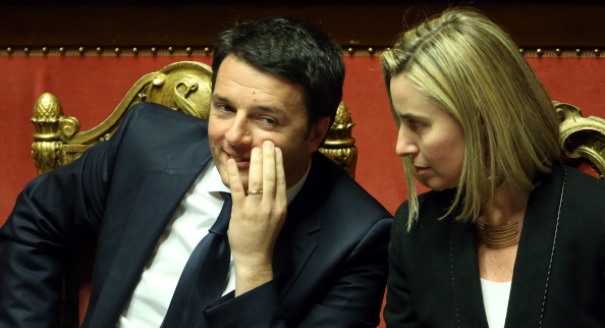
Source: Getty
Italian Prime Minister Matteo Renzi pushed hard to get Federica Mogherini installed as the EU’s next foreign policy chief. That determination may yet pay off domestically.
“At times in foreign policy, we make mistakes because we act too quickly without first properly understanding how things really are,” affirmed Federica Mogherini last spring. Will the EU’s incoming foreign policy chief be able to make her colleagues understand how things really are and act appropriately? What will Mogherini’s nomination bring for Europe and, in particular, for Italy?
When the 41-year-old Mogherini was appointed Italian foreign minister in February 2014, the Italian press impolitely asked: “Mogherini who?” The reactions were similar when in July, Italian Prime Minister Matteo Renzi put her name forward as a candidate for the position of EU foreign policy high representative. Pundits who did recognize her accused her of being too young, too inexperienced, or too pro-Russian.
To say that Mogherini is too young is disrespectful: there are plenty of (male) prime ministers in her age range, and nobody bats an eyelid. To lambast her for a lack of experience is ridiculous: all she has done in her professional life is foreign policy. She graduated with a thesis on the Middle East, took part in the EU’s Erasmus student exchange program, and was international secretary of the Italian Young Democrats.
Mogherini then joined the International Relations Department of the Italian Democratic Party and entered parliament, where she was an active member of both the Foreign Relations and Defense Committees. In early 2014, she made the Democratic Party a full member of the pan-European Party of European Socialists. As foreign minister as of February, she began repairing the damage done to Italian diplomacy by one of her predecessors, promoting competent people to key posts and achieving long-overdue reforms.
As for claims that she is too pro-Russian, Mogherini showed her ability to balance Italian and European interests. She reminded colleagues that sanctions against Russia must be a means of exerting pressure and should not be confused with the goal of pacifying Ukraine and resuming full cooperation with Moscow. Mogherini has the potential to be a great EU high representative, not least by bringing to the job her stress-free leadership style—quite a change from the modus operandi of the outgoing foreign policy chief, Catherine Ashton.
Whether Italy will support Mogherini and amplify her bargaining power remains to be seen. Traditionally, Rome has abandoned its leaders who go on to head international organizations (ask Romano Prodi, a former European Commission president). The more intriguing question is why Renzi was so determined to have Mogherini appointed and chose to risk all of his (still limited) international political capital on the nomination.
It is hard to believe that Matteo thought the EU needed Federica—especially since he was the one who needed her foreign policy expertise. Was that expertise in fact the problem? Renzi, who, contrary to custom, did not take Mogherini along on his international travels, seems to consider foreign policy like any other policy area: what matters are his opinions and his actions.
Did Mogherini find herself out of place in this setup? One cannot fail to notice how in recent weeks, her fellow ministers’ habit of parroting Renzi’s statements has become her own tendency, too.
Possibly, the main explanation for Renzi’s obstinacy in having Mogherini appointed EU foreign policy chief was his desire for a government shake-up—although he has never openly said so. The prime minister’s main target in any cabinet reshuffle would be Economy Minister Pier Carlo Padoan, whose ouster is opposed by Italy’s President Giorgio Napolitano. It will be interesting to see how this will unfold.
The questions of who will succeed Mogherini as foreign minister and when that appointment will be made also remain a mystery. Whoever gets the job, it is likely to be a woman, to maintain one of the key principles of Renzi’s government: gender balance.
Last but not least, Renzi needed an international trophy to respond to domestic criticism that he lacked authority in foreign policy—especially when compared with his predecessors, Enrico Letta and Mario Monti. Renzi also had to respond to allegations that there was a consensus on Letta’s appointment as the next European Council president, as well as to those who criticized him for dismissing the possibility of an Italian becoming the next secretary general of NATO.
German Chancellor Angela Merkel’s alleged comment to Renzi following Mogherini’s appointment—“I owed it to you”—can therefore be read as a reward for Renzi’s reversal of his predecessors’ efforts, leading to the nomination of former Norwegian prime minister Jens Stoltenberg as NATO chief.
European leaders should therefore be warned: if Renzi does you a favor, he will cash in later. Of course, he took a great risk with Mogherini. Many observers predicted that his behavior, which was not in the traditional style of the EU’s horse-trading, would lead to failure. What they did not factor in is that bullishness and a readiness to gamble are among Renzi’s main traits and what led him to become prime minister.
Renzi and the Italian media presented Mogherini’s appointment as the ultimate international victory. Newspapers ran such bold headlines as “Renzi-Europe 1:0” and “Italy Wins in Europe” to remind readers of Italy’s victory in the 2006 soccer World Cup and of former prime minister Silvio Berlusconi’s “tough” stance on the EU.
That approach did not pay off for Berlusconi, but it seems to be working well domestically for Renzi. What really matters to Matteo is maintaining a high rate of domestic approval that will enable him to win early elections next year under his own steam and finally secure “his” government. Renzi’s determination may yet be worth it.
Federiga Bindi is a senior fellow at the Center for Transatlantic Relations at the Johns Hopkins School of Advanced International Studies and Jean Monnet Chair at the University of Rome Tor Vergata.
Former Nonresident Scholar, Europe Program
Federiga Bindi was a nonresident scholar in the Europe Program at the Carnegie Endowment for International Peace working on European politics, EU foreign policy, and transatlantic relations.
Recent Work


Zaha Hassan, Sarah Yerkes, Yasmine Farouk, …
Federiga Bindi
Carnegie does not take institutional positions on public policy issues; the views represented herein are those of the author(s) and do not necessarily reflect the views of Carnegie, its staff, or its trustees.

With its public finances in shambles, the far right polling at 35 percent ahead of the 2027 presidential election, and a growing protest movement, is France’s crisis a threat to the EU’s geopolitical awakening?

Rym Momtaz, ed.

Ahead of a tough winter for Ukraine, Donald Trump’s swing back toward Russia bodes ill. But instead of panicking, Kyiv’s European allies are focusing on action.
Rym Momtaz

While the EU and European governments are embracing the much-lauded middle-power moment, this entails three difficult conundrums.

Richard Youngs

Much has been said of the changes Brussels is trying to make to the EU enlargement process. Here’s why gradual integration might—or might not—be the answer.

Dimitar Bechev

The European Commissioner for Trade is headed to China. But after President Xi’s bridge-building visit to Washington, can a more isolated EU overcome Beijing’s stranglehold on critical raw materials? Who will blink first?
Rym Momtaz, ed.