

Commentary
Judy Dempsey
{
  "authors": [
    "Judy Dempsey"
  ],
  "type": "commentary",
  "blog": "Strategic Europe",
  "centerAffiliationAll": "",
  "centers": [
    "Carnegie Endowment for International Peace",
    "Carnegie Europe"
  ],
  "collections": [
    "Europe’s Eastern Neighborhood",
    "Transatlantic Cooperation"
  ],
  "englishNewsletterAll": "",
  "nonEnglishNewsletterAll": "",
  "primaryCenter": "Carnegie Europe",
  "programAffiliation": "",
  "programs": [],
  "projects": [],
  "regions": [
    "Russia",
    "Europe",
    "Eastern Europe",
    "Ukraine"
  ],
  "topics": [
    "Security",
    "EU",
    "Civil Society",
    "Foreign Policy"
  ]
}
Source: Getty
The West and Russia are tacitly agreeing to a new cordon sanitaire of countries in Eastern Europe. The region’s civil society will not accept that.
When Poland’s Solidarity trade union movement was founded in 1980, several Western countries and labor unions shuddered at the idea of those upstart Poles daring to challenge the post-1945 settlement and the Iron Curtain that divided Europe.
The feeling at the time was that the Cold War had brought about stability. Forget the fact that Soviet tanks had crushed the Hungarian Uprising of 1956 or the Prague Spring of 1968. And forget the silencing of dissidents across Eastern and Central Europe. But the West’s acceptance of the Cold War status quo—often blindly supported by left-wing parties—was not going to stop those behind the Iron Curtain who wanted freedom and democracy.
It seems that history is repeating itself. This time round, NATO is not prepared to help the countries in Europe’s East, while the EU is divided and weak over how to deal with Russian President Vladimir Putin’s invasion of eastern Ukraine and illegal annexation of Crimea in March.
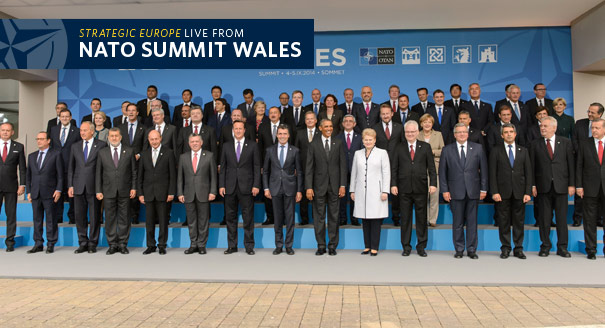
During a press conference with Ukrainian President Petro Poroshenko on September 4 at the NATO summit in Wales, the alliance’s Secretary General Anders Fogh Rasmussen tried to put the best spin on NATO help to Ukraine. Since NATO is not prepared even to consider the idea of Ukraine one day becoming a member of the organization, Rasmussen—and indeed Poroshenko—didn’t mention the “m-word.”
“It is for the Ukrainian people to decide . . . [their] future relationship with NATO,” the secretary general said—as if Putin will allow that to happen.
Rasmussen did say that NATO allies had pledged to provide support to help Ukraine improve its own security. “Our support is concrete and tangible. . . . Ukraine has stood by NATO. Now in these difficult times, NATO stands by Ukraine.”
Rasmussen explained how the allies had established “a comprehensive and tailored package of measures” to help Ukraine. The focus of NATO support would be on four areas: rehabilitation for injured troops, cyberdefense, logistics, and command and control and communications. “And allies will assist Ukraine with around €15 million [$19 million] through NATO,” Rasmussen added. NATO would not be supplying weapons. But that won’t stop individual countries from doing so.
Above all, the NATO chief insisted that an independent, sovereign, and stable Ukraine firmly committed to democracy and the rule of law was key to Euro-Atlantic security. “We stand united in our support of Ukraine’s sovereignty and territorial integrity,” he said.
Actually, the West is only rhetorically united over Ukraine’s sovereignty and territorial integrity. Western nations have no real intentions of matching that statement with deeds to allow Ukraine to regain territory in eastern Ukraine that has been taken over by rebels backed by Russian troops and tanks—let alone Crimea.
As for the EU, it is prepared to impose more sanctions on Russia—but with many misgivings and criticisms from several member states, especially Hungary, Slovakia, and the Czech Republic. That is despite the fact that until twenty-five years ago, these countries were under the Soviet yoke.
The measures undertaken by NATO and the EU are insufficient because they perpetuate the new rules of the game that Putin is writing across Eastern Europe. And because the West’s responses give him no reason to desist, at least for the moment, Western countries are repeating the mistakes they made when Eastern European civil society reared its head during the Communist era. The West is not prepared to stand up to Putin’s Russia.
Instead, willy-nilly, the West is allowing a new cordon sanitaire of countries to take hold between Russia and the EU. But if Putin and European leaders believe that this buffer zone is going to represent a new, stable “post-post–Cold War” status quo, they are seriously mistaken.
The reason is that civil society across these countries, from Belarus to Armenia, will not accept these new demarcation lines on a permanent basis. Just as Poles challenged their country’s Communist regime in 1980, the same will happen across the states in Europe’s East.
That has already happened in Ukraine. And despite the war in eastern Ukraine and the continuing influence of the country’s oligarchs, the supporters of the Euromaidan are not prepared to let this revolution fail. They are not naive enough to believe that the EU and NATO will come to their rescue. Instead, against all the odds, they will continue to struggle for their freedom to choose their own political path.
Ukraine is not an exception. Sooner or later, civil society will blossom in other Eastern European countries. When it does, that resurgence will require immense and sustained moral, political, and financial support from the West, just as the U.S. National Endowment for Democracy extended its backing to Solidarity and Polish underground movements.
Europe’s own European Endowment for Democracy needs far more funding and support from EU governments to foster civil society movements, particularly the media. And the EU’s Erasmus higher education program needs a radical overhaul to reach out to Eastern Europeans. As for political and economic reforms, if governments such as Moldova’s really want to move closer to the EU, then paying lip service to reform while perpetuating corruption at all levels does nothing for their cause.
These measures are not huge, sensational steps. They are incremental. They also reflect Europe’s values. That is what is really at stake in Ukraine—even though realpolitikers would beg to differ.

Nonresident Senior Fellow, Carnegie Europe
Judy Dempsey is a nonresident senior fellow at Carnegie Europe
Recent Work
Judy Dempsey
Judy Dempsey
Carnegie does not take institutional positions on public policy issues; the views represented herein are those of the author(s) and do not necessarily reflect the views of Carnegie, its staff, or its trustees.
As we close out another season of Strategic Europe, it is worth taking stock of the deep shifts underway.

Rym Momtaz
The EU had to compromise to adopt a twenty-first sanctions package against Russia, exposing growing cracks in the union’s resolve. Is this latest, weaker round worth it to keep pressure on Moscow?
Rym Momtaz, ed.

Trump is distracted and Ukraine wants Europe to step up. The continent’s leaders must find their voice and assert it in talks with Russia.

Alissa de Carbonnel

Mounting economic strain and battlefield losses will not necessarily make the Kremlin less dangerous. They could instead push Moscow toward a more aggressive hybrid campaign designed to test NATO’s Eastern flank, exploit allied hesitation, and fracture European resolve.

Maksym Beznosiuk
Over the past ten years, NATO has held almost as many summits as it did during the entirety of the Cold War. Are they still useful, or is it time to stop holding annual meetings?
Rym Momtaz, ed.