

Report
- +9
Richard Youngs, Erik Jones, Dan Baer, …
{
  "authors": [
    "Richard Youngs"
  ],
  "type": "commentary",
  "blog": "Strategic Europe",
  "centerAffiliationAll": "dc",
  "centers": [
    "Carnegie Endowment for International Peace",
    "Carnegie Europe"
  ],
  "collections": [
    "Europe’s Southern Neighborhood",
    "Arab Awakening",
    "Democracy and Governance"
  ],
  "englishNewsletterAll": "democracy",
  "nonEnglishNewsletterAll": "",
  "primaryCenter": "Carnegie Europe",
  "programAffiliation": "DCG",
  "programs": [
    "Democracy, Conflict, and Governance"
  ],
  "projects": [],
  "regions": [
    "Middle East",
    "Europe",
    "Western Europe"
  ],
  "topics": [
    "Foreign Policy",
    "Democracy",
    "Political Reform",
    "Security",
    "EU"
  ]
}
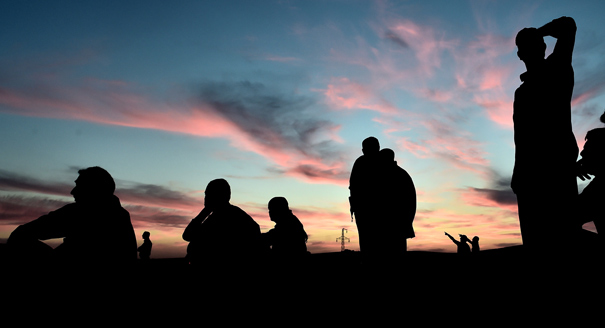
Source: Getty
To address the root causes of chaos and disorder in the Middle East, the EU needs to develop a two-pronged approach that focuses on both security and political reform.
In response to the arc of crisis burning across the Middle East, European governments seem to have reverted to traditional perspectives on stability and counterterrorism. Their policies now exhibit many salient features from the period before the Arab Spring that began in 2011. European countries are active in the campaign against Islamic State and are providing Arab regimes with enhanced counterterrorism, intelligence, and other security assistance.
So, have European policies come full circle? Does counterterrorism once again outweigh any focus on political and economic reform in the Middle East? In the early days of the Arab Spring, European ministers, leaders, and commissioners lined up to insist they had learned the lesson that security alliances with autocrats cannot provide the stability that is their realpolitik justification. Have these same leaders now forgotten their own warnings?
The prominent foreign policy debates are once again about defeating radical jihadism. Observing this fitful drift in strategic reflection is like watching a replay of the late 1990s or the period after the September 11, 2001, terrorist attacks.
The reversion is not complete, however. Many still make the argument that stability, peace, and deradicalization ultimately depend on inclusive and participative government. EU policymakers today have fewer illusions about purely security-oriented cooperation and alliances.
European leaders have ruled out cooperating formally with the Syrian regime and recall that Assad’s autocracy was one of the causes of the Islamic State surge. Most governments stress that returning to the EU’s pre-2011 rapprochement with dictators such as Assad hardly offers grounds for sustained stabilization.
So, European leaders acknowledge that they must give more priority to encouraging inclusive, democratic government in Iraq. They are relatively uncritical toward the reempowered Egyptian military but maintain a greater distance than they did in the era of former president Hosni Mubarak. Several formal European statements have drawn attention to government repression in Egypt simply storing up the prospect of violence in the future.
The EU has tried backing the #ArabSpring as a route to social stability. It failed. So, what now?Tweet This
Consequently, the situation is nuanced: the EU has tried security containment, and it has tried (modestly) backing the Arab Spring as a route to social stability. Both apparently failed. So, what now?
The answer is that the EU needs a better synthesis between its security and reform agendas.
In the period prior to the Arab revolts, counterterrorism experts played a more prominent role in European decisionmaking than those voices advocating a focus on supporting democratic reforms.
In 2011 and 2012, this situation switched around: EU policy briefly became a more positive enterprise in assisting local Arab demands for better governance, rather than a nervous and negative exercise in containment. It seemed that the main players in the region were tech-savvy, modern, and cosmopolitan youngsters, not jihadists.
The pre-2011 policy overplayed the counterterrorism angle and failed to understand the Middle East’s underlying social changes. After 2011, the EU was not particularly ambitious in supporting democratic transitions; but its focus was on national reforms more than on the regional geopolitical ramifications of states’ internal political changes.
It is easy to point out that a focus on political reform is essential to address the root drivers of radicalization. But the EU committed itself to supporting reforms from 2011 with little consideration of how reform efforts would relate to geostrategic questions. As Islamic State rampages and intra- and interstate order in the Middle East teeters, the challenge is to move toward a more combined approach that tackles both security and reform imperatives.
It is now commonly argued that the EU should strike flexible and security-oriented alliances with friendly powers, forget about transformation and conditionality, and abandon its ambitious schemes of regional cooperation. Those favoring a security-first approach insist this is necessary because modernization in the Middle East and North Africa is subjugated to sectarian identity.
This argument contains much that is sound, but it is now being pushed too far. In today’s dire circumstances, security cooperation is necessary. But pursued as the central plank of European foreign policy, an emphasis on security reinforces the very power dynamics that drive radicalization. It risks worsening the disease it purports to cure.
While regional alliances are needed to contain Islamic State, these partnerships should not divert the EU from providing more effective backing for moderate opposition groups in Syria. European governments have conspicuously not matched the United States’ new package of support for the opposition Free Syrian Army.
Long-term stability in the #MiddleEast requires tempering social frustrations within Gulf states.Tweet This
In Iraq, European governments talk of the need for inclusive government in Baghdad, but still need to reverse a decade of disengagement. Iraq needs a genuinely democratic basis of inclusiveness, not the current divvying out of power quotas among discredited elites. The EU should not forget that long-term stability in the Middle East still requires the tempering of social frustrations within unreformed Gulf states—however closely these regimes now work with Western powers on counterterrorism.
And, perhaps most crucially, some form of more effective and broader regional security architecture is needed to link together what happens within states with what happens at a regional level. The EU needs strategic deliberation that more systematically connects security actions with domestic political factors in the Middle East.
A focus on reform without security cooperation today looks naive; a focus on security without reform is likely to be self-defeating. The pressing need is to understand precisely how these two dimensions of change are causally linked to each other.

Senior Fellow, Democracy, Conflict, and Governance Program
Richard Youngs is a senior fellow in the Democracy, Conflict, and Governance Program, based at Carnegie Europe. He works on EU foreign policy and on issues of international democracy.
Recent Work

Richard Youngs, Erik Jones, Dan Baer, …

Richard Youngs, Thomas Carothers
Carnegie does not take institutional positions on public policy issues; the views represented herein are those of the author(s) and do not necessarily reflect the views of Carnegie, its staff, or its trustees.

As we close out another season of Strategic Europe, it is worth taking stock of the deep shifts underway.

Rym Momtaz

The EU had to compromise to adopt a twenty-first sanctions package against Russia, exposing growing cracks in the union’s resolve. Is this latest, weaker round worth it to keep pressure on Moscow?
Rym Momtaz, ed.

Trump is distracted and Ukraine wants Europe to step up. The continent’s leaders must find their voice and assert it in talks with Russia.

Alissa de Carbonnel

Mounting economic strain and battlefield losses will not necessarily make the Kremlin less dangerous. They could instead push Moscow toward a more aggressive hybrid campaign designed to test NATO’s Eastern flank, exploit allied hesitation, and fracture European resolve.

Maksym Beznosiuk

Over the past ten years, NATO has held almost as many summits as it did during the entirety of the Cold War. Are they still useful, or is it time to stop holding annual meetings?
Rym Momtaz, ed.