

Commentary
Marc Pierini
{
  "authors": [
    "Marc Pierini"
  ],
  "type": "commentary",
  "blog": "Strategic Europe",
  "centerAffiliationAll": "",
  "centers": [
    "Carnegie Endowment for International Peace",
    "Carnegie Europe"
  ],
  "collections": [
    "Turkey’s Transformation",
    "Europe’s Southern Neighborhood"
  ],
  "englishNewsletterAll": "",
  "nonEnglishNewsletterAll": "",
  "primaryCenter": "Carnegie Europe",
  "programAffiliation": "",
  "programs": [],
  "projects": [],
  "regions": [
    "Middle East",
    "Europe",
    "Türkiye",
    "Syria"
  ],
  "topics": [
    "Security",
    "Military"
  ]
}
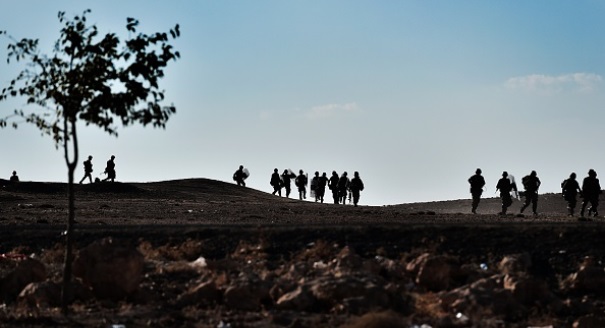
Source: Getty
If Islamic State militants were to gain control of Syrian Kurdish areas, it would trigger a political earthquake among the Kurdish communities of Turkey and Western Europe.
The Islamic State’s current offensive against the Syrian Kurdish city of Kobanê is interfering with the politics of many countries, triggering a massive humanitarian emergency, and raising many questions. It also brings immense political and social risks for Turkey and the Kurds.
For the most part, the anti-Islamist resistance in Kobanê is provided by the Syrian Kurds of the Democratic Union Party (PYD) and its armed wing, the People’s Protection Units (YPG). The Western and Arab coalition that is fighting the Islamic State offers limited close air support, although the Sunni jihadists’ tactics and the absence of special forces on the ground render that support largely ineffective. Turkey has refused a transit of reinforcements of PYD-affiliated fighters to Kobanê from Qamishli, another Syrian Kurdish district to the east.
The ensuing inaction has triggered widespread protests across Turkey, resulting in about 30 casualties since October 8, and has created tensions with the United States.
In military terms, U.S. military planners consider openly that saving Kobanê is now unrealistic, for two reasons. First, there is an absence of strong allied forces on the ground; and second, the Islamic State has dispersed its assets throughout the city, making it impossible to efficiently target the militants’ heavier weaponry.
In strategic terms, when compared with Syria’s other Kurdish districts and with the ominous threat on the outskirts of Baghdad, Kobanê inevitably looks like a small dot on the map, one of limited relevance for the coalition’s military planners. This assessment sounds very cynical, but it is at the core of the current situation.
The massacre that could predictably occur in Kobanê would represent another Srebrenica.Tweet This
The combination of Turkey’s unwillingness to help save Kobanê and the U.S. military judgment could produce humanitarian consequences of staggering proportions in the very near future. Given the Islamic State’s track record, the massacre that could predictably occur in the city would represent another Srebrenica—right under the eyes of the Turkish army and the world’s media just two miles away across the border in Turkey. In human terms, this would be a shameful outcome.
This emergency warrants at the very least some immediate contingency planning. A humanitarian rescue operation should be mounted to exfiltrate to Turkey the 10,000 Syrian Kurds left in Kobanê. This is a delicate operation, but the Turkish Red Crescent could implement it in a matter of hours, with Turkish military cover on the land and close support from the coalition in the air. While not necessarily guaranteeing Kobanê’s safety from the Islamic State, this operation would at least avoid a mass slaughter.
More generally, in political terms, a defeat of the Syrian Kurds would mean the loss of the only force in Syria that is staying away from religious sectarianism and is at the same time strongly committed to resisting the Islamic State and other radical groups.
Notwithstanding the Turkish authorities’ doubts about their alliance with the Kurdistan Workers’ Party (PKK), which fought a long armed struggle against the Turkish state, Syrian Kurds are an actor of resistance against radical Islamists in Syria. This gives the Syrian Kurdish PYD new responsibilities in the regional context.
There is also a very important ideological factor to the battle for Kobanê. To a large extent, the Islamic State’s influence stems from its ability to successfully use the Islamic theme of martyrdom. In the group’s own logic, their supporters must be able to see concrete military achievements, as was the case during the early period of Islam.
The immense symbolic significance of the fall of Kobanê would help the jihadists prove their “righteousness.”Tweet This
The immense symbolic significance of the fall of Kobanê would help the jihadists prove their “righteousness” and prevent any wavering within their ranks. It would allow the militants to recruit more supporters and send them into combat more easily. Conversely, defeating the Islamic State in Kobanê would dent this narrative.
Some analysts say that after so much wavering, it is now too late to save Kobanê, which is the smallest of Syria’s three Kurdish districts. The next political dilemma lies with the two other Kurdish districts of Afrin to the west and Qamishli to the east. These districts are much larger, and Qamishli is adjacent to Iraqi Kurdistan.
If these areas survive any future onslaught by the Islamic State, Qamishli’s size and geographical location will raise the fear in Ankara, Damascus, and Baghdad of a potential independent Kurdish entity.
If, however, Afrin and Qamishli were to fall to the Islamic State, this would trigger a political earthquake among the Kurdish communities of Turkey and Western Europe. Ankara’s inaction over Kobanê has already badly bruised the so-called Turkish peace process with the Kurds of Turkey. The success of that process is crucial for the ruling Justice and Development Party’s (AKP’s) performance in Turkey’s legislative elections of June 2015, and reconciliation efforts would most probably not survive if such large Kurdish populations were forced to flee or eliminated.
These two possible outcomes—the fall of large Syrian Kurdish districts or the collapse of peace talks with the Turkish Kurds—call for a serious and responsible reassessment of the situation by both Ankara and the Kurds of Turkey and Syria.
The Turkish government should carefully weigh up its priorities in the short term. Insisting on a campaign to bring down the Assad regime and on a largely irrelevant no-fly zone, while sitting on the fence and not thoroughly contributing to the coalition’s efforts to defeat the Islamic State, makes Turkey look like an unhelpful NATO member.
In addition, by letting the Islamists prosper and conquer (if only by default) and by trapping the Syrian Kurds in a horrendous spiral of violence and murder, the Turkish leadership would trigger unfathomable violence from the Kurds in Turkey.
In Kobanê, Afrin, and Qamishli, Western stakeholders are playing with a new deck of cards.Tweet This
As for the Kurds, they should weigh up their responsibilities in Turkey, where the PKK would hardly benefit from widespread violence across the country, and in Syria, where the PYD has become, by way of the regional upheaval, a potential force for stability in the Middle East.
In Kobanê, Afrin, and Qamishli, Western stakeholders are playing with a new deck of cards.

Senior Fellow, Carnegie Europe
Pierini is a senior fellow at Carnegie Europe, where his research focuses on developments in the Middle East and Turkey from a European perspective.
Recent Work
Marc Pierini
Marc Pierini

Montenegro and Albania are frontrunners for EU enlargement in the Western Balkans, but they can’t just sit back and wait. To meet their 2030 accession ambitions, they must make a strong positive case.


Dimitar Bechev, Iliriana Gjoni
Donald Trump has repeatedly bashed NATO and European allies, threatening to annex Canada and Greenland and deploring their lack of enthusiasm for his war of choice in Iran. Is this latest round of abuse the final straw?

Rym Momtaz, ed.
Donald Trump’s repudiation of NATO goes against the Make America Great Again vision of a U.S.-centered foreign policy. If the goal is to preserve the alliance by boosting Europe’s commitments, leaning into France’s vision is the most America First way forward.
Rym Momtaz
Hungarians head to the polls on April 12 for an election of national and European consequence. Three different outcomes are on the cards, each with their own implications for the EU.

Zsuzsanna Szelényi
The far right failed to win big in France’s municipal elections. But that’s not good news for the country’s left wing, which remained disunited while the broader right consolidated its momentum ahead of the 2027 presidential race.

Catherine Fieschi