

Commentary
Judy Dempsey
{
  "authors": [
    "Judy Dempsey"
  ],
  "type": "commentary",
  "blog": "Strategic Europe",
  "centerAffiliationAll": "",
  "centers": [
    "Carnegie Endowment for International Peace",
    "Carnegie Europe"
  ],
  "collections": [
    "Europe’s Eastern Neighborhood"
  ],
  "englishNewsletterAll": "",
  "nonEnglishNewsletterAll": "",
  "primaryCenter": "Carnegie Europe",
  "programAffiliation": "",
  "programs": [],
  "projects": [],
  "regions": [
    "Eastern Europe",
    "Ukraine"
  ],
  "topics": [
    "Foreign Policy",
    "Democracy",
    "Security"
  ]
}
Source: Getty
The ceasefire between Ukrainian forces and pro-Russian rebels in eastern Ukraine appears to be holding. Could that be enough for the EU to ease sanctions against Russia?
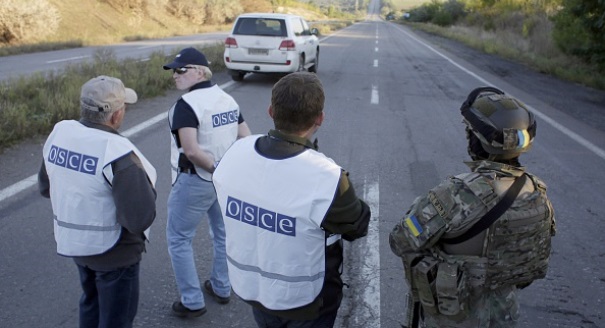
Since September 26, the Organization for Security and Cooperation in Europe (OSCE) has been monitoring a ceasefire in the Donbas area of eastern Ukraine.
The Special Monitoring Mission to Ukraine is observing how the Ukrainian forces and the pro-Russian rebels in the self-proclaimed “people’s republics” of Donetsk and Luhansk establish ceasefire lines and a buffer zone. The Russian and Ukrainian governments are also part of this mechanism, which is aimed at ending months of fighting in this part of Ukraine.
For Vladimir Putin, the Russian president, the ceasefire could be his chance to get Western sanctions lifted, something that some EU countries are beginning to advocate.
On September 29, Merkel said there was no scope to ease sanctions against Russia. “Unfortunately, we are a very long way from that,” she stated. “The situation in eastern Ukraine is . . . anything but satisfactory.”
“The basic question of the ceasefire is not yet cleared up, let alone the future status and cooperation between the Luhansk and Donetsk regions and the Ukrainian central government,” Merkel added. She explained that there was “no protection of the border along the entire area of Luhansk and Donetsk, no control, no buffer zones. All of these things are the minimum conditions for us to be able to consider revoking sanctions.”
Clearly, Merkel is in no hurry to give Russia any benefit of the doubt about its intentions in Ukraine, as she told Putin in a telephone call on September 30.
Merkel is in no hurry to give Russia any benefit of the doubt about its intentions in Ukraine.Tweet This
Yet the ceasefire is already creating a quandary for some EU governments. Even though there have been some major violations of the truce, including recent attacks on the Ukrainian-held Donetsk airport, as a whole the ceasefire is holding.
According to the OSCE’s monitoring mission, the level of violence has dropped, the two sides are exchanging prisoners, international organizations are delivering humanitarian aid, and people are returning to their homes—if those homes have not already been destroyed. Given this progress, some EU governments could be very tempted to lift the sanctions. Indeed, Putin must be hoping that a ceasefire will be enough to persuade Europe to do just that.
But for several other European leaders, the reasons for the sanctions still apply. The measures were imposed because of Putin’s annexation of Crimea and his invasion of parts of eastern Ukraine. The effects of both are still clear to see: Moscow’s meddling has also allowed pro-Russian rebels to establish facts on the ground in Donbas, while Russia has no intentions of returning Crimea to Ukraine.
The ceasefire is beset with two main problems. First, the OSCE lacks basic equipment, personnel, and other support to monitor it properly. And second, the ceasefire and the buffer zone give Russia an ideal opportunity to cement the status quo in a way that could turn the Donbas into a frozen conflict.
So far, the OSCE has over 250 international monitors plus over 100 local staff on the ground in Ukraine. The monitors, however, have very little backup. The mission lacks both financial support from the OSCE’s 57 member states and armored vehicles—even though some of the monitors have been shot since the ceasefire was announced. Nor do the monitors have any unmanned aerial vehicles or drones that could monitor the ceasefire in real time.
Two drones have been waiting since September 5 in Kiev, where they are undergoing tests and bureaucratic procedures. An OSCE diplomat told Carnegie Europe that the first monitoring flight could take place in mid-October. Meanwhile, the Donetsk “people’s republic” has threatened to shoot down unmanned aerial vehicles, aware that they could provide the very intelligence that the monitors require.
Even if the monitoring mission does receive the drones, it has neither the experts to analyze the information collected by the vehicles nor protection for the drones and the mission’s unarmed staff. France and Germany are considering providing drones and some protection. Meanwhile, the operating budget for the mission from March 21, 2014, to March 21, 2015, is €76.7 million ($97.7 million). As of October 9, the mission was €43.3 million ($55.2 million) short, according to the OSCE.
These shortcomings mean that pro-Russian rebels and Russia itself have ample time to consolidate their grip on the eastern side of the buffer zone by establishing by default demarcation lines.
Putin’s priority is to get the EU’s sanctions lifted but also to ensure Russia’s grip over eastern Ukraine.Tweet This
With such an advantage, it is also in the interests of Russia and its backers to abide by the ceasefire—for the moment. After all, Putin’s priority is to get the EU’s sanctions lifted but also to ensure Russia’s grip over eastern Ukraine. The OSCE’s monitoring mission, in contrast, is at a distinct disadvantage.
In the past, the OSCE’s attempts to prevent and resolve frozen conflicts, such as the Minsk Group set up in 1992 to break the deadlock in the disputed region of Nagorno-Karabakh, have failed. Given all the circumstances in eastern Ukraine, there is little reason to believe the Donbas will be any different.

Nonresident Senior Fellow, Carnegie Europe
Judy Dempsey is a nonresident senior fellow at Carnegie Europe
Recent Work
Judy Dempsey
Judy Dempsey
Carnegie does not take institutional positions on public policy issues; the views represented herein are those of the author(s) and do not necessarily reflect the views of Carnegie, its staff, or its trustees.

As we close out another season of Strategic Europe, it is worth taking stock of the deep shifts underway.

Rym Momtaz
The EU had to compromise to adopt a twenty-first sanctions package against Russia, exposing growing cracks in the union’s resolve. Is this latest, weaker round worth it to keep pressure on Moscow?
Rym Momtaz, ed.

Trump is distracted and Ukraine wants Europe to step up. The continent’s leaders must find their voice and assert it in talks with Russia.

Alissa de Carbonnel

Mounting economic strain and battlefield losses will not necessarily make the Kremlin less dangerous. They could instead push Moscow toward a more aggressive hybrid campaign designed to test NATO’s Eastern flank, exploit allied hesitation, and fracture European resolve.

Maksym Beznosiuk

Over the past ten years, NATO has held almost as many summits as it did during the entirety of the Cold War. Are they still useful, or is it time to stop holding annual meetings?
Rym Momtaz, ed.