

Commentary
Are Germany’s economic, industrial, and political struggles becoming a liability for the EU’s ability to rise to the geopolitical moment?
Rym Momtaz, ed.
{
  "authors": [
    "Sacha de Wijs"
  ],
  "type": "commentary",
  "blog": "Strategic Europe",
  "centerAffiliationAll": "",
  "centers": [
    "Carnegie Endowment for International Peace",
    "Carnegie Europe"
  ],
  "collections": [],
  "englishNewsletterAll": "",
  "nonEnglishNewsletterAll": "",
  "primaryCenter": "Carnegie Europe",
  "programAffiliation": "",
  "programs": [],
  "projects": [],
  "regions": [
    "Europe",
    "Western Europe",
    "Germany"
  ],
  "topics": [
    "EU",
    "Security",
    "Foreign Policy"
  ]
}
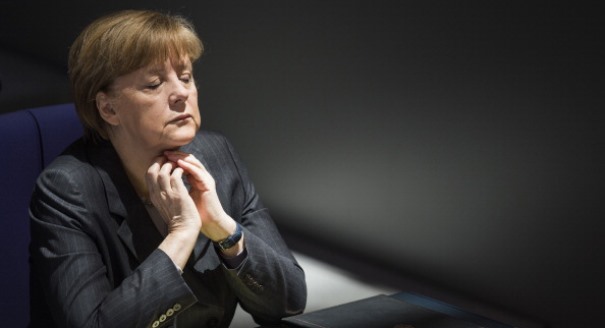
Source: Getty
The same issues that prevented Germany from assuming a greater international role in the past are still present. That is unlikely to change anytime soon.
Having recently moved from Berlin to Brussels, I have noticed that one of the most striking debates among EU foreign policy wonks is about Germany’s increasing role as a leading foreign policy actor.
At first glance, recent developments appear to confirm Berlin’s newfound status. Germany has become a disproportionately powerful country in Europe—not only because of its own economic strength but also because of the weakness of its neighbors.
This strength has been accompanied by increased rhetoric from German politicians about the need for stronger German responsibility in international crisis situations.
At the 2014 Munich Security Conference, German Foreign Minister Frank-Walter Steinmeier demanded a stronger German role in addressing global crises. It was no longer enough, he said, to merely “comment on world politics.” At the same conference, German President Joachim Gauck called on Germans to have more trust in their own power and to assume more responsibility in resolving international conflicts.
To recognize #Germany as a leading foreign policy actor is premature.Tweet This
But a closer look—beyond economic might and foreign policy rhetoric—reveals that to recognize Germany as a leading foreign policy actor is premature.
German talk of increased global responsibility comes at a time when international partners seem to both need and welcome more German engagement. The world is currently confronted with multiple massive, primarily man-made, international crises, and numbers of refugees worldwide are at their highest since World War II.
Although humanitarian funding globally increased from $17 billion in 2010 to $22 billion in 2013, there is simply not enough money to meet all current needs. Humanitarian and development assistance must be flanked by active security, political, and diplomatic initiatives.
Such initiatives are what international and European partners want from Germany when they talk about Berlin taking more responsibility. They are looking for Germany to take an active part in crisis situations.
When Germans talk of increased responsibility, they mean #Germany's development role.Tweet This
When German politicians talk of increased international responsibility, by contrast, they refer to Germany’s already strong role as a long-term aid and development partner, not as an actor in crisis situations. What European neighbors hear is not always what Germany means.
Recent examples make this clear. After a heated debate in the German parliament, Germany agreed to send weapons to Kurdish fighters in Iraq to support their campaign against the Islamic State. Berlin also increased its humanitarian aid to the region. But Germany chose not to join other European countries that have launched air strikes against Islamic State targets. Many other EU countries did not join the coalition either, but they were not among the big three member states.
When the Ukraine crisis erupted in early 2014, the West looked to Germany to play a leading role given Berlin’s potential leverage over Moscow. Germany pledged €500 million ($622 million) for the rebuilding of eastern Ukraine and €25 million ($31 million) in aid for refugees.
But although Germany did play a key role in diplomatic efforts to resolve the crisis, German-guided European measures were too little, too late. Berlin’s actions were also too openly intended to keep channels of communications with the Kremlin open. Communication channels are important, of course, but not if they send the signal that Germany is not prepared to get tough. If Moscow perceives Berlin’s unwillingness to back up its dialogue with action, that only gives Russia further room for maneuver.
The result of this timid German approach has been an enormous victory for Russian President Vladimir Putin, especially in ensuring that Ukraine will remain divided and destabilized for years to come.
For European and international partners, a "checkbook #Germany" is not enough.Tweet This
The role of a long-term development partner is, in many ways, checkbook diplomacy. This is the role in which Germany likes to see itself, and it is a way for Germany to assume responsibility without going beyond its national comfort zone. For European and international partners, however, a “checkbook Germany” is not enough.
The same underlying issues that prevented Germany from assuming a greater international role in the past are still present. That will not change quickly, and so, for the time being, Germany will remain a reluctant hegemon. Three main factors restrain Germany from taking the leading role its partners are longing for.
The first is Germany’s “culture of restraint,” which has been deeply rooted in the country’s development since 1945. This culture has led to a complete absence of strategic thinking, be it on international crises or, indeed, on Germany’s own geopolitical interests.
Geopolitical interest, which is important for all countries, remains a taboo in Germany. Germany’s former president, Horst Köhler, resigned in 2010 following severe criticism of remarks he made that suggested military involvement was central to Germany’s economic interests.
Whenever Germans talk about their role in the world—for example, in the euro crisis or in international crisis situations—it is always in the context of German responsibility, not German interests.
#Merkel has so far avoided providing a vision for #Germany's new role in the world.Tweet This
The second constraint on Germany’s role is the fact that although statements by the foreign minister are important, it is the chancellor who calls the shots on key foreign policy issues. Germany has witnessed an “executivization” of foreign policy, away from the foreign ministry. And when it comes to a greater German responsibility internationally, the chancellor has so far avoided providing a vision for Germany’s new role in the world.
This is unlikely to change soon, given Merkel’s risk-averse governing style and the fact that German public opinion is still overwhelmingly opposed to a major active role for the country in international affairs.
The third limiting factor is the state of Germany’s armed forces. A recently leaked parliamentary report made clear how challenging it would be for Germany to transfer its rhetoric of more responsibility into actual hard power. According to the report, only seven of the country’s 43 navy helicopters are flightworthy and only four of Germany’s submarines are operational. Half of the German Transall C-160 transport planes are out of commission.
An embarrassed defense minister had to admit that Germany was not fulfilling its obligations to NATO partners regarding deployable German forces. Berlin would need to invest more in hard power to take on the more active role that many want it to assume. In times of austerity, this is a great challenge that will require a strong vision.
German politicians and the public need to realize that it is not enough to say that a stronger German role in the world is a necessary responsibility given the country’s size, economic power, and, indeed, history. Germany’s geopolitical interests also need to be part of this discussion.
Sacha de Wijs is the director of the Brussels office of Crisis Action.
Sacha de Wijs
Crisis Action
Carnegie does not take institutional positions on public policy issues; the views represented herein are those of the author(s) and do not necessarily reflect the views of Carnegie, its staff, or its trustees.

Are Germany’s economic, industrial, and political struggles becoming a liability for the EU’s ability to rise to the geopolitical moment?

Rym Momtaz, ed.

European Commission President Ursula von der Leyen is about to give her annual address on the state of the EU. Here’s what she won’t—but should—say.
Rym Momtaz

The aftermath of the Ceuta crisis shows Europe has drawn the wrong lessons. Rather than doubling down on failed migration policies, the EU needs to address the underlying roots of such episodes.

Richard Youngs

An overwhelming victory by a far-right-wing party in a small state in eastern Germany will have major repercussions for Chancellor Friedrich Merz’s coalition.

Judy Dempsey

Canadian Prime Minister Mark Carney has twice inspired praise for standing up to U.S. President Donald Trump: at the 2026 World Economic Forum in Davos and on Canada-U.S. trade negotiations. Is Carney showing a third way better than the EU has in dealing with the Trump administration?
Rym Momtaz, ed.