

Commentary
Marc Pierini
{
  "authors": [
    "Marc Pierini"
  ],
  "type": "commentary",
  "blog": "Strategic Europe",
  "centerAffiliationAll": "",
  "centers": [
    "Carnegie Endowment for International Peace",
    "Carnegie Europe"
  ],
  "collections": [
    "Europe’s Eastern Neighborhood"
  ],
  "englishNewsletterAll": "",
  "nonEnglishNewsletterAll": "",
  "primaryCenter": "Carnegie Europe",
  "programAffiliation": "",
  "programs": [],
  "projects": [],
  "regions": [
    "Russia",
    "Europe",
    "Western Europe",
    "France"
  ],
  "topics": [
    "Foreign Policy",
    "Security",
    "Military",
    "EU"
  ]
}
Source: Getty
France has been wavering over whether to honor a contract for the sale of two warships to Russia. Together with its Euro-Atlantic partners, Paris should cancel the deal.
When he entered office, French President François Hollande inherited a contract with Russia worth €1.2 billion ($1.5 billion) for the sale of two Mistral-class amphibious assault ships. In the wake of Russian President Vladimir Putin’s new expansionist policies, the sale has become highly controversial.
Paris has been wavering between honoring the contract and postponing the delivery until Moscow respects an increasingly elusive ceasefire in eastern Ukraine, where government forces are fighting pro-Russian rebels. France should reject both of these options. Instead, it should clearly and definitively cancel the sale, for a number of strategic reasons.
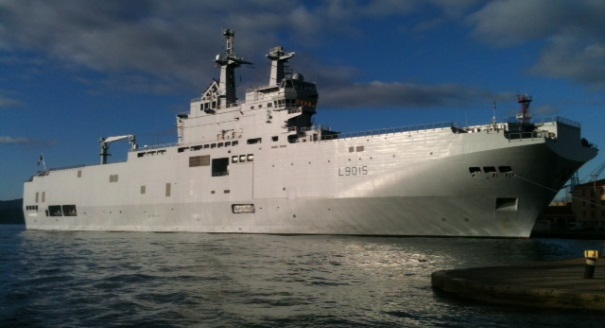
Three similar ships are currently in service in the French navy under the names Mistral, Tonnerre, and Dixmude (pictured). They were conceived as multipurpose expeditionary corps vessels capable of handling various types of operations: launching helicopters, landing troops and equipment, commanding and supporting these assets, and evacuating civilians from conflict zones.
Each ship can carry and launch sixteen attack or transport helicopters and four landing craft, including hovercrafts. On board each vessel is a 2,650 square meter (246 square foot) garage for various types of vehicles, including armored ones, and a hospital with 70–120 beds. And each ship has a command-and-control center with 150 workstations and can host several hundred troops.The United States has objected to the deal to sell the ships to Russia from the outset. Now the plan has become much more problematic in the wake of Russia’s aggressive moves in the past few months: its annexation of Crimea, its engagement of troops and weapons in eastern Ukraine, its repeated military flights near or over European airspace, and its assertive narrative against the West.
Western countries worry that if delivered and based in the Crimean port of Sevastopol (as many experts assume they would be), the two vessels would give the Russian army a major force projection vector. They would enable the Russian military to land or airlift troops and armored vehicles anywhere around the Black Sea while providing soldiers with close air cover.
The list of potential theaters of operation for the Russian ships is long: the Ukrainian coast on the Sea of Azov, the Ukrainian port of Odessa, the Moldovan breakaway region of Transnistria, Georgia, Bulgaria, or Romania. Farther afield, the ships could be used in the Eastern Mediterranean, where Russia supports the regime of Syrian President Bashar al-Assad, or off the coast of the Western Balkans.
@fhollande, the EU, and NATO should think twice about the #Mistral ships.Tweet This
In other words, the two Mistral-class ships would not be just another piece of military gear for the Russian Armed Forces. Rather, they would constitute a pair of state-of-the-art, battle-proven vessels in the service of a patent policy of harassment and intrusion in Russia’s neighborhood. This is why not only Hollande but also the European Council and NATO should think twice about the deal. Given the prevalent mood in Moscow, the sale of the Mistral ships has become a major strategic issue.
Putin’s short statement after his encounter with Hollande on December 6 seemed to suggest France’s inescapable way out of its dilemma. Putin essentially said that Russia had paid for the ships and expected to receive them, but that if the sale were canceled, Moscow would want to be refunded.
The deal has domestic implications for Hollande to worry about. If the sale is abandoned, the government will lose a massive amount of income. Worse, the extreme-right National Front—which is openly sympathetic to Russian foreign policy and funded by a Russian bank loan—may use the cancellation as a political device against the ruling Socialists.
So perhaps, instead of more pressure from his U.S. and EU colleagues, Hollande needs solidarity and creative ideas for how to reallocate two ready-to-use pieces of military hardware. Despite the legal and technical intricacies of canceling the contract (Russian electronics are already installed on board the first ship), the many security threats in and around Europe provide ample justification for France and its allies to use the ships themselves. These threats affect the Black Sea and the Eastern Mediterranean coast and include movements of refugees and migrants and an increase in Islamic State–affiliated terrorist activity in the Sinai, Libya, and Algeria.
Delivering the #Mistral ships would add to the risks of Russian aggression.Tweet This
The key strategic factor is the message the Western community will send to Russia. Conspiracy theories may be useful in Russia, and the Russian public, under the pressure of a massive propaganda apparatus, may believe them. From a Western standpoint, however, such theories merely hide a neo-expansionist policy aimed at re-creating the marches of the Soviet empire. Talks, warnings, and sanctions have not dented Putin’s determination and assertiveness. The risks of more Russian aggression are huge, and delivering the Mistral ships would add to them.
If decided on in a Euro-Atlantic context, the cancellation of the sale of the two Mistral-class ships will give a strong signal that Russia’s actions have gone far enough and will constitute a tangible, effective redline. Conversely, the ships’ delivery would inevitably be read by Moscow as another sign of Western weakness and would offer a premium to Russia’s bullying tactics. That is a far bigger issue than the technicalities of canceling a contract.

Senior Fellow, Carnegie Europe
Marc Pierini is a senior fellow at Carnegie Europe, where his research focuses on developments in the Middle East and Turkey from a European perspective.
Recent Work
Marc Pierini
Marc Pierini
Carnegie does not take institutional positions on public policy issues; the views represented herein are those of the author(s) and do not necessarily reflect the views of Carnegie, its staff, or its trustees.

Before the next wave of EU enlargement takes place, the union needs to grapple with thorny questions of how power is distributed among its members.


Emil Sondaj Hansen, Ditte Brasso Sørensen

A summer of escalation in the Black Sea has hurt Ukraine economically and is exacerbating world food security. A truce is needed—as is a broader reframing of Europe’s Ukraine strategy.

Thomas de Waal

Are Germany’s economic, industrial, and political struggles becoming a liability for the EU’s ability to rise to the geopolitical moment?

Rym Momtaz, ed.

European Commission President Ursula von der Leyen is about to give her annual address on the state of the EU. Here’s what she won’t—but should—say.
Rym Momtaz

The aftermath of the Ceuta crisis shows Europe has drawn the wrong lessons. Rather than doubling down on failed migration policies, the EU needs to address the underlying roots of such episodes.

Richard Youngs