

Commentary
Nathalie Tocci, Jan Techau
{
  "authors": [
    "Jan Techau"
  ],
  "type": "commentary",
  "blog": "Strategic Europe",
  "centerAffiliationAll": "",
  "centers": [
    "Carnegie Endowment for International Peace",
    "Carnegie Europe"
  ],
  "collections": [
    "Europe’s Eastern Neighborhood",
    "Transatlantic Cooperation"
  ],
  "englishNewsletterAll": "",
  "nonEnglishNewsletterAll": "",
  "primaryCenter": "Carnegie Europe",
  "programAffiliation": "",
  "programs": [],
  "projects": [],
  "regions": [
    "Europe",
    "North America",
    "Eastern Europe",
    "United States",
    "Ukraine",
    "Western Europe"
  ],
  "topics": [
    "Security"
  ]
}
Source: Getty
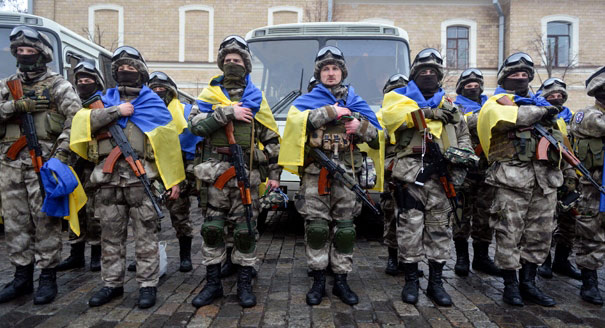
The war in eastern Ukraine is about more than the future of the European geopolitical order. It is about the role of the United States in Europe.
Is there really a strategic rift between the United States and Europe? Yes, if you believe the media echo that reverberated in unison after the February 6–8 Munich Security Conference, an annual gathering of leaders and defense experts. The question of whether the West should deliver arms to the Ukrainian government to support its defensive battle against Russian-backed separatists in eastern Ukraine was all the craze in Munich and elsewhere.
In fact, the answer to whether there is a transatlantic schism is both more complicated and more unsettling. Because the real issue is not Ukraine. It is something a lot bigger.
In essence, Europeans and Americans are in the midst of negotiating who should be in charge of security in Europe at a time of strategic scarcity. The United States must and wants to shift its geopolitical focus to the Pacific, where a formidable rival is emerging and where the future of the global balance of power will be decided over the next few generations.
The European theater, by comparison, is thought to demand less attention. There, the rich countries of the old continent should, in theory, be perfectly capable of taking care of most of their own security. This is especially true since the biggest threat to Europe comes from Russia, a declining Eastern behemoth barely capable of assuring its own economic survival and controlling its auto-aggressive behavior.
But Europe is far from security self-reliance. In fact, instead of becoming more autonomous, its governments keep increasing their dependence on U.S. security services by steadily reducing their own capabilities. This is partly because of economic distress, partly because of acute strategic dyslexia. Europeans seem to be unaware of their own strategic dilemma: that the United States must focus elsewhere while Europe’s security is increasingly threatened by its wide, unruly neighborhood.
The rift between the US and Europe over #Ukraine is much smaller than it seems.Tweet This
The Ukraine crisis has only accelerated the speed at which the West is negotiating Europe’s new security system. Curiously, the actual rift over Ukraine itself is much smaller than it seems. When the crisis turned serious, the United States and Europe acted in a fairly synchronized fashion. Their response was a mix of reassurance within NATO, sanctions against Russia, and support for the new government in Kiev.
Most importantly, however, the West (rightly) decided very early on in the crisis that it was unwilling to go to war over Ukraine. By doing so, Western leaders made it clear—implicitly—that their security guarantees did not apply to Ukraine, and that the country was not part of the European security architecture.
This was tragic for those Ukrainians who stuck their necks out on Kiev’s Independence Square during the antigovernment protests of 2013–2014, but it was the only way forward. Western military involvement would have been sheer madness. To this day, that policy has not changed. The United States and Europe are actually very much on the same page.
The talk of a rift comes from the discussion about supplying arms to the Ukrainian government. The noise that the Washington hawks made at the Munich Security Conference about the issue—just listen to U.S. Senator John McCain’s angry diatribe against German Chancellor Angela Merkel’s “foolish” diplomacy—was directed less at Europeans than at U.S. President Barack Obama and his team, whom their internal opponents accuse of being too soft.
At a more fundamental level, the hubbub also reflected a genuine disgruntlement on the U.S. side about the Europeans’ unwillingness to understand the basic strategic dilemma they face. McCain may be barking up the wrong tree on Ukraine, but he has an important point when he asks Europeans to do more for their own security.
What will be the outcome of the negotiations on European security in the post-European world? It is unclear, and no lasting solution has so far been found.
Europeans are unwilling to understand the basic strategic dilemma they face.Tweet This
For the time being, America is back, albeit reluctantly. With renewed U.S. commitment, NATO is reinforcing its Eastern flank, marking the boundary at which Western security responsibilities end. Ukraine is left dangling in an in-between position, with part of its territory becoming another frozen conflict that ensures lasting Russian influence over this part of the post-Soviet space. The Europeans, in the meantime, are trying desperately to keep their economies and their always-fragile political order from disintegrating.
Can this form of Western retrenchment, European halfheartedness, and a slightly beefed-up U.S. security presence in Europe be the future of European security? Not for long. The lingering power vacuum invites external probing. Europe seems capable neither of policing nor of integrating its neighborhood. Germany, Europe’s temporary leader, is an incomplete strategic player, while Europe’s traditional key players—France and the UK—have, at least for the moment, sidelined themselves because of internal weakness.
In the end, all will again depend on Washington. The decisive question for European security is whether the United States will be able to tend to both beating hearts of world order, Europe and Asia, at the same time. The real negotiations over European security are not taking place in Ukraine or in Brussels. They are being held on the Potomac.

Director, Europe Team, Eurasia Group
Techau is director with Eurasia Group's Europe team, covering Germany and European security from Berlin. Previously, he was director of Carnegie Europe.
Recent Work

Nathalie Tocci, Jan Techau
Jan Techau
Carnegie does not take institutional positions on public policy issues; the views represented herein are those of the author(s) and do not necessarily reflect the views of Carnegie, its staff, or its trustees.
As we close out another season of Strategic Europe, it is worth taking stock of the deep shifts underway.

Rym Momtaz
The EU had to compromise to adopt a twenty-first sanctions package against Russia, exposing growing cracks in the union’s resolve. Is this latest, weaker round worth it to keep pressure on Moscow?
Rym Momtaz, ed.

Trump is distracted and Ukraine wants Europe to step up. The continent’s leaders must find their voice and assert it in talks with Russia.

Alissa de Carbonnel

Mounting economic strain and battlefield losses will not necessarily make the Kremlin less dangerous. They could instead push Moscow toward a more aggressive hybrid campaign designed to test NATO’s Eastern flank, exploit allied hesitation, and fracture European resolve.

Maksym Beznosiuk

Over the past ten years, NATO has held almost as many summits as it did during the entirety of the Cold War. Are they still useful, or is it time to stop holding annual meetings?
Rym Momtaz, ed.